

Arrangements for former Malaysian prime minister Najib Razak to serve his sentence under house arrest have hit a snag.
After UMNO paid his RM50 million (about S$15.8 million) fine in full on Friday, Najib had been expected to leave prison for house arrest that day.
However, the Attorney General’s Chambers announced a pause in the arrangements to clarify the legal interpretation of his conditional pardon and the remaining penalties after payment of the fine.
According to Malaysian media reports, including Sin Chew Daily and Oriental Daily, UMNO secretary-general Asyraf Wajdi Dusuki said in a statement on Friday (6 November) morning that the party had raised RM50 million for Najib and paid the fine in full at the Kuala Lumpur High Court that morning.
Payment of the fine was one of the conditions for Najib to serve his sentence under house arrest.
Najib’s lawyer Muhammad Farhan confirmed at a press conference at the court complex that Najib’s special officer had obtained the court order for house arrest and delivered it to Kajang Prison for the necessary procedures to begin. Whether Najib could leave prison that day depended on the progress of those procedures.
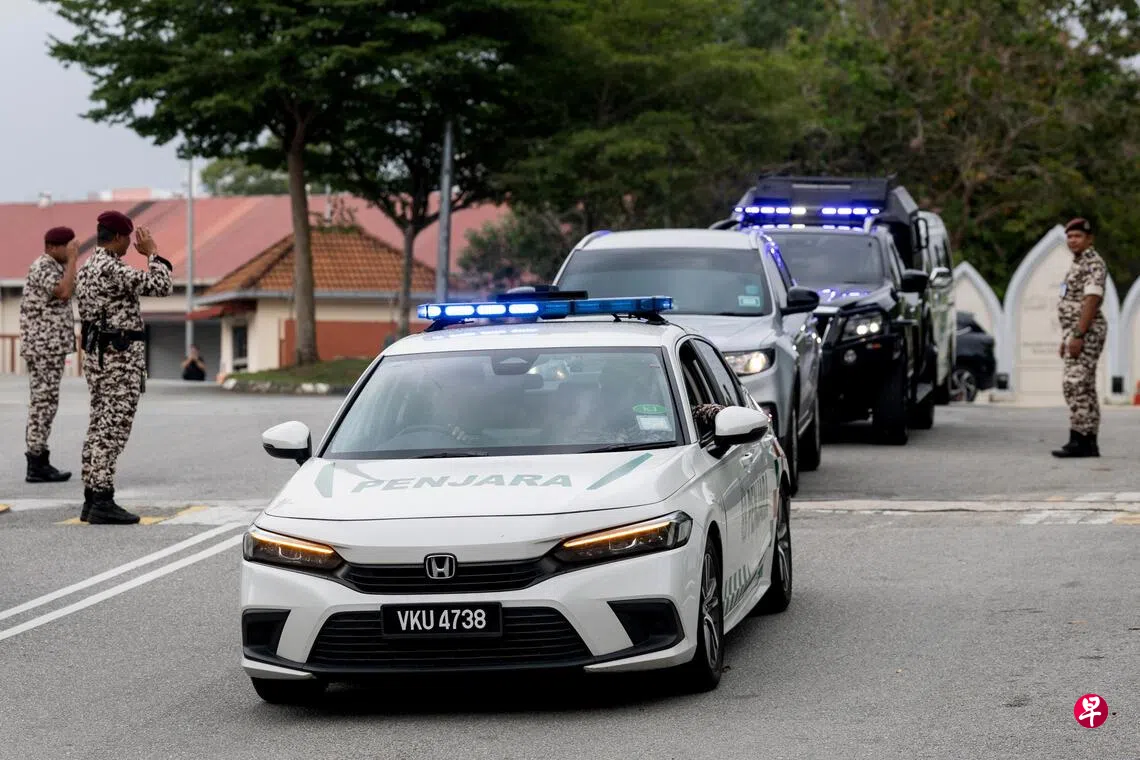
At about 2.30pm, reporters waiting outside Kajang Prison saw a Prison Department convoy believed to be carrying Najib leave the premises. Word quickly spread at the scene that Najib was on his way home, but it was later confirmed that he had first been taken to hospital for a medical examination.
Attorney General’s Chambers says pardon has two interpretations
While Najib was undergoing his medical examination, Malaysia’s Attorney General’s Chambers issued a statement at about 6pm abruptly halting the house arrest arrangements. It said two different interpretations had emerged of the conditional pardon approved by King Sultan Ibrahim on 18 September.
Under the first, paying the RM50 million fine in full fulfils only the financial penalty: Najib must still serve his prison sentence until 23 August 2028, but at home rather than in prison.
Under the second, full payment of the fine brings the pardon fully into effect, meaning all penalties imposed on Najib in the SRC International case, including imprisonment, are pardoned.
The Attorney General’s Chambers said in its statement that the dispute also concerned the legal effect of the High Court’s order of discharge on payment of fine.
The order directs the authorities to release Najib immediately, but also specifies that, under the conditional pardon, he must serve the remainder of his sentence under house arrest.
The Attorney General’s Chambers therefore considered it necessary to further clarify the legal effect of the court order and its relationship with the conditional pardon.
It added that house arrest was unprecedented in Malaysian judicial practice. No further action should therefore be taken until the dispute was fully resolved, and Najib should remain in prison to serve his sentence.
The Attorney General’s Chambers stressed that suspending the house arrest arrangements did not question or deny the king’s power to grant pardons. Rather, it was intended to ensure that the pardon and court order were implemented accurately, in an orderly manner and in accordance with the law.
UMNO accuses authorities of disregarding king’s wishes; Anwar opposes fundraising that could allow corruption to go unpunished
After the Attorney General’s Chambers issued its statement, Najib was taken back to Kajang Prison following his medical examination, leaving it unclear when he would begin serving his sentence under house arrest.
The abrupt halt to the arrangements immediately sparked heated debate in Malaysia. UMNO and Najib’s lawyers accused the authorities of disregarding the king’s wishes and demanded that Najib be allowed to begin house arrest immediately.
Prime Minister Anwar Ibrahim, however, disagreed with UMNO’s move to raise funds to pay Najib’s fine. When asked about it, Anwar said, “I disagree with this as it could give the public the impression that large-scale corruption can go unpunished.”
On 23 August 2022, Najib was convicted of misappropriating RM42 million from SRC International, a former subsidiary of 1MDB, and sentenced to 12 years in prison and a RM210 million fine.
He received a pardon in 2024, which halved his prison sentence to six years and reduced the fine to RM50 million.
On 18 September this year, Najib received a further conditional pardon allowing him to serve the remainder of his sentence in the SRC International case under house arrest, provided he first paid the RM50 million fine in full.
Anthony Loke reiterates resignation takes effect when Najib returns home
Besides keeping an eye on when Najib will leave prison, public attention has also turned to whether Democratic Action Party secretary-general Anthony Loke will keep his promise to resign as Minister for Transport when Najib begins house arrest.
At a press conference at about 5pm on Friday, Loke stressed that his resignation would take effect as soon as Najib stepped into his home. “If Najib steps into his home tonight, my resignation takes effect tonight. If it is tomorrow, then it will take effect tomorrow”.
Loke submitted his resignation on 19 September, the day after Najib was granted house arrest, to express the DAP’s opposition to the pardon. He has repeatedly said that his resignation would take effect on the day Najib begins serving his sentence under house arrest.
