

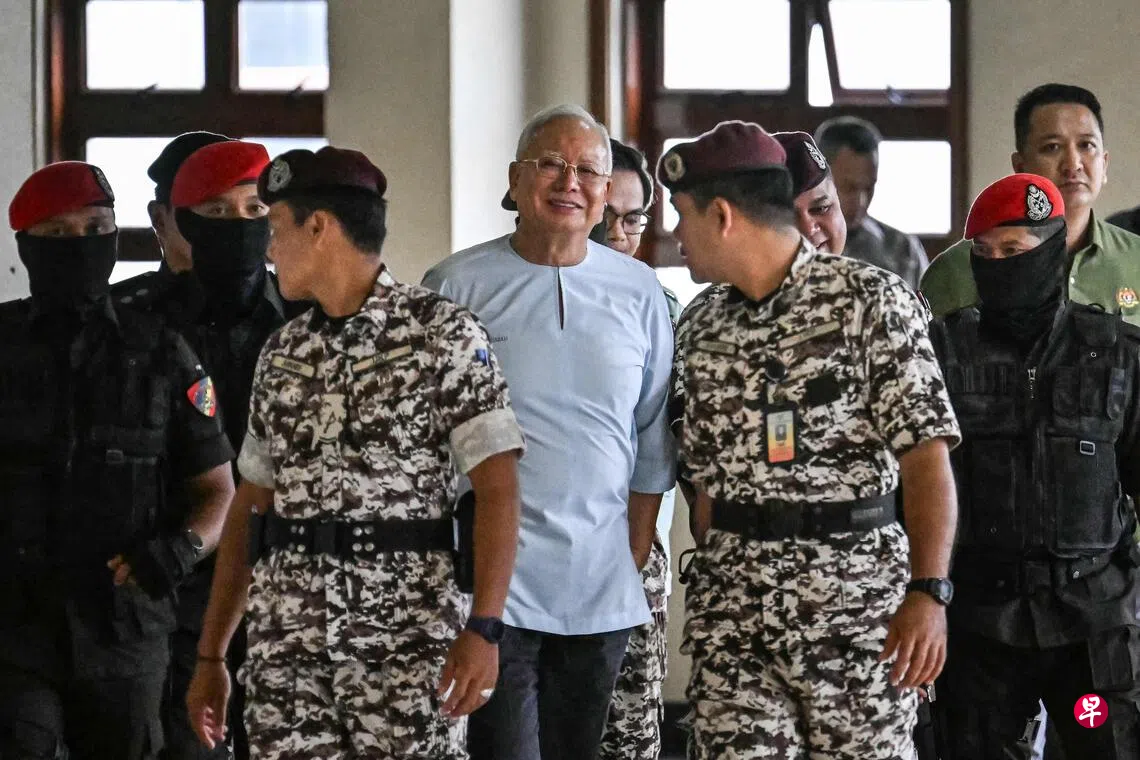
(Kuala Lumpur, agencies) The Malaysian government has acknowledged that minutes of a Federal Pardons Board meeting discussing house arrest for former prime minister Najib Razak were leaked and circulated on social media before being submitted to court. The authorities denied deliberately leaking the documents and are preparing to investigate who was responsible.
Responding to questions in the lower house of parliament on Tuesday (24 November), Prime Minister Anwar Ibrahim said the Ministry of Home Affairs should investigate why documents relating to Najib’s pardon had circulated online before the relevant court proceedings began, and who had released them. Anwar denied that the government had leaked the documents.
Anwar said the Attorney General had sought to have the documents declassified and handled in accordance with the law for the relevant court proceedings. He stressed that once documents were tendered in court, they would naturally become publicly available. How the documents had been leaked before being tendered, however, remained a matter for investigation.
Anwar also said the case required the decision on the pardon, rather than the minutes of the Federal Pardons Board meeting. Any application to declassify the minutes would therefore require approval from the Attorney General and the court.
Home Minister Saifuddin Nasution Ismail told reporters on Tuesday that he had ordered Inspector-General of Police Mohd Khalid Ismail to investigate the matter thoroughly.
He said that, legally, the documents had become public documents after being declassified under the Official Secrets Act 1972. This did not, however, prevent police from investigating allegations that the documents had been leaked and disseminated.
According to minutes of the Federal Territories Pardons Board’s 64th meeting on 18 September this year, which circulated on social media last week, Attorney General Mohd Dusuki Mokhtar and Hannah Yeoh Tseow Suan, Minister in the Prime Minister’s Department responsible for Federal Territories affairs, both opposed granting Najib a conditional pardon that would allow him to serve his sentence under house arrest rather than in prison.
However, Malaysia’s King Sultan Ibrahim, who chaired the meeting, ultimately decided to grant Najib a conditional pardon. This would allow Najib to serve the remainder of his sentence in the case involving SRC International, a former subsidiary of 1Malaysia Development Berhad (1MDB), under house arrest, provided he paid his RM50 million (about S$15.7 million) fine in full.
On 10 November, the Malaysian Bar filed an application at the Kuala Lumpur High Court for leave to seek judicial review of the Federal Territories Pardons Board’s decision.
The Attorney General’s Chambers said in a statement on Tuesday that it had objected to the application in court, arguing that the King’s decision at the Pardons Board meeting, made under Article 42 of the Federal Constitution, could not be challenged through judicial review.
The Attorney General’s Chambers said that, when the Kuala Lumpur High Court heard the application for leave to seek judicial review on 12 November, it had told the court that the King’s decision was non justiciable and had therefore opposed the Malaysian Bar’s leave application. The Kuala Lumpur High Court will hear submissions from all parties on 17 March next year.
