

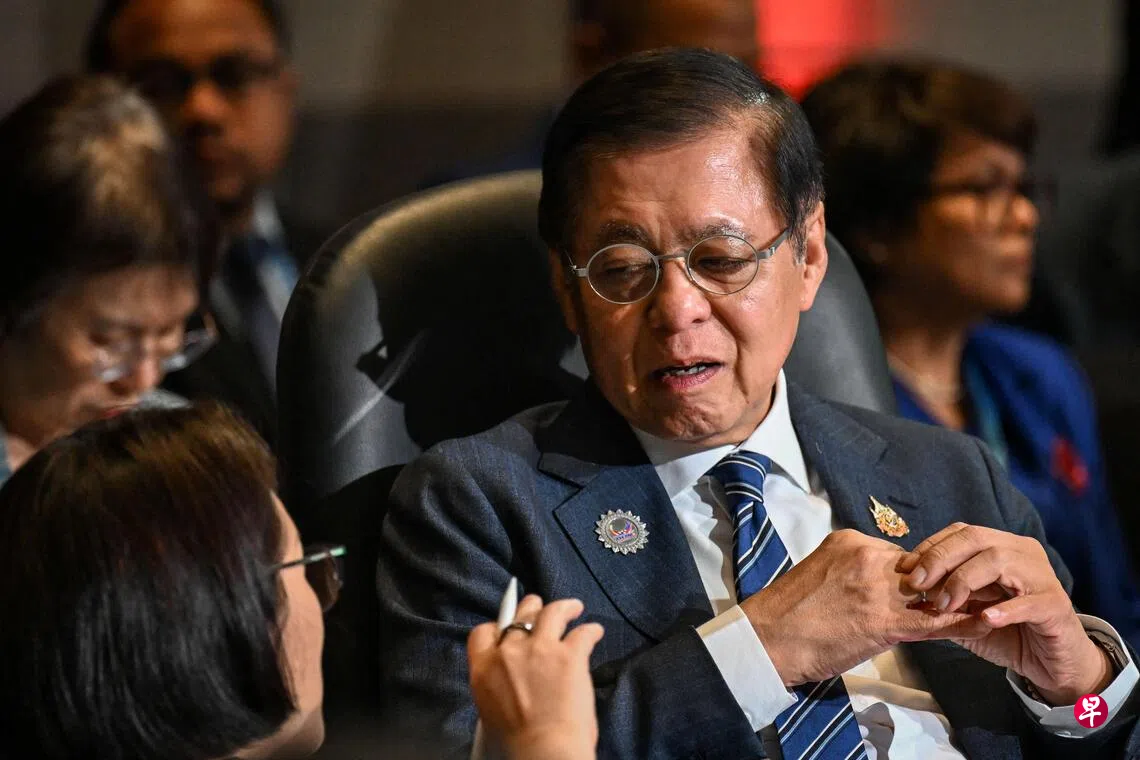
Thai Foreign Minister Sihasak Phuangketkeow said the latest US restrictions on the export and use of high-end semiconductors could affect Thailand’s plans to become a regional data centre hub.
In an interview broadcast on Bloomberg Television on Wednesday (18 November), Sihasak Phuangketkeow said the US Department of Commerce’s latest export controls on advanced chips could affect Thailand’s development goals, adding that “we have to be more careful now”.
Speaking about US efforts to prevent China from obtaining the most advanced semiconductors, Sihasak Phuangketkeow said: “They have concerns about these chips being sent to certain places where they they don’t want them to be sent. I think we saw it coming.”
The Bureau of Industry and Security, part of the US Department of Commerce, announced a new “interim final rule” on Monday (16), tightening controls on advanced semiconductor exports. It designated Indonesia, Malaysia, Singapore, Thailand and Brazil as countries at higher risk of transshipment.
Sihasak Phuangketkeow noted that most of these countries were US friends and partners. “We’re going to have to talk with the US about what we’re going to do, and we’ll see how we’re going to handle that,” he said.
Thailand’s economy grew by 2.9% in the third quarter of this year, driven by a boom in artificial intelligence (AI)-related investment, including data centre construction, and strong exports. These offset continued weakness in other sectors.
Bloomberg reported in May this year that a key company supporting Thailand’s national AI development plans was suspected of helping to smuggle billions of dollars’ worth of servers containing advanced Nvidia chips into China, with Alibaba Group reportedly among the end users.
Meanwhile, shortly before Sihasak Phuangketkeow’s interview, Thai Prime Minister Anutin Charnvirakul and Donald J. Trump signed a trade-related statement signalling that a US-Thailand trade agreement was nearing completion. Thailand made concessions on several key points it had previously resisted, including eliminating all tariffs on US goods and opening its market to US pork.
On this, Sihasak Phuangketkeow said: “We all have to make sacrifices and compromises.”
Asked whether the US was using chips as leverage in trade negotiations, Sihasak Phuangketkeow replied that “we try not to look at it that way”. He added that the controls were not aimed at Thailand or its neighbours, but were intended to prevent the chips from reaching China.
