

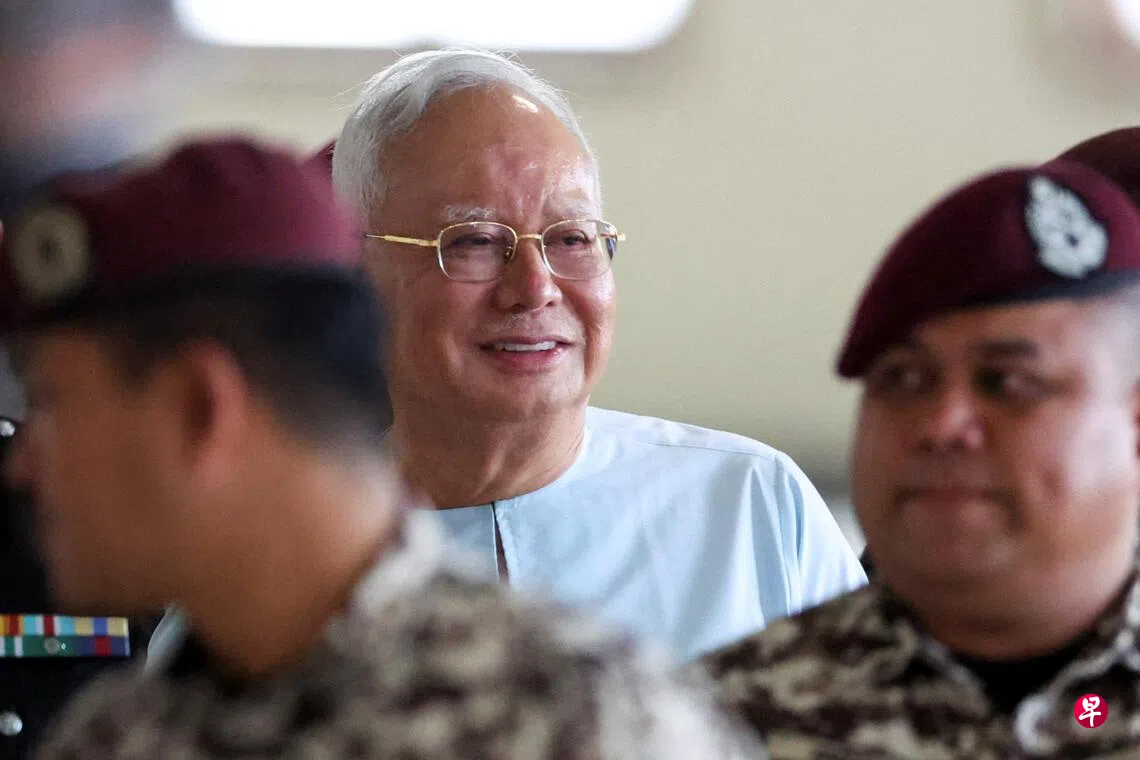
(Kuala Lumpur) Malaysia’s Ministry of Home Affairs said minutes of the Federal Pardons Board meeting on former prime minister Najib Razak’s pardon application must be declassified so that the Attorney General’s Chambers can prepare a full affidavit in response to the Malaysian Bar’s application for leave to seek judicial review.
According to the New Straits Times, Home Minister Saifuddin Nasution Ismail told reporters after a public event on Sunday (22 November) that the Attorney General’s Chambers had to submit the government’s response through a counter-affidavit, following the Malaysian Bar’s application for judicial review of the decision to allow Najib to serve his sentence under house arrest. The relevant documents therefore had to be declassified before the chambers could prepare the affidavit.
He said the contents of the minutes, including key details of the pardons board’s deliberations, had to be included in the affidavit from the Attorney General’s Chambers.
However, Saifuddin declined to comment on whether the minutes should be made public, or to disclose who had authorised their declassification and when.
He also said he did not know who had leaked the pardons board’s minutes or what their motives were.
According to the previously released minutes of the Federal Territories Pardons Board’s 64th meeting on 18 September this year, Attorney General Mohd Dusuki Mokhtar and Hannah Yeoh Tseow Suan, Minister in the Prime Minister’s Department responsible for Federal Territories affairs, both opposed granting Najib a conditional pardon that would allow him to move from prison to house arrest.
However, Malaysia’s King Sultan Ibrahim ultimately decided to grant Najib a conditional pardon, allowing him to serve the remainder of his sentence in the case involving SRC International, a former subsidiary of 1MDB, under house arrest, provided he paid his RM50 million (about S$15.7 million) fine in full.
On 10 November, the Malaysian Bar filed an application at the Kuala Lumpur High Court for leave to seek judicial review of the Federal Territories Pardons Board’s decision.
However, the Attorney General’s Chambers opposed the application on the grounds that the court had no jurisdiction to hear the matter, as the decision being challenged had been made at a pardons board meeting chaired by the King.
Last Wednesday (18 November), Tony Pua, the former Member of Parliament for Damansara in Selangor from the Democratic Action Party, a member of the ruling coalition, was the first to publish the pardons board’s minutes on Facebook. This drew objections from UMNO, which said it would raise the matter with the cabinet.
Anwar Ibrahim subsequently said that the original documents containing the Federal Pardons Board’s meeting minutes were indeed official secrets, but that a court challenge involving the documents would trigger the declassification process.
