

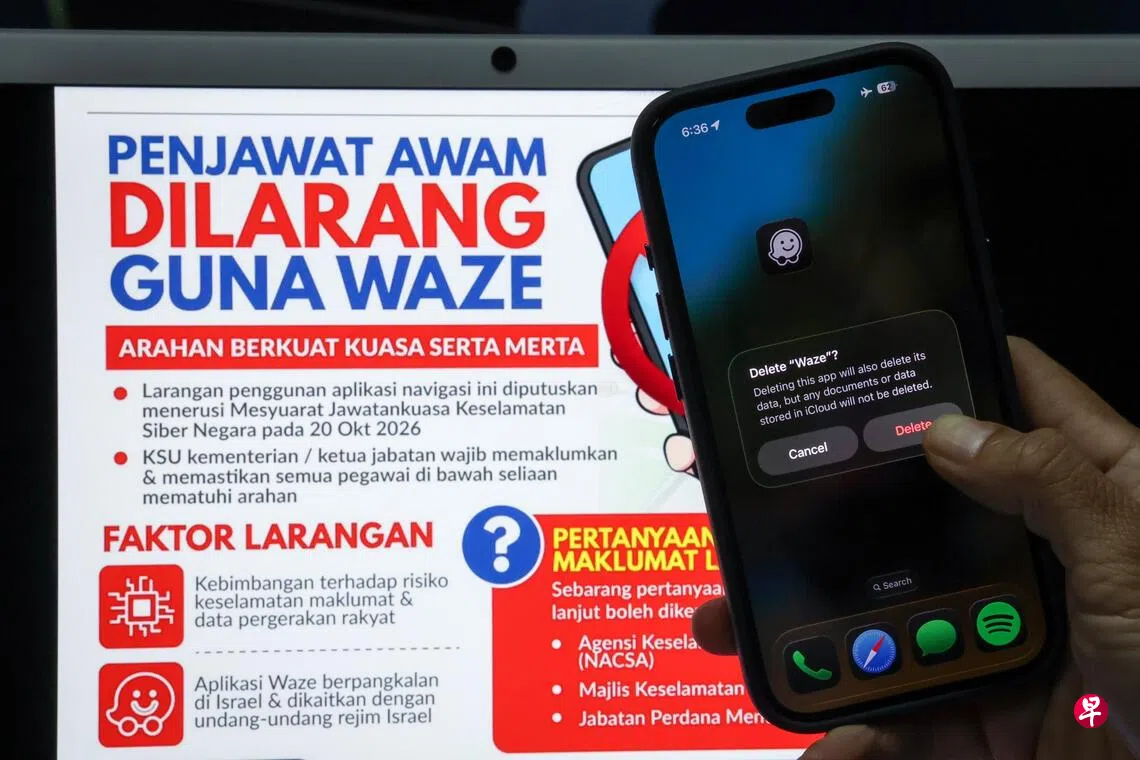
I happened to be in a private-hire car when the Malaysian government announced on 20 October that it would ban civil servants from using the navigation app Waze. After seeing the news in my social media feed, I glanced towards the driver’s seat. The driver was navigating with Waze.
When I told the Malay driver, Nur Fasiyyah, about the news, she was surprised and admitted she had not known that Waze had links to Israel. But rather than worrying about leaks of personal information and national data, her greater concern was this: if the app were banned outright, how would she drive passengers around?
She said frankly that although Grab has a built-in navigation feature, Waze offers more accurate route planning and real-time traffic information. As long as the government had not blocked it completely, she would keep using it.
Malaysian Prime Minister Anwar Ibrahim defended the decision, saying Waze is subject to Israeli government jurisdiction and laws, potentially posing risks to Malaysia’s information security and data on people’s movements. Besides explicitly banning civil servants from using Waze, the government has urged the public to uninstall it and has not ruled out a nationwide ban in future.
Objectively speaking, the authorities’ security concerns are not unfounded. Waze operates through crowdsourcing, relying heavily on users voluntarily reporting road conditions while continuously collecting location and traffic data. If public officials’ movements were maliciously mined or improperly used, there would indeed be potential security risks.
Malaysia has long supported Palestine and has yet to establish diplomatic relations with Israel. Therefore, it comes as no surprise that the country remains wary of technology with Israeli links.
Some countries with strained relations with Israel also restrict Waze. Iran has blocked the app, while Iraq plans to ban it from 2027.
The main reason this national security precaution has drawn public scepticism is that, when announcing the ban, the government neither adequately explained the specific basis for its risk assessment nor presented a comprehensive set of measures and supporting arrangements.
Google acquired Waze back in 2013. Some members of the public have therefore questioned why the government is singling out Waze without taking similar measures against apps such as Google Maps. Do apps developed in other countries pose no data security risks?
Responding to the criticism, National Cyber Security Agency (NACSA) Chief Executive Megat Zuhairy explained that Waze had collected sensitive geographical data on Malaysia for years, incorporating some undisclosed sensitive locations into a database in Tel Aviv, Israel.
Poor policy communication gives ban a political dimension
The government’s inadequate communication at the outset also turned a ban concerning national data security into a political issue.
As Malaysia moves into election mode, Anwar’s government is seeking to win public support through various policies. Some analysts believe that, with the Palestinian issue continuing to resonate with the Malaysian public, Anwar’s move against companies with Israeli links could help win Muslim support and strengthen his image as an Islamic leader.
But what really sparked outrage over the restrictions was the alternative proposed by the authorities.
Anwar suggested that people switch to TuJu, a navigation app developed by the Malaysian Highway Authority. Yet the hastily rolled-out app soon exposed its shortcomings as large numbers of people began using it: sluggish searches, confused routing and a poor navigation experience, at times even failing to locate specified destinations. As downloads rose, the surge in traffic temporarily crashed the system — a problem that remains unresolved.
Democratic Action Party (DAP) adviser Lim Guan Eng bluntly criticised TuJu as a laughing stock and demanded that the government severely punish those responsible for misleading Anwar. Some internet users have even questioned whether vested interests and nepotism lie behind the government’s vigorous promotion of TuJu.
Safeguarding national data security is undoubtedly non-negotiable. But policies should be based on clear risk assessments and backed by viable alternative services, rather than targeting a particular company. Before imposing a ban, the government should also assess how different platforms handle data and examine whether existing alternatives are genuinely workable.
In an age of transparent, readily accessible information and diverse choices, winning public understanding and support requires effective policy communication and supporting measures. If the government keeps falling into a vicious cycle of making rash decisions, sparking outrage and scrambling to put out fires, it will ultimately erode not only its administrative credibility but also the public’s trust and patience.
