

(The Hague/Manila, agencies) Former Philippine president Rodrigo Duterte will go on trial on Monday at the International Criminal Court (ICC) in The Hague, the Netherlands, over a six-year anti-drug campaign that left thousands dead. He faces three counts of crimes against humanity, with a maximum sentence of life imprisonment if convicted on any one count.
Rodrigo Duterte, 81, is accused of involvement in 85 murders and two attempted murders between 2011 and 2018, when he served as mayor of Davao City and during the early years of his Philippine presidency. Prosecutors say these victims are only the tip of the iceberg, with as many as 30,000 people killed in the anti-drug campaign.
Reuters reported that the case is one of the highest-profile proceedings in the ICC’s more than 20-year history, and its biggest test since the US government imposed sweeping financial sanctions and pressed for its closure. Rodrigo Duterte is the second former head of state to be prosecuted by the ICC for alleged crimes committed while in office, after former Ivory Coast president Laurent Gbagbo, who was acquitted in 2019.
Rodrigo Duterte was arrested and transferred to The Hague in March last year, and has remained in detention there.
When the trial opens on Monday (30 November), the court will ask Rodrigo Duterte to enter a plea, after which prosecutors will deliver their opening statement. His lawyers have told the judges that he denies all charges. The trial is expected to run until 2027, with more than 500 victims’ representatives due to address the court.
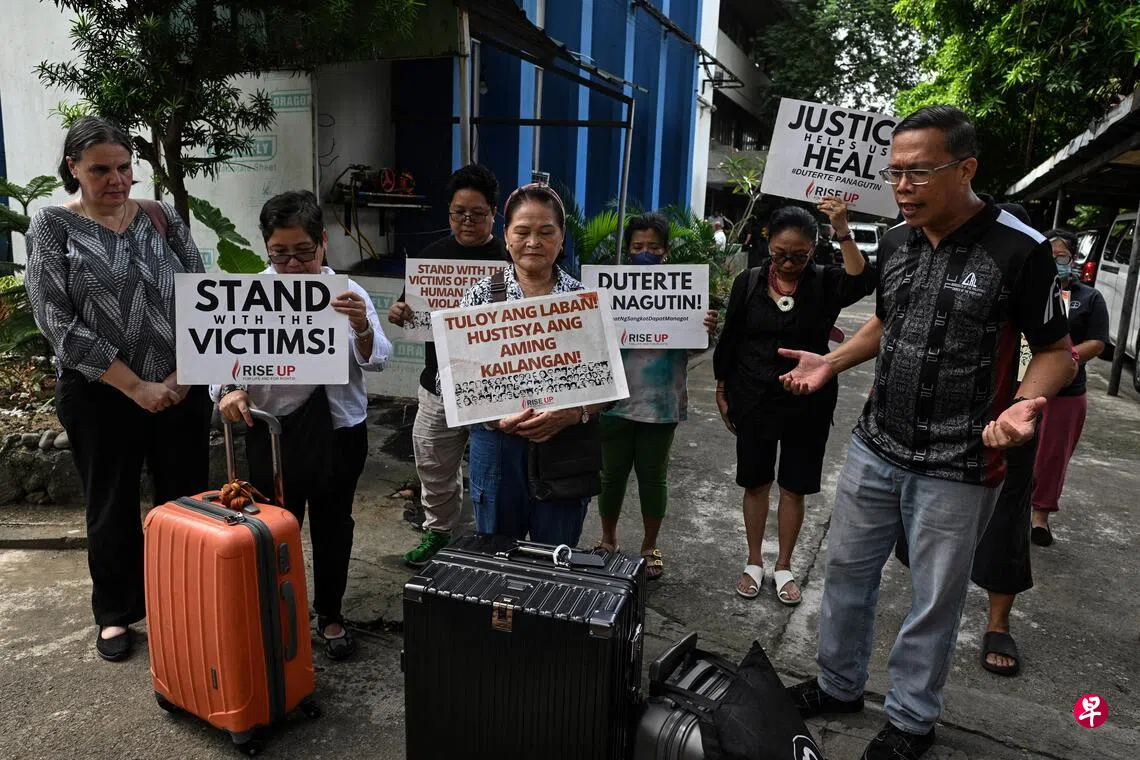
Bereaved mother heads to The Hague, calling trial “most beautiful gift” for her 73rd birthday
For Philippine families who have lost loved ones, this is a long-awaited day.
Llore Pasco, who lost two sons in the anti-drug campaign, turns 73 on Monday, the day the trial opens. Speaking with emotion in an interview before flying to the Netherlands, she said: “This is the greatest and most beautiful gift you could give me. My only wish is not just justice for my children, but for all those killed during the time of Rodrigo Duterte. I hope the killings stop for the next generation.”
Many photojournalists who spent those years racing to murder scenes through the night, calling themselves “nightcrawlers”, also have mixed emotions. Former AFP photographer Noel Celis covered about 200 killings linked to the anti-drug campaign. One of his photographs, showing a young woman cradling the body of her boyfriend, who had been shot dead, at a busy junction became an iconic image of the drug war for its resemblance to Michelangelo’s sculpture “La Pieta”.
Several photojournalists interviewed by AFP recalled that police initially spoke openly to the media about fatal anti-drug operations. But as public outrage grew, police stopped talking, leaving photographers to follow hearses called by officers to reach the scenes.
One of the photographers, Dondi Tawatao, admitted that after four consecutive years photographing bloody anti-drug operations, the killings had become routine to him. Towards the end, he no longer went out to take photographs unless there were at least three bodies at the scene.
None of these photographers believes the drug war solved the Philippines’ drug problem. They firmly believe that police killed thousands to carry out Rodrigo Duterte’s wishes, and stress that their photographs provide “incontrovertible proof” that mass killings took place during his presidency.
