

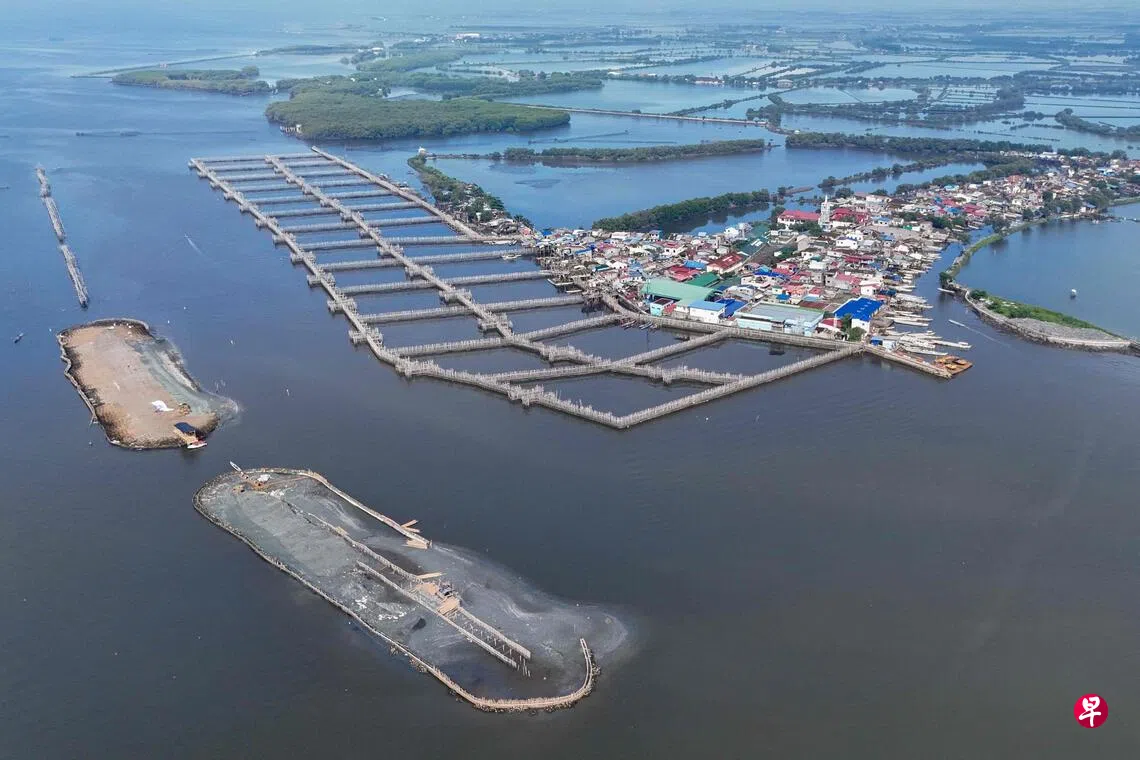
(Malolos, AFP) An island in the Philippines plagued by seawater flooding is breaking with conventional flood defences, replacing costly concrete seawalls prone to weathering and collapse with an eco-friendly breakwater made of bamboo poles and discarded oyster shells to harness nature to protect homes.
The nature-based solution, the first of its kind in the Philippines, has delivered clear results since its first phase was completed. It has breathed new life into a low-lying fishing village long inundated with seawater, while offering coastal communities threatened by climate change a new, low-cost approach to flood management.
The low-lying fishing village of Pamarawan in northern Manila Bay is home to about 3,000 islanders. For years, villagers have added layers of concrete to raise and reinforce their homes, but have been unable to stop seawater from regularly flooding them.
In an interview, 48-year-old fisherman Edgar Javier recalled the frightening moment when huge waves brought down his home's concrete outer wall. He said: “We were terrified whenever there were typhoons. We couldn't sleep at night. Whenever the waves hit, the wall shakes.”
When first proposed, the Philippines' first eco-friendly breakwater met with scepticism and resistance from some local officials and villagers because there was no precedent or fully developed plan. But Malolos Mayor Christian Natividad, whose city in Bulacan province includes Pamarawan, pressed ahead despite the opposition.
Christian Natividad said bluntly that islanders, long beset by flooding, had “nothing to lose”. He said: “It's like you accept daily flooding or you do something else with risk. I chose risk.”
Work began in May last year. Workers, including many islanders, drove closely spaced bamboo poles into the coastal shallows and filled the bamboo frames with branches. This interwoven lattice of bamboo not only protects against erosion by currents and dissipates wave energy, but also traps sediment carried by the water.
As sediment gradually raises the seabed over the years, mangroves can eventually be planted on the newly formed land, creating a more lasting natural protective barrier.
About 100 metres offshore, villagers have packed discarded oyster shells into bags woven from coconut fibre, then anchored them to shallow sandbanks with sturdy wooden stakes to create multiple lines of sea defences. The bags dissipate wave energy in stages and serve as artificial reefs, encouraging wild oysters to attach and reproduce. As the shellfish calcify, the breakwater grows stronger.
Environmental expert Antonio Contreras said the Philippines had long relied too heavily on concrete embankments. Many projects had been rushed through without adequate scientific and hydrological assessments, while some had design flaws linked to corruption. They ultimately collapsed during storms, causing deaths and injuries.
However, Antonio Contreras stressed that nature-based projects were no panacea for flooding. Bamboo poles inevitably rot after prolonged immersion in seawater, making long-term arrangements for maintenance and a sustainable supply of replacement materials essential.
In the face of devastating disasters such as super typhoons, these eco-friendly breakwaters still need to work alongside essential flood-control infrastructure to provide comprehensive protection.
