

Police in Singapore and Cambodia have successfully intercepted and recovered US$12.8 million (about S$16.35 million) lost by a Singapore petrochemical company to business email fraud, following a joint cross-border investigation.
Xinhua, citing a press release issued by Cambodia’s General Commissariat of National Police (GCNP) on Thursday (29 October) evening, reported that Singapore police received a report on Monday (26 October) that a Singapore petrochemical company had been scammed, with more than US$10 million transferred to a suspicious bank account in Cambodia. Preliminary investigations showed that scammers had used fraudulent emails to induce the company to authorise the transfer.
After receiving the report, Singapore authorities immediately sought assistance from Cambodian police to trace the funds. GCNP said in a statement: “Through this collaborative effort, the General Commissariat of National Police coordinated with the National Bank of Cambodia and other relevant institutions to successfully freeze the aforementioned funds and return them to the victim.”
Although countries in the region have stepped up joint efforts to crack down on scam compounds in Southeast Asia, the resilience and tactics of criminals to evade detection continue to put pressure on regional security measures. According to The Nation, Thailand’s military and security agencies held an emergency meeting on Friday (30 October) to prevent the further proliferation of human trafficking and contraband smuggling.
Intelligence gathered by Thailand indicates that, despite earlier regional crackdowns on scam hubs such as Shwe Kokko and KK Park in Myanmar, the scam networks have not been dismantled. Instead, they have split into smaller groups, moving large numbers of people and communications equipment inland to neighbouring countries.
A study commissioned by the EU-ASEAN Business Council (EU-ABC) and conducted by the International Institute for Strategic Studies (IISS) found that lax border controls and interconnected trade networks allow transnational criminal groups in Cambodia, Myanmar and Laos to relocate and regroup rapidly after crackdowns.
Kayakhon Chotiphanat, commander of the 25th Infantry Battalion stationed at O Smach on the Thai-Cambodian border, said: “The groups involved have been gradually moving key equipment linked to scam operations and relocating about 10,000 people, using more than 100 transport vehicles to move into the Cambodian interior.”
People have also been on the move in other border areas besides O Smach. In March, a batch of equipment and between 2,000 and 3,000 people were moved from Trat, Thailand’s easternmost province, to Pailin province in western Cambodia.
The Royal Thai Armed Forces’ Nattapong Praokaew, chief of Joint Staff, said border command centres would set up checkpoints and interception points to strictly screen people and goods entering and leaving the country. He said plainly that border interceptions alone were no longer enough to curb the spread of criminal networks. This also required coordinated action by Thai officials to trace financial flows, intermediary networks and equipment transport routes, alongside close international cooperation, extending beyond interceptions at the border.
Thai military halts informal border trade as Myanmar fighting spills into Thailand
Separately, fighting between Myanmar government forces and ethnic armed groups near the Thai border spilled into Thailand, with a villager in Tak province wounded by shellfire on Thursday.
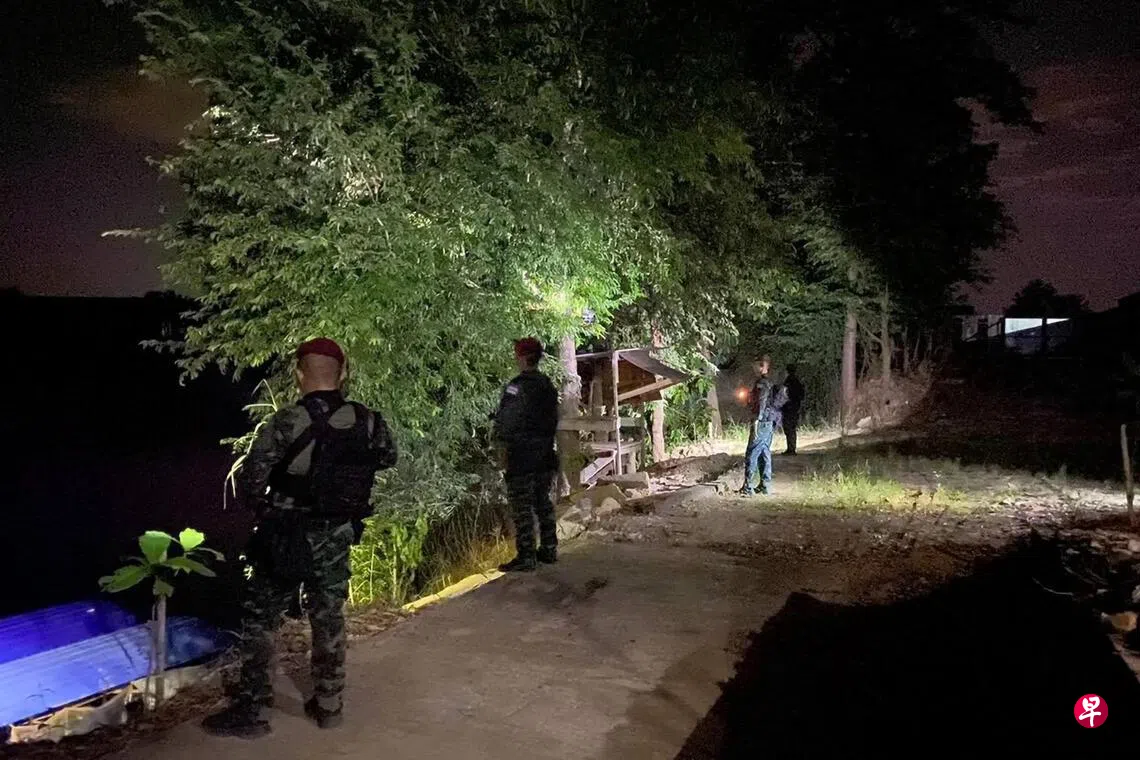
On Friday, Thai border troops urgently suspended import and export trade through all unofficial crossings along the Thai-Myanmar border for seven days to prevent strategic supplies and contraband from reaching combat zones. Elite patrol units were also deployed to maintain round-the-clock vigilance.
Prime Minister Anutin Charnvirakul has instructed the governor of Tak and local security agencies to take all necessary measures to protect border residents. He also said he had informed Myanmar’s leadership of the situation and warned that Thailand might strengthen its defensive measures if Myanmar failed to act.
