

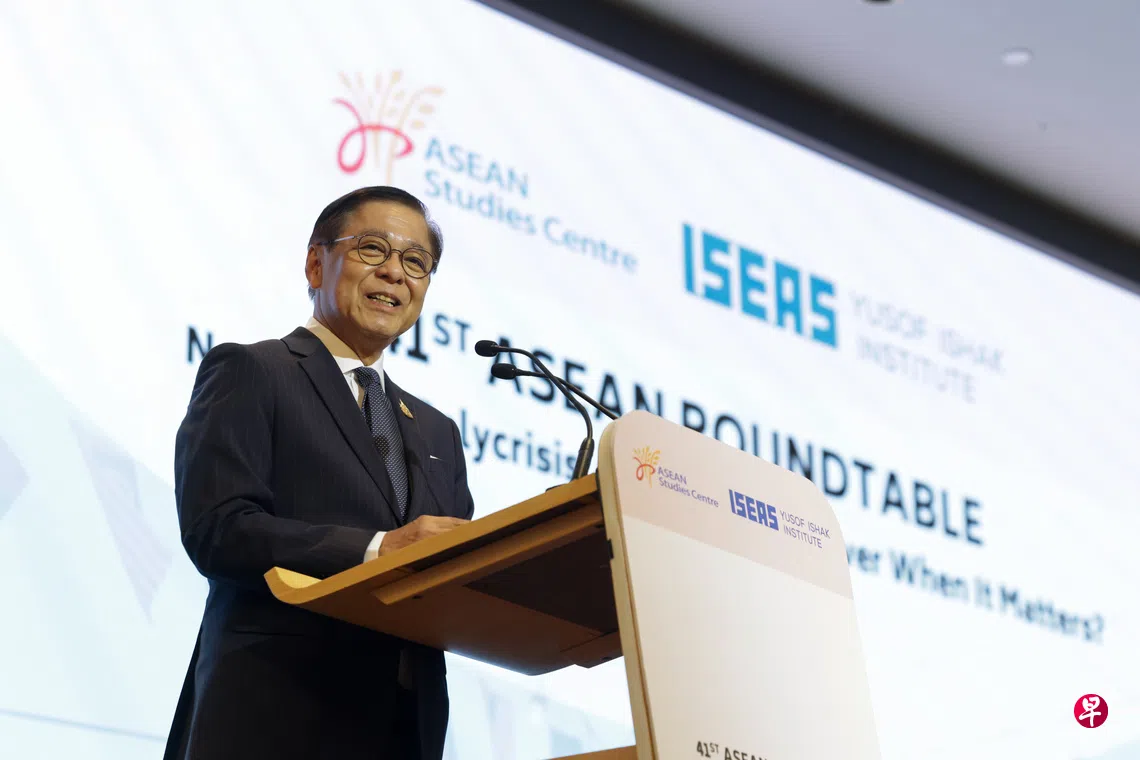
With the Myanmar crisis dragging on for years, Thai Deputy Prime Minister and Minister of Foreign Affairs Sihasak Phuangketkeow said ASEAN must review its response, adopt a more flexible and pragmatic engagement strategy, and reform its existing decision-making mechanisms.
Delivering the keynote address at the 41st ASEAN Roundtable organised by the ISEAS – Yusof Ishak Institute in Singapore on Thursday (5 November), Sihasak said ASEAN’s Five-Point Consensus remains the common framework for resolving the Myanmar crisis. But beyond appointing a special envoy, member states have yet to formulate a clear implementation strategy.
During the question-and-answer session, he acknowledged that the five-point consensus had yielded no substantive progress in the five years since it was put forward. Whenever Myanmar was discussed, ASEAN member states tended simply to reiterate the consensus and leave the issue to the special envoy, moving on to the next agenda item without providing specific guidance.
He said: “We have to think about what to do. Myanmar is part of ASEAN.”
He stressed that the principle of non-interference in member states’ internal affairs should not mean inaction. Isolating Myanmar would not benefit the region, and he did not want the country to become an arena for geopolitical rivalry.
Sihasak said relevant parties in Myanmar should also be involved when ASEAN discusses its response to the crisis. He said, “We have to deal with people who can make decisions, and if they can attend ASEAN meetings at an appropriate level, I think that's going to help this policy engagement.”
On Thailand’s strategy for addressing the Myanmar crisis, Sihasak Phuangketkeow noted that the country, which borders Myanmar, had to deal with border-related issues daily. It would therefore adopt a two-track approach: resolving practical issues through bilateral engagement while promoting Myanmar’s internal peace process and inclusive dialogue, and encouraging communication among ethnic armed groups and other relevant parties.
However, he stressed that Myanmar’s problems must ultimately be resolved by its own people, not decided for them by external powers.
On ASEAN reform, Sihasak said the bloc must review its traditional ways of working in the face of increasingly complex regional crises, improving decision-making efficiency while upholding its fundamental principles.
Consensus remained a fundamental ASEAN principle, he said, but applying it rigidly to every issue could impede urgently needed action, turning the decision-making mechanism into an obstacle to collective action.
He proposed expanding the coordinating role of the rotating ASEAN chair during crises, allowing it to convene emergency consultations swiftly rather than wait for scheduled meetings.
Sihasak also advocated making the “Troika” mechanism, comprising the previous, current and incoming ASEAN chairs, a standing arrangement. “I think if we really want ASEAN to be relevant, timely action is important.”
