

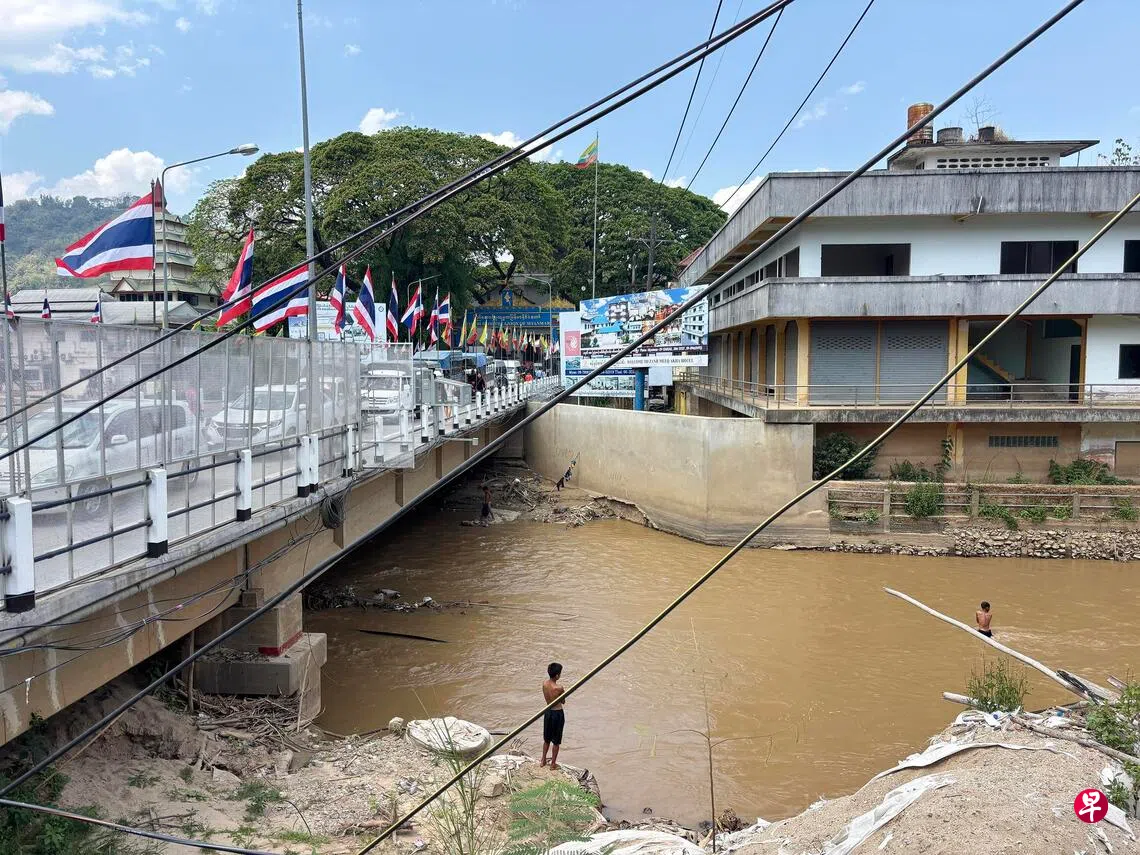
Thailand will ask Myanmar to take urgent action over suspected mining-related pollution in cross-border rivers. Levels of arsenic (commonly known as white arsenic) have surged to 30 times the Thai standard, threatening drinking water and farmland in northern Thailand.
Thai Prime Minister Anutin Charnvirakul said on Wednesday (11 November) that Deputy Prime Minister and foreign minister Sihasak Phuangketkeow would raise pollution in the Kok, Sai and Ruak Rivers when he meets Myanmar President Min Aung Hlaing in the Myanmar capital, Naypyidaw, on Thursday (12 November).
Myanmar officials have yet to comment on the matter.
Although Thai authorities have yet to pinpoint the source of the surge in arsenic levels, officials suspect mining activities upstream in Myanmar’s Shan State.
On 5 November, the Sai River was extremely murky in Mae Sai, a town in Thailand’s Chiang Rai province on the border with Myanmar. Tests found arsenic levels of 0.3 milligrams per litre, 30 times Thailand’s surface water standard, seriously compromising the safety of local drinking water.
Sihasak Phuangketkeow will also meet Myanmar foreign minister Tin Maung Swe during his visit. The two countries are understood to have agreed to set up a working group on water quality, with its first meeting expected in late November. Thailand will also seek Myanmar’s approval to install water quality monitoring equipment upstream within Myanmar.
The issue has also drawn China into the diplomatic efforts. Thai opposition member of parliament Phattarapong Leelaphat urged Anutin Charnvirakul to seek Beijing’s help in tracking mineral shipments when Chinese premier Li Qiang visits Thailand on Friday and Saturday (13 and 14 November).
The Shan Human Rights Foundation has alleged that Chinese miners are extracting gold along the upper reaches of the Sai River. Thailand raised the pollution issue with Beijing last year, and the Chinese embassy in Thailand supported a scientific investigation at the time.
