

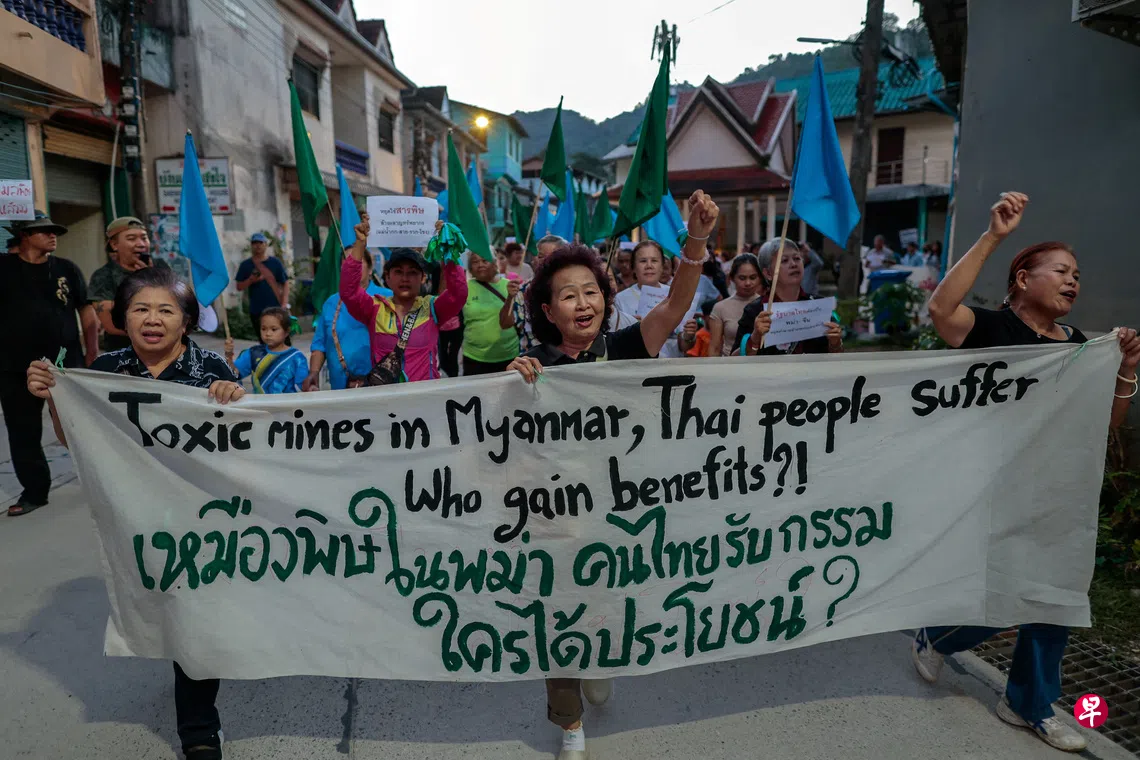
(Bangkok, agencies) The Thai government has asked China to help secure a halt to mining operations in northeastern Myanmar for at least six months to stop arsenic (commonly known as white arsenic) pollutants from entering Thai rivers and threatening local water safety.
Thailand made the request during trilateral talks with representatives from China and Myanmar at the Thai Ministry of Foreign Affairs on Tuesday (24 November).
According to Bloomberg and Thailand’s The Nation, Thai Foreign Minister Sihasak Phuangketkeow and Deputy Prime Minister and Minister of Higher Education, Science, Research and Innovation Yodchanan Wongsawat told the meeting that they hoped Beijing would help address the cross-border pollution, as Chinese companies operate some mines in Myanmar’s Shan State and most of the minerals are shipped to China.
China was represented at the meeting by its ambassador to Thailand, Zhang Jianwei, while Myanmar’s delegation was led by the permanent secretary of its Ministry of Natural Resources and Environmental Conservation.
Representatives of the three countries agreed during the talks that mining activities in Shan State were the source of arsenic pollution in the Kok and Sai rivers in northern Thailand. Arsenic levels in the river water have reached as high as 30 times Thailand’s safety limit, threatening downstream water sources, farmland and communities.
Sihasak Phuangketkeow said China acknowledged that private Chinese companies operated mines in the area. Thailand believes that, as most of the rare earths are shipped to China, Beijing may be able to trace the minerals’ origins and verify environmental standards at upstream mines in Myanmar.
Thai Prime Minister Anutin Charnvirakul raised the water pollution issue during a meeting with Chinese President Xi Jinping last Friday (20 November). Beijing pledged technical support to help improve water quality monitoring.
Thailand also plans to ban the export or transshipment to Myanmar of chemicals used in rare earth mining. The measures are still under review. According to Thailand’s National Security Council, about 70% to 80% of such mining chemicals shipped to Myanmar originate in Thailand.
Thailand also plans to designate a stretch of more than 150 kilometres of the Kok River as a pollution control zone from 2 December and arrange alternative water supplies for nearly 20,000 residents in Chiang Rai province. It also plans to establish four water quality monitoring stations each in Myanmar and Thailand, and add about 20 monitoring points along the affected rivers and their tributaries.
The Thai-Myanmar water resources working group will continue meeting on Wednesday (25 November) and Thursday (26 November) to discuss measures Myanmar can take immediately, mining regulations and technical assistance from Thai and Chinese laboratories.
Sihasak Phuangketkeow stressed that river pollution affects both Thailand and Myanmar, requiring coordinated action upstream and downstream, as well as technical support.
