

(Bireuen, AFP) A year after devastating floods struck Sumatra in Indonesia, reconstruction remains slow, leaving thousands of survivors struggling in makeshift shelters and even raising their own funds to repair roads and build bridges. As the rainy season returns, many fear a repeat of the disaster and say they feel forgotten.
Last year’s floods destroyed more than 200,000 homes, killed about 1,200 people and displaced more than two million. According to Indonesian government figures, in the 11 months after the disaster, fewer than a quarter of eligible survivors received the promised housing repair and reconstruction grants of 15 million to 70 million rupiah (about S$1,100 to S$5,000) per household.
In the worst-hit province of Aceh, reconstruction task force chief Safrizal acknowledged that fewer than 2,000 of the roughly 50,000 homes needed had been completed.
Flood survivor Asmiyati, 63, broke down in tears as she described her family’s plight. She said only part of the foundations had been laid for the new home promised by the government. Her family of six is now crammed into a shack her husband built using timber, cardboard and corrugated iron sheets supplied by relatives and friends. They have to cook and wash outdoors. “I feel very sad because we have no beds and the room is so cramped. I can’t help thinking about the home we no longer have.”
She said tearfully that the family had received relief supplies such as rice and cooking oil only in the immediate aftermath of the disaster. She and her husband lost their jobs in construction, while the pomelo orchard that supplemented their income was also washed away. They now make brooms from coconut fibre, earning less than US$3 (about S$3.87) a day. “I’m disappointed in the government … It feels as though nobody cares about us,” she said.
In another flood-hit area, residents tired of waiting for relief funds raised 80 million rupiah themselves in September this year to buy concrete, gravel, sand and a compactor. They mobilised 700 people to repair a road linking 14 villages that is crucial for transporting crops.
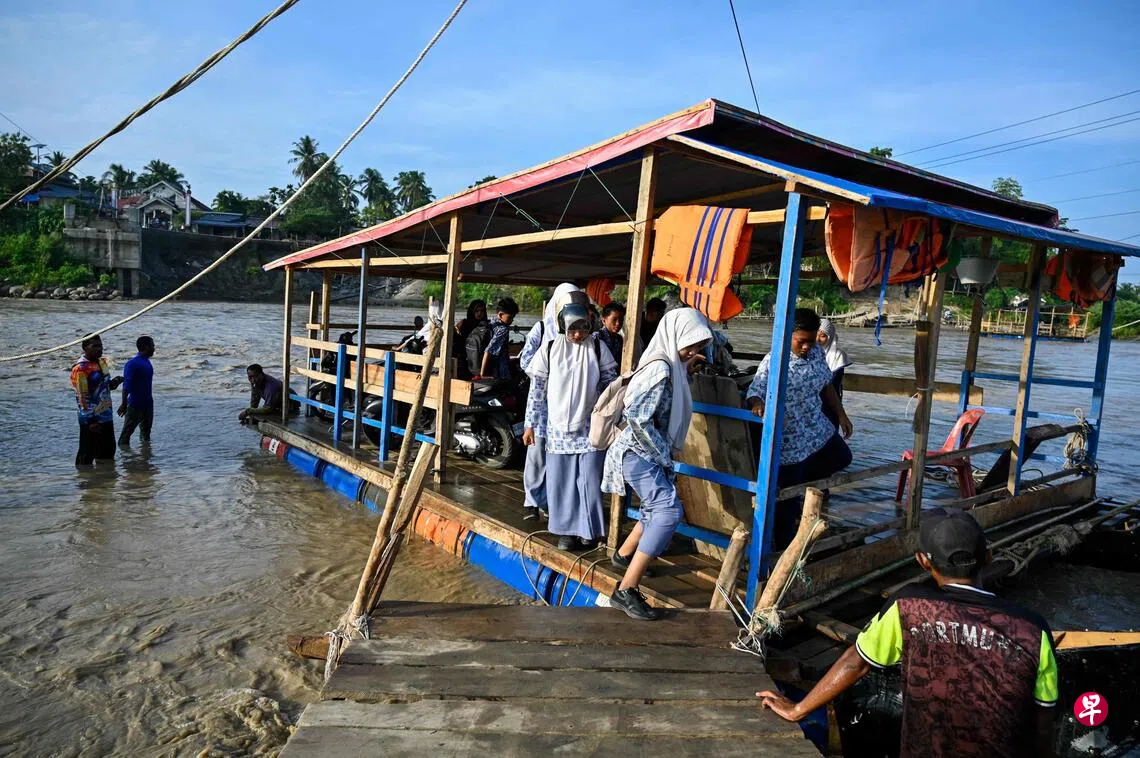
Residents had also built a temporary bamboo bridge to replace a concrete bridge swept away by the floods. The bamboo bridge was used for eight months until the government completed a new one. One villager said bluntly that their remote village received no attention, and that it was better to do the work themselves than wait indefinitely.
Indonesia’s central government has allocated more than 100 trillion rupiah over three years for reconstruction in three provinces on Sumatra. But survivors and critics say relief and rebuilding efforts have been slow.
With the rainy season returning, survivors fear another disaster. Alfian, spokesman for the Civil Society Coalition for Aceh-Sumatra Disaster Response, urged the government to focus at least on dredging rivers and repairing embankments, “so that disasters do not keep happening”.
