

With the Democratic Party taking control of both chambers of Congress after the midterm elections, it will step up investigations into corruption in the Donald J. Trump administration, push to impeach Secretary of War Pete Hegseth, and use budgetary powers to constrain some policies. Still, Trump will retain broad powers over foreign affairs, according to a former senior US diplomat.
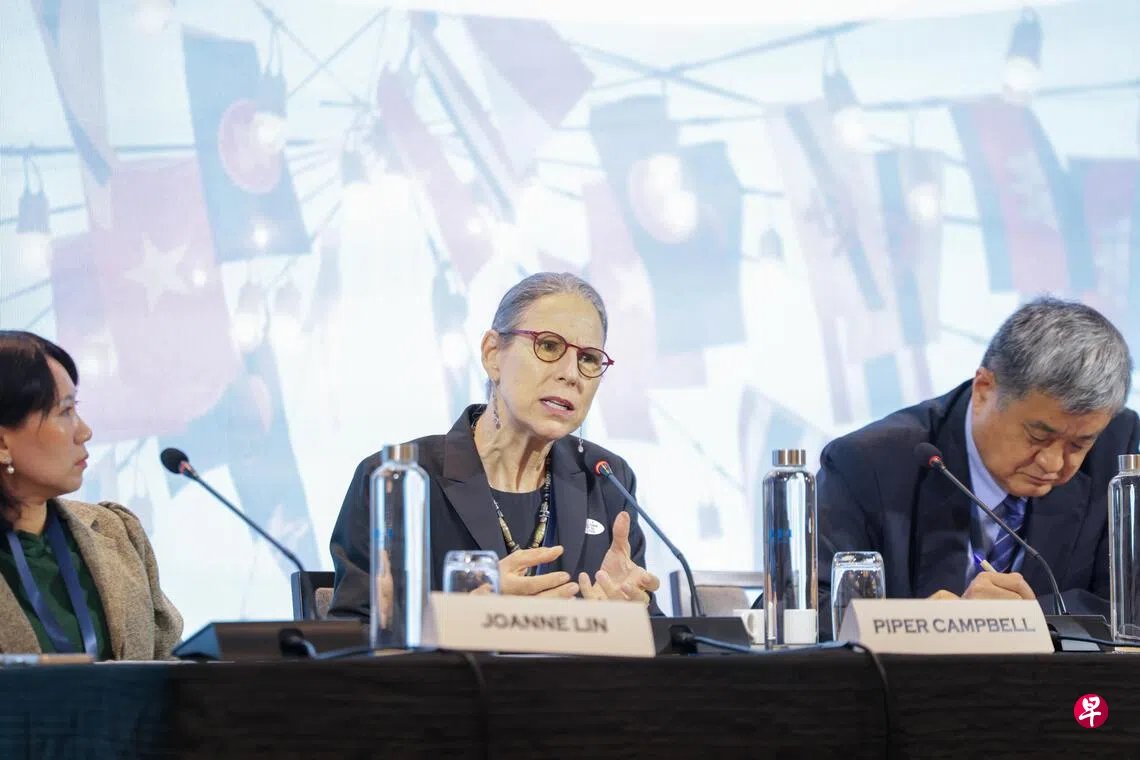
Piper Campbell, inaugural chair of the Department of Foreign Policy and Global Security at American University’s School of International Service, attended the 41st ASEAN Roundtable organised by the ISEAS – Yusof Ishak Institute on Thursday (5 November).
Campbell told the conference that the US midterm elections reflected voters’ dissatisfaction with rising prices and the country’s direction, and their demand for change. But this did not mean they supported the Democratic Party’s policy positions. The party also faces internal divisions, limiting Congress’s ability to respond to voters’ demands.
The former US ambassador to Mongolia said President Trump could be both a “lame duck”, constrained in governing, and an “angry bird”, actively exercising executive power.
“We've got an angry president who still has many powers vested in the presidency, including in the area of foreign policy. We've got a Democratic Congress which represents a range of views, a range of strategies and tactics, and we are moving into an interesting period.”
Campbell expects the Democrats to focus on investigating possible corruption and the blurring of public and private interests in the Trump administration, including through congressional hearings and investigations.
She also expects the Democrats to step up impeachment efforts, with Secretary of War Pete Hegseth “the likely first target”. A Democratic member of the House of Representatives introduced an impeachment motion against Hegseth in April this year. She said whether Republican lawmakers supported removing Hegseth would be an important indicator of whether similar bids would follow over the next two years.
The Democrats may also use Congress’s appropriations powers to limit government spending and insert provisions that the Trump administration would regard as “poison pills” into major legislation, such as the National Defense Authorization Act.
Although Trump could veto such bills, the Democrats could still seek support from some Republican lawmakers to try to override a presidential veto. However, Campbell said a more practical approach might be to capitalise on Trump’s preference for “making deals” by negotiating directly with him to secure concessions.
Campbell noted that tariffs are widely seen as a major factor driving up US prices and influencing the midterm election results. In practice, however, Congress would struggle to prevent the Trump administration from continuing to impose tariffs, so she did not expect any major changes in tariff policy.
Southeast Asia’s confidence in the US badly shaken
During the question-and-answer session, no one in the audience asked the US representative about the midterm election results. This prompted ISEAS – Yusof Ishak Institute Director and Chief Executive Officer Ng Chee Khern to ask Campbell whether she would convey to Washington that the US should pay more attention to ASEAN.
Campbell replied: “I'm flabbergasted that nobody had any questions for me, and I'm choosing to believe it's because the election results are so new. I'm choosing to believe that it is not reflective of a reduction in confidence in the US.”
She acknowledged, however, that Southeast Asia’s confidence in the US had indeed been badly shaken. This was not simply a development of the past two years, but the cumulative result of repeated shifts in US foreign policy over roughly the past decade.
Campbell stressed that US policymakers should pay greater attention to the lack of confidence abroad in the future direction of US policy.
Trump will attend the ASEAN Summit in Manila, the Philippines, next week, before travelling to the Asia-Pacific Economic Cooperation (APEC) summit in Shenzhen, China. Campbell expects him to make full use of the president’s broad powers over foreign affairs to project strength on the international stage and signal that he will continue to pursue his existing policies.
