

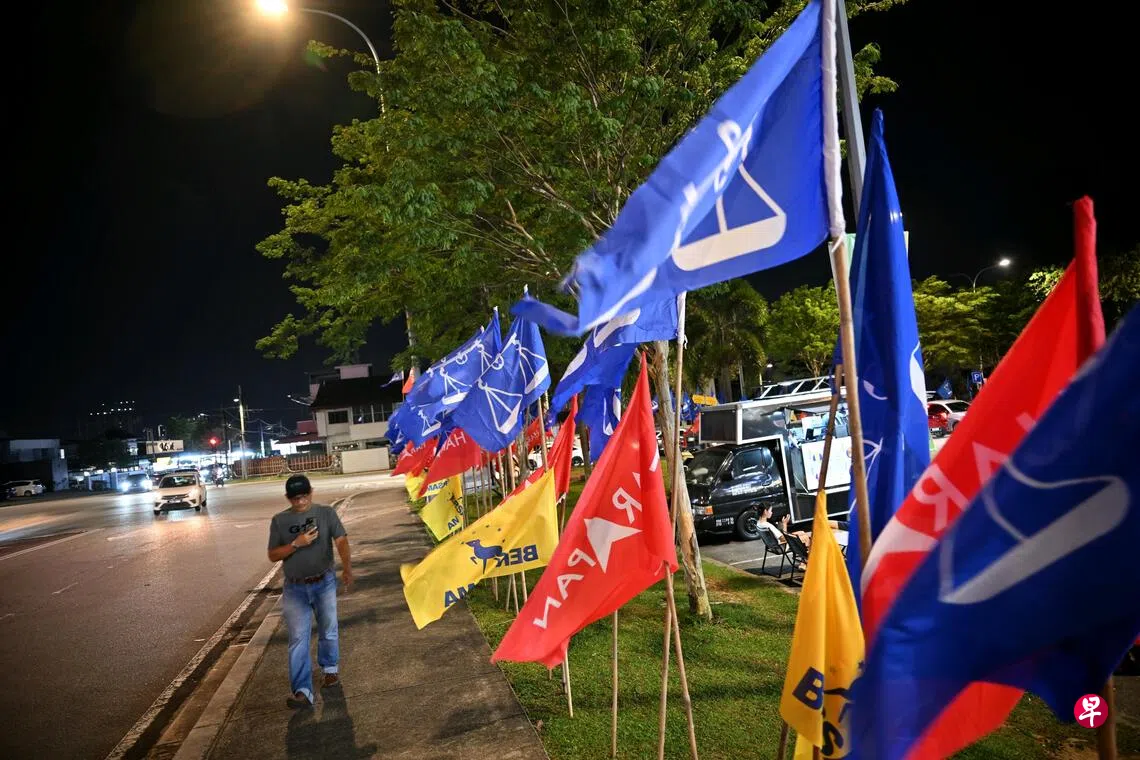
New parties Parti Bersama Malaysia and Parti Wawasan Negara have emerged, as Malaysia’s party landscape continues to fragment and identity politics grows increasingly polarised. Parti Bersama Malaysia founder Rafizi Ramli is championing reform, while Parti Wawasan Negara chairman Hamzah bin Zainudin is focused on consolidating Malay political forces. The two parties differ in outlook, but both have Prime Minister Anwar Ibrahim and Pakatan Harapan in their sights, adding uncertainty to the political landscape.
Rafizi, 49, emerged from the Reformasi generation and is known for exposing corruption and mounting public opinion campaigns. He became economy minister after the 2022 general election, but resigned from the government after losing the deputy presidency in the 2025 Parti Keadilan Rakyat leadership election. He subsequently accused Anwar’s former political secretary, Farhash Wafa Salvador, of political interference behind the scenes.
His 12-year-old son was subsequently attacked. The case remains unresolved, further intensifying tensions. In May this year, he and former vice-president Nik Nazmi bin Nik Ahmad, who had also suffered a setback in the party election, quit the party and formed a new one.
Hamzah, 69, began his political career in UMNO. After the Barisan Nasional government fell in 2018, he led five MPs into the Malaysian United Indigenous Party. In 2020, he helped orchestrate the Sheraton Move, which brought down the Pakatan Harapan government.
He later fell out with Malaysian United Indigenous Party president Muhyiddin Yassin, weakening the party and helping Parti Islam Se-Malaysia (PAS) secure dominance within Perikatan Nasional. He is now using Parti Wawasan Negara to further marginalise his former party.
Parti Bersama Malaysia: ideals tested amid polarisation
Parti Bersama Malaysia’s platform centres on institutional reform and fighting corruption. It has pressed issues such as the shareholding controversy involving former Malaysian Anti-Corruption Commission chief Azam bin Baki and the “corporate mafia”, accusing Anwar of breaking his promises on integrity. Positioning itself as a multiracial party, it is trying to carve out a moderate path between the polarised camps.
On the one hand, Parti Bersama Malaysia is seeking Malay votes from those who dislike Anwar Ibrahim and the Democratic Action Party. On the other, it is trying to persuade non-Malay voters to switch allegiance by arguing that Pakatan Harapan has shifted to the right and compromised with conservative forces.
Ahead of the Johor state election, Rafizi cited internal polling showing that swing voters accounted for 32% of Malay voters, 60% of Chinese voters and 68% of Indian voters. He argued that this pool was far larger than widely assumed and represented potential support for Parti Bersama Malaysia, using the figures to rebut accusations that it was splitting Pakatan Harapan’s vote.
Yet Parti Bersama Malaysia suffered a complete rout in Johor. All 15 candidates lost their deposits, and the party secured just 1.54% of valid votes statewide. Even in Larkin, where it performed best, it won only 5.45%, well below the 12.5% needed to retain its deposit.
During the campaign, one candidate discussing pig farming in Selangor disregarded the history of the 1998 Nipah virus outbreak, which claimed more than 100 lives, and asked whether anyone living near pig farms had died or fallen ill. Internet users responded by mocking the party’s mouse-deer emblem, turning it into a pig. Despite strenuous damage-control efforts, Rafizi was unable to bridge the polarised responses to ethnic issues.
The Melaka state election will be a crucial test for Parti Bersama Malaysia. Rafizi must show that it can attract more Malay votes than Pakatan Harapan to win over Chinese voters who are disillusioned with the coalition but fear UMNO and PAS joining forces to take power. Otherwise, they may still reluctantly support Pakatan Harapan as the likelier winner, rather than split the vote and benefit UMNO and PAS.
Only if Parti Bersama Malaysia’s vote share grows while support for Parti Keadilan Rakyat continues to decline might Rafizi’s former comrades switch parties after parliament is dissolved.
Parti Wawasan Negara: consolidating power under the banner of “grand unity”
Unlike Parti Bersama Malaysia, which rejects alliance-building and is prepared to wait two or three general elections to reap the rewards, Parti Wawasan Negara is focused on an immediate realignment of power. It has offered to act as a bridge in negotiations between UMNO and PAS. In an interview on 17 September, Hamzah said frankly: “In a country where Malays are the majority, how can there be national stability if Malays are not united?”
Although Parti Wawasan Negara has an ethnic Chinese deputy president, its secretary-general Saifuddin Abdullah has rejected the description of it as a multiracial party, instead calling it a “Malaysian party” or one that “reflects the face of Malaysia”.
In the lower house on 19 October, party vice-president Wan Saifulruddin bin Wan Jan urged the government to close large pig farms nationwide, help pig farmers move into other activities and meet demand through cheap pork imports — a clear appeal to mainstream Malay sentiment.
Parti Wawasan Negara’s bargaining power comes from the 31 parliamentary seats the Malaysian United Indigenous Party won in 2022. Muhyiddin currently controls just six. Excluding another six whose MPs switched to supporting Anwar’s government in 2023 and 2024, most of the remaining MPs lean towards Hamzah.
After Hamzah was expelled from the Malaysian United Indigenous Party, he did not join PAS but instead formed Parti Wawasan Negara. His aim was to take over his former party’s role within Perikatan Nasional: softening PAS’s theocratic image and appealing to urban and swing voters.
PAS president Abdul Hadi Awang personally named Parti Wawasan Negara, presided over its founding ceremony and announced that Hamzah would again be nominated as parliamentary opposition leader, signalling that PAS feels more comfortable with the new party.
Hadi’s backing, together with PAS’s loyal grassroots voters and mobilisation machinery, underpins Parti Wawasan Negara’s prospects for survival. If negotiations between UMNO and PAS fail, it can seek a larger allocation of seats to contest and expand its reach. If UMNO and PAS join forces but cannot agree on a prime ministerial candidate, Hamzah could emerge as a compromise acceptable to all sides, rising from kingmaker to prime minister.
Since the change of federal government in 2018, Malaysia has entered a volatile new normal in which no single party or coalition can command an outright parliamentary majority to govern.
Parti Bersama Malaysia is trying to find a way forward for stalled reforms, while Parti Wawasan Negara seeks to reshape the distribution of power by consolidating political parties. In different ways, both are manoeuvring within the existing system, seeking to redraw Malaysia’s present and future political landscape.
