

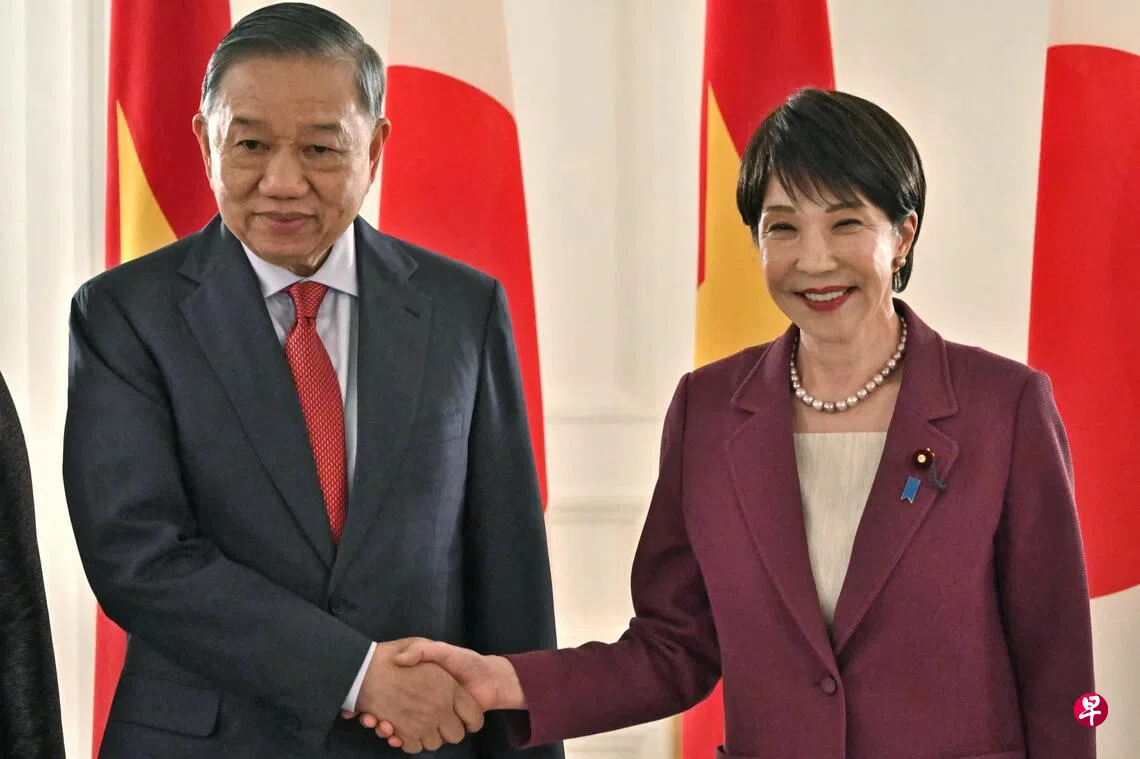
Vietnamese President To Lam, who is visiting Japan, held talks with Japanese Prime Minister Sanae Takaichi on Monday (9 November).
The two sides signed a memorandum of understanding on nuclear energy cooperation, with plans to build next-generation nuclear reactors in Vietnam after 2040. Vietnam will then become the first Southeast Asian country to use Japanese nuclear technology.
To Lam began a four-day visit to Japan on Sunday at the invitation of the Japanese government. This is the first visit to Japan by a Vietnamese president in 11 years, since Nguyen Phu Trong’s visit in 2015.
During the talks, Takaichi emphasised the concept of a “Free and Open Indo-Pacific” and expressed her hope to work with Vietnam to address regional challenges.
She noted Vietnam’s support for Japan’s “Free and Open Indo-Pacific” vision and said Japan hoped to deepen cooperation with Vietnam under this framework, taking their comprehensive strategic partnership to a higher level.
Nikkei noted that although China is Vietnam’s largest trading partner, the two countries have sovereignty disputes over areas including the Spratly Islands. Japan and Vietnam therefore share concerns over some strategic interests. During their talks, the two leaders affirmed that they would advance security cooperation to uphold a free and open international order.
Japan plans to provide Vietnam with equipment for UN peacekeeping operations through its Official Security Assistance (OSA) programme. On economic security, the two sides will encourage their governments and businesses to accelerate concrete cooperation on critical minerals.
Energy has long been a key area of cooperation between Japan and Vietnam. During Sanae Takaichi’s visit to Vietnam in May this year, the two sides resumed related negotiations and reached a consensus on advancing nuclear energy cooperation beyond 2040. The latest talks further clarified the scope of that cooperation.
Vietnam will be Japan’s first partner in its nuclear energy development plans in Southeast Asia. Following the leaders’ talks, the two countries signed a memorandum of understanding on plans to bring Japanese-developed next-generation nuclear reactors, known as small modular reactors (SMRs), into operation in Vietnam after 2040.
Vietnam has selected sites for two nuclear power plants in the south-central province of Khanh Hoa and the former province of Ninh Thuan.
The two countries also signed a loan agreement for energy development, covering the construction of a high-efficiency gas turbine combined-cycle (GTCC) power plant in Vietnam. The two leaders also discussed how to expedite power generation projects fuelled by liquefied natural gas (LNG) and other fuels.
In a speech to Japan’s parliament, To Lam stressed: “Japan is Vietnam’s largest provider of official development assistance (ODA). Vietnam aims to join the ranks of high-income countries by 2045 and regards science and technology, innovation and digital transformation as key drivers underpinning its new phase of development. Japan has a crucial role in this process.”
Vietnam’s proposed programme to “train 100 PhD specialists in artificial intelligence (AI)” received strong support from Japan.
The memorandum of understanding signed by the two sides covers joint research and development in digital technology and AI. Their joint statement also said that Japan’s AI Safety Institute would work with relevant Vietnamese bodies to address safety issues involving frontier AI.
