

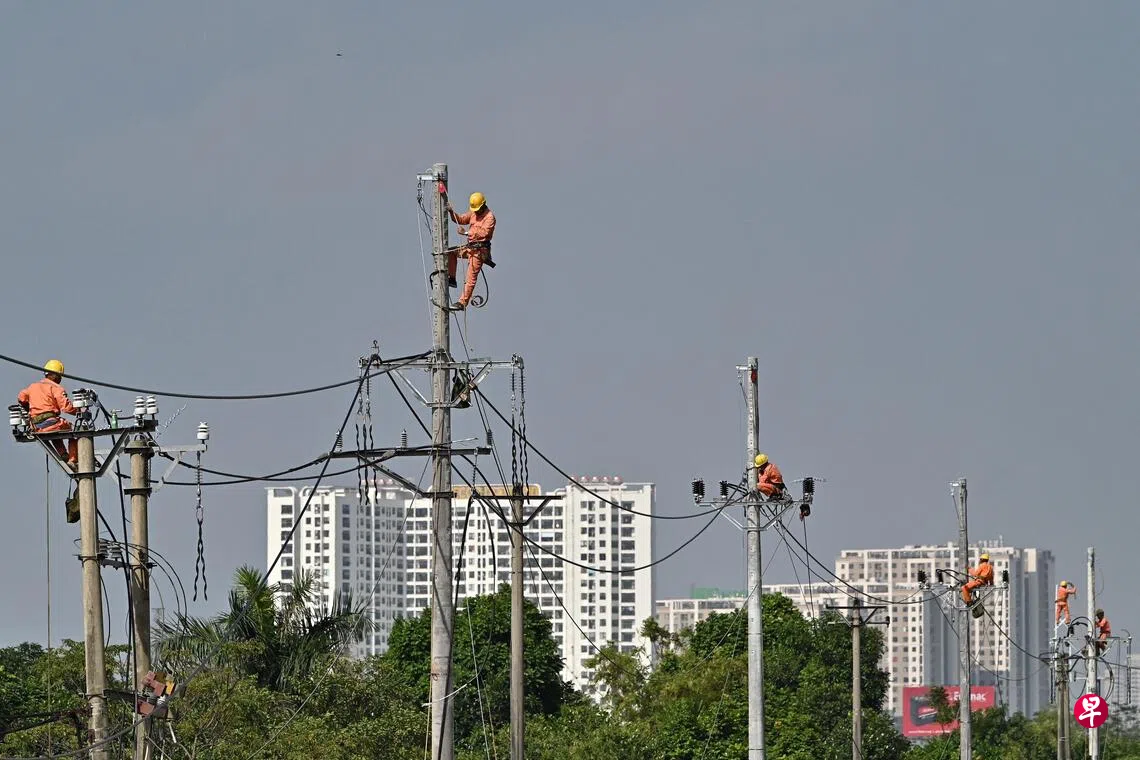
Vietnam’s government has announced a 2% cut in the average retail electricity price from November and a temporary suspension of the special consumption tax on petrol to support economic stability and lower costs for households and businesses.
The government said in a statement on Saturday (31 October) that the average retail electricity price, excluding value-added tax, would fall to 2,159.9 dong (about S$0.10) per kilowatt-hour from Sunday (1 November), a 2% reduction from the current level.
The special consumption tax on petrol, which took effect in July this year at rates of 7% to 10%, will also be reduced to zero from Sunday. Both measures will remain in place until 31 March next year.
This is Vietnam’s first cut in average electricity prices in nearly 20 years, apart from electricity subsidies and price reductions during COVID-19. Between 2023 and 2025, electricity prices were adjusted four times, rising by a cumulative 18.2%.
Vietnamese Deputy Prime Minister Nguyen Van Thang told the National Assembly on Saturday that the adjustments to electricity prices and the special consumption tax on petrol would provide about 0.07 percentage points of additional room to contain inflation, helping to meet the assembly’s 4.5% inflation target.
Nguyen Van Thang said Vietnam’s economy was facing major global shocks from adverse external factors, including frequent geopolitical and military conflicts and high international oil prices. An additional 12.5% US tariff on Vietnamese goods, affecting about 70% of exports, was also a major reason businesses faced pressure in the third quarter.
Vietnam Electricity (EVN) said it had decided to lower electricity prices as requested by the government after conducting a review, making calculations and cutting costs as much as possible. The aim was to ease the burden on households and businesses, maintain macro-economic stability and safeguard social welfare.
To meet the 4.5% inflation target, the government has allocated more than 64 trillion dong since the start of the year to measures reducing taxes and fees on petrol and diesel. It is expected to allocate a further 4 trillion dong from November to the end of the year to reduce the special consumption tax on petrol to zero.
Data from Vietnam’s statistics office showed that annual inflation stood at 5.08% in September, compared with 4.89% in August.
Petrol prices in Vietnam fell on Sunday to their lowest level since 16 July, following the government’s temporary suspension of the special consumption tax on petrol.
The price of E10 RON95 petrol, which is widely used in Vietnam, fell by 6.14% to 24,150 dong per litre, while E5 RON92 petrol fell by 6.92% to 24,220 dong per litre. Diesel prices remained unchanged at 30,240 dong per litre.
