

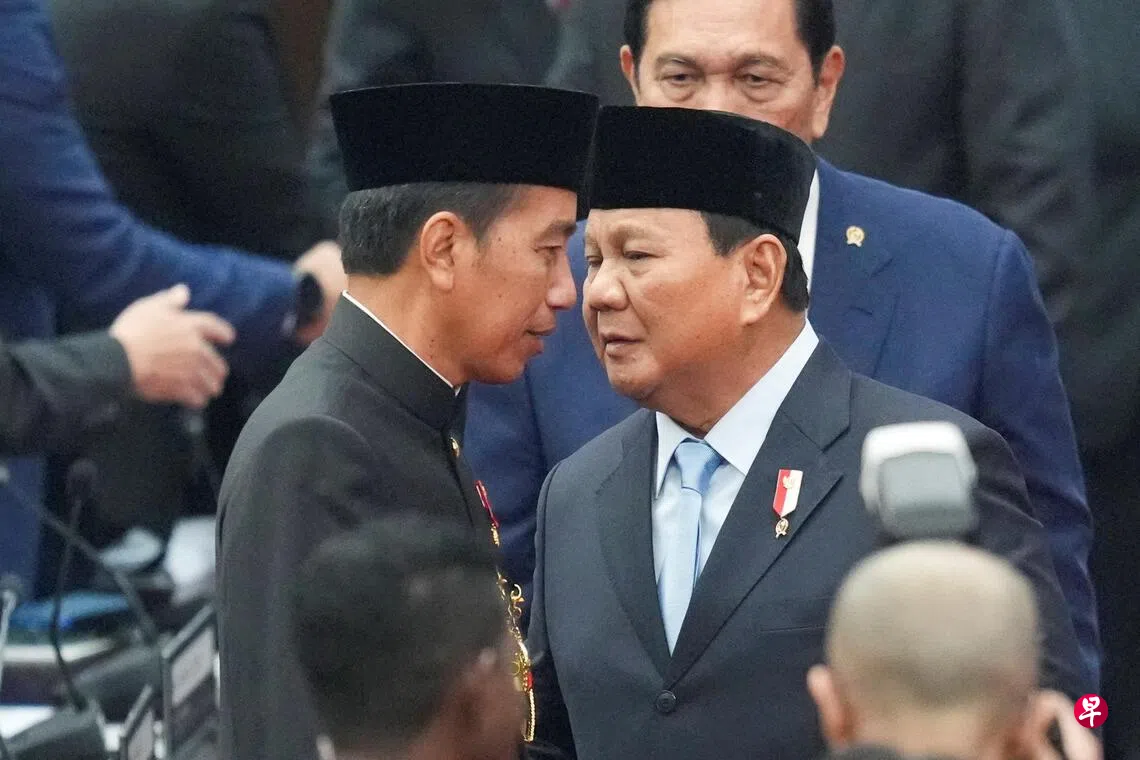
A scandal over the illegal wiretapping of Indonesian President Prabowo Subianto has sent shock waves through the country’s military and political establishment.
The Indonesian military deployed nearly 21,000 troops to the capital Jakarta this week to bolster security. The move has fuelled speculation that the political alliance between Prabowo and former president Joko Widodo is heading for a rupture, while also bringing the longstanding power struggle between the military and police into the open.
Bloomberg reported that despite the tensions simmering in Jakarta, business activity appeared normal as of Friday (6 November) morning. There was little sign of a large military presence in the city centre, or of any imminent security threat.
Dedi Dinarto, associate director at strategic advisory firm FGS Global, said, “There is little to suggest a credible threat to Prabowo’s presidency, given his strong backing from the military and the ruling coalition. The large-scale military deployment could be a precautionary move to prevent tensions within the security establishment from escalating.”
Presidential chief of staff Listyo Sigit Prabowo and two senior police officers were named as suspects and detained on Wednesday (4 November) over allegations that they illegally wiretapped Prabowo and senior government officials. The Indonesian presidential office formally dismissed Listyo Sigit Prabowo on Thursday (5 November).
The wiretapping case, which has rocked Indonesia’s political establishment, poses a severe test for the political alliance Prabowo and Joko Widodo forged during the 2024 presidential election.
Prabowo won the presidency with Joko Widodo’s strong backing and subsequently returned the favour by elevating several of his close allies, with Joko Widodo’s eldest son Gibran Rakabuming Raka becoming vice-president.
Now, the arrests of senior police officers including Listyo Sigit Prabowo, coupled with a Supreme Court ruling last week that invalidated the educational certificate Gibran Rakabuming Raka used when standing for election and triggered calls for his removal, have shattered political trust between the two men.
Dedi Dinarto said developments in the wiretapping case could give Prabowo “an opportunity to further consolidate his political authority and weaken the influence of figures linked to Joko Widodo”.
Political analyst Arfiki Chaniago of Indonesia said bluntly that differences between the two sides had gone beyond a contest over power and interests and were developing into a complete breakdown of trust.
He warned that Prabowo’s approval ratings were falling and that political opponents were highly likely to exploit the rift to position themselves early for a bid for power ahead of the 2029 presidential election.
Yanuar Nugroho, a visiting senior fellow at the ISEAS–Yusof Ishak Institute in Singapore, said, “There are two levels of conflict here: the power struggle between Prabowo and Joko Widodo, and the historical rivalry between the military and the police.”
Historically, Indonesia’s police were long subordinate to the military and heavily constrained by it. After becoming a separate institution in 1999, the police took charge of domestic security, gaining both status and a larger budget.
The stark reversal in their relative standing, along with competition over local interests, has led to overt and covert struggles for political power between the military and police.
Oversight gaps fuel concerns over abuse of power
The abuse-of-power scandal has also prompted deep concern across society over gaps in legal oversight.
Indonesia Cyber Security Forum (ICSF) chair Ardi Sutedja warned, “When activity logs can be deleted at will and the absence of an external oversight body prevents investigations, the legal system has failed and transformed into a tool of tyranny.”
Indonesia currently has no unified law specifically governing wiretapping. Instead, separate laws covering counter-terrorism, anti-corruption, drug enforcement and state intelligence give law enforcement agencies limited powers to intercept communications.
Meanwhile, Indonesian police held a press conference on Thursday night and formally named a former senior police officer who had long overseen cyber crime as the fourth criminal suspect.
Police said the former officer was suspected of authorising illegal surveillance of Prabowo and allowing subordinates to delete intercepted electronic communications records to destroy evidence.
