

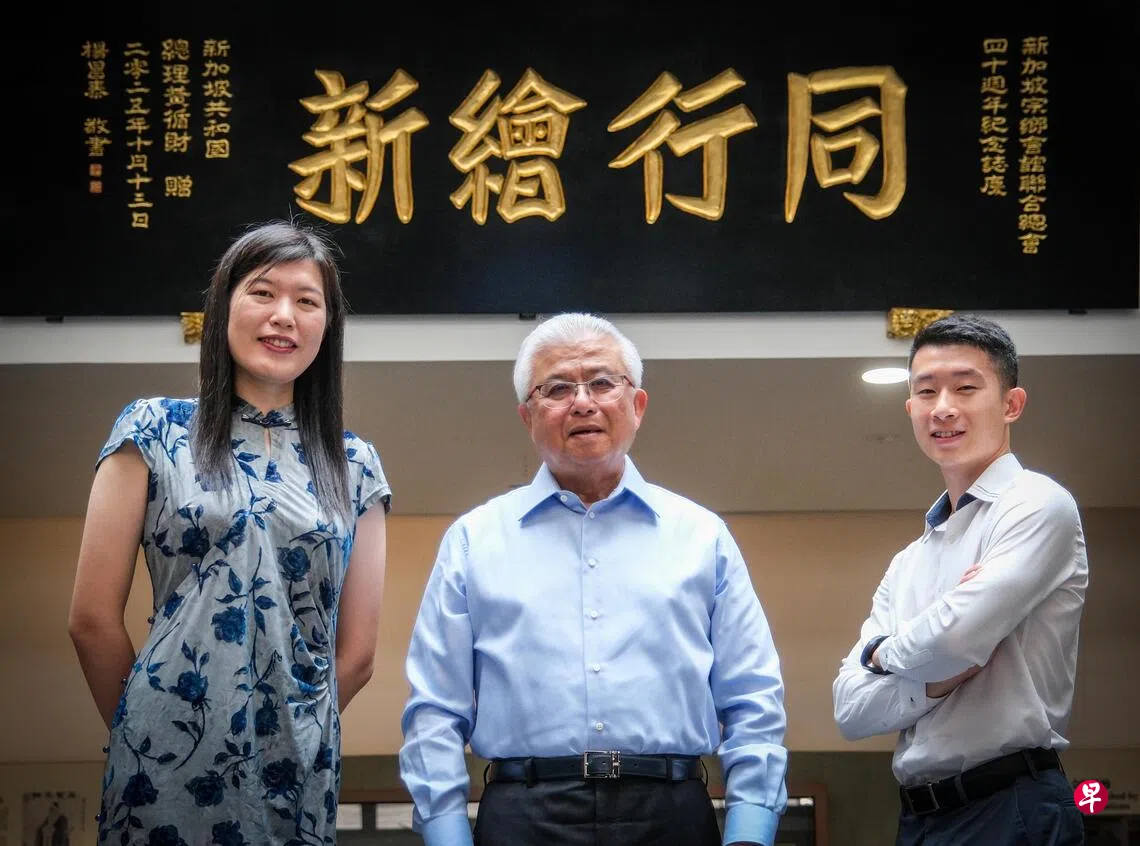
The Singapore Federation of Chinese Clan Associations (SFCCA) launched its scholarship in 2011 to support young Singaporeans pursuing further studies in China, nurturing a new generation with bilingual and bicultural skills who can contribute to Singapore society. Fifteen years on, the applicants’ backgrounds and fields of study have become increasingly diverse. Federation president Thomas Chua Kee Seng believes that, in an increasingly complex and diverse international environment, Singapore needs more people who are rooted locally yet have an international outlook.
In an interview, Chua said the SFCCA Scholarship not only encourages young Singaporeans to acquire specialist knowledge in China, but also hopes that studying and living there will deepen their understanding of Chinese culture and society, as well as their own cultural roots and identity as Singaporeans. “We also hope that, with their understanding of both Singapore and China, they will be able to serve as bridges in future, promoting exchanges and understanding between different groups.”
Now in its 15th edition, the scholarship has benefited more than 70 students across over 20 fields of study. Besides previously popular subjects such as Chinese language and literature, international politics and business administration, recipients in recent years have also chosen technology-related disciplines such as robotics engineering and automation.
Scholarship looks beyond Chinese-language grades, says Chua
Chua said selection is not based solely on students’ Chinese language grades. Some recipients come from English-speaking homes, and some are of mixed Malay-Chinese heritage. The scholarship places greater emphasis on applicants’ overall qualities and potential.
Zhu Yixuan, 26, who studied economics and finance at Tsinghua University with support from the federation’s scholarship, now works as a relationship manager at a bank. “Studying in China gave me a deeper understanding of its economy, putting me in a better position to seize opportunities to expand our client base in Greater China.”
Li Yixing, 32, studied in Peking University’s Chinese Department and now teaches in the college section of Hwa Chong Institution. She recalled being inspired by teachers who embodied the spirit of traditional Chinese scholars. For instance, Song Yayun, who taught classical Chinese, would begin each lecture by reciting from memory the entire poem or prose text to be taught that day, including the 2,500-character “Encountering Sorrow”. Zhang Ming, who taught a course on Su Shi, would often appear in a plain, understated traditional long gown and speak with an easy eloquence and gestures that made him seem like Su Dongpo himself, stepping out of the Song dynasty. His students affectionately called him “Master”. These educators from Peking University became her role models in teaching. “Through them, I saw that literature was not a pile of old texts. It is a living tradition that has flowed through the centuries and remains vibrant and alive today. Studying literature can cleanse the mind and lift us above the daily grind, so that we are neither elated by material gains nor saddened by personal setbacks. This is the most precious reward, one that is difficult to measure in material terms.”
Chen Jiongrui, 23, who is studying in Fudan University’s Chinese department, said the federation’s scholarship comes with fewer conditions, giving young people greater freedom to make their own choices. For young Singaporeans hoping to further their studies in China, the funding not only eases their financial burden but also encourages them to pursue their aspirations boldly. After completing his undergraduate degree, he plans to pursue a master’s in cultural studies or East Asian studies in the UK. “In the longer term, I hope to understand China’s cultural contexts and bring that understanding back to the Singapore context, working in cross-cultural exchange or cultural education.”
Tan Pek Nan, 32, studied international political economy at Peking University before earning an MBA at Stanford University. He is now a business director at Blizzard, which is owned by Microsoft. He said his years at Peking University coincided with a surge in China’s digital economy, during which China overtook the US to become the world’s largest gaming market. When the pandemic struck, people could not leave home or meet in person, but could still come together in games. This was a major reason he chose to work in the gaming industry.
Tan said, “The most valuable thing studying abroad gave me was a sense of greater possibilities. I became more open-minded.” This means that, whatever the market feedback, he first considers the cultural reasoning behind it rather than rush to conclusions based on his own standards or limited understanding.
Chua noted that the earliest graduates are now around 35 years old, and many are still building their careers and starting families. He hopes they will have more time and capacity to take part in community service in future. While some recipients are currently pursuing careers overseas, this does not mean they have lost their ties to Singapore. The professional experience, international perspectives and networks they build abroad are also valuable resources. If they choose to return to Singapore, they can bring all this back with them, offering fresh perspectives and broader connections, he said. “For us, this scholarship is a long-term investment in nurturing talent, and its impact cannot be fully apparent at this stage. We hope to see these young people continue to grow in their respective fields and, at different stages of their lives, contribute to Singapore through their expertise, experience and abilities.”
