

During the COVID-19 pandemic, the Attorney-General's Chambers (AGC) received more than 1,300 COVID-related requests for legal advice from the Government in the first half of 2020 alone, almost all of them urgent. Officers across AGC and the Legal Service worked tirelessly together to advise on the formulation of unprecedented measures to contain the pandemic, draft and amend legislation at speed, support enforcement, and ensure that Singapore's response remained consistent with its international obligations.
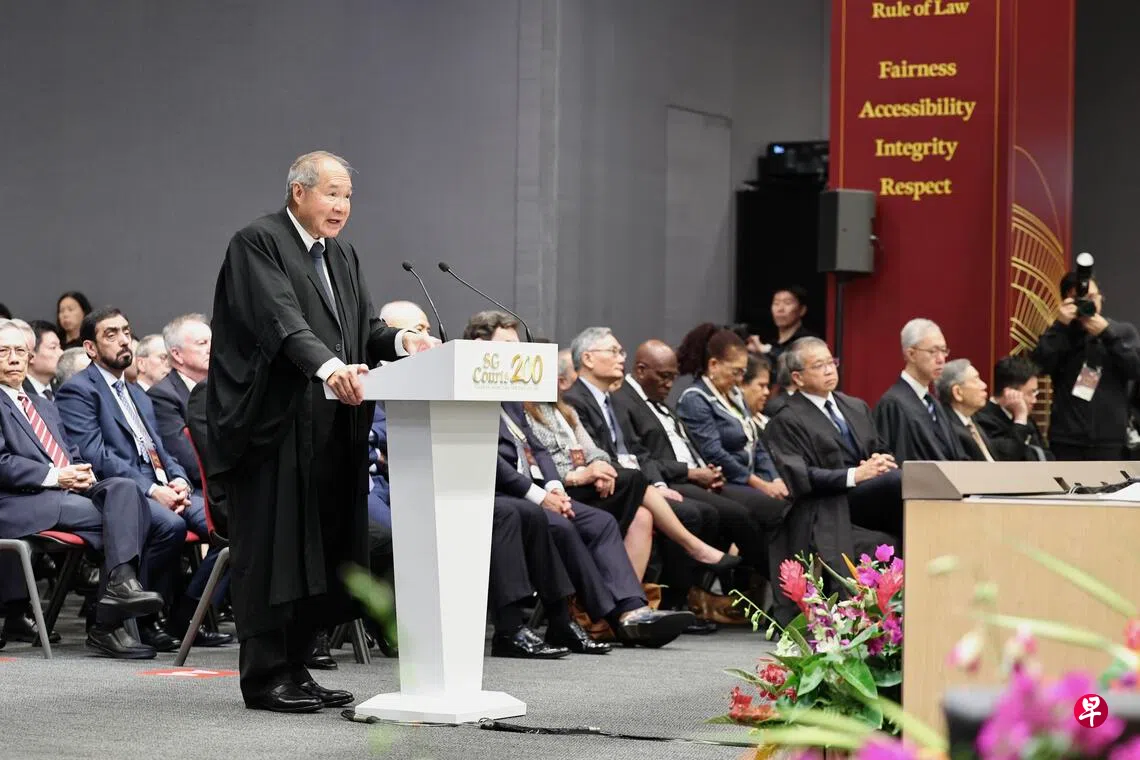
Speaking at a special sitting marking the Singapore Judiciary's 200th anniversary, Attorney-General Lucien Wong said AGC's contribution to the rule of law extends beyond criminal prosecution. Much of its work, though less visible, is integral to upholding the rule of law, including ensuring that the Government acts through lawful authority, follows proper processes and receives objective legal advice.
He said AGC's responsibility is to provide the Government with independent, rigorous and practical legal advice. This includes identifying the legal boundaries within which the Government acts, while helping it find lawful and effective means of achieving its policy objectives. Government decisions engage multiple areas of law and policy, including constitutional and administrative law, commercial and financial law, international obligations, technology and national security.
Wong stressed that the rule of law is not demonstrated only when disputes reach the courts and are adjudicated; it must also be embedded in the ordinary processes of government. The close collaboration between AGC and the Legal Service in providing legal support to help the Government respond to the COVID-19 pandemic illustrates how different areas of law work together.
He said developments in artificial intelligence (AI), digital assets, climate change and geopolitics are making the legal questions confronting the Government increasingly complex. Lawyers cannot address these questions solely by relying on what they learnt at the beginning of their careers. AGC therefore continues to deepen its officers' expertise through training and mentoring, while equipping them to work with new technologies, particularly AI.
What defines success? Young lawyers may have a different paradigm
In his address, High Court Assistant Registrar Elton Tan, 37, shared what he had learnt from conversations with younger lawyers. He found that they generally sought fulfilment, a sense of community and meaning in their careers. Many were already working towards these goals, pursuing their ideals while serving society and advancing the legal profession. He said young lawyers might have a somewhat different paradigm of what success in a legal career looks like.
He cited the example of a young lawyer who began by founding legal technology start-ups, then learnt skills in sales, fundraising and business operations to broaden his career options. He now works on international trade matters at the Ministry of Energy, Trade and Industry, while helping with the adoption of AI. Tan said young lawyers would have more opportunities to combine their interests and expertise in exploring diverse career paths.
Senior Counsel Michael Hwang, 83, also told the sitting that the Law Society of Singapore, recognising the value of senior practitioners to the legal community, had recently formed a committee to guide lawyers in their 50s in planning how to continue practising or remain involved in legal work after 60. The committee also promotes the sharing of experience through senior practitioners mentoring younger lawyers.
Law Society president and Senior Counsel Tan Cheng Han said in his address that training, especially that of young lawyers, was even more crucial as the legal profession faced transformation and change. He said young lawyers' growing reliance on AI tools could leave them with fewer opportunities to think independently and develop professional judgement. Senior lawyers should devote time and energy to nurturing the next generation to ensure the profession's continued development.
