

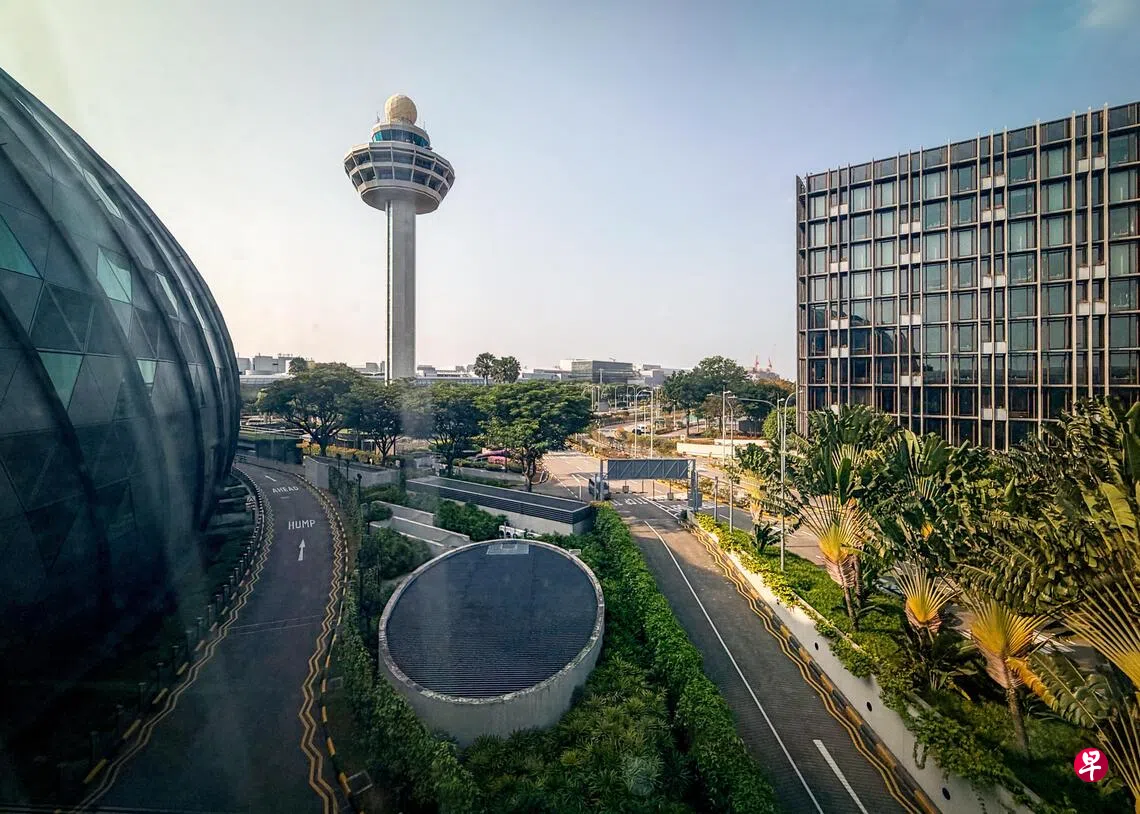
It is a relatively rare profession in Singapore, with only about 500 people nationwide doing the job. They do not necessarily work in airport control towers, but every day they shoulder the responsibility of directing aircraft take-offs and landings, coordinating air traffic and ensuring flight safety. They are air traffic control officers.
One of the world’s busiest airports, Changi Airport served nearly 70 million passengers last year and handled 374,000 aircraft movements. About 7,000 flights operate from the airport weekly, equivalent to an aircraft taking off or landing every 90 seconds on average. Behind this busy traffic are air traffic control officers (ATCOs), who coordinate and direct flights to keep them safe and orderly.
With Changi Airport Terminal 5 expected to open in the mid-2030s, flight and passenger traffic are set to increase further. The Civil Aviation Authority of Singapore (CAAS) plans to hire 200 more ATCOs, expanding its current pool of about 500 by roughly 40% to 700 to meet future demand.
To attract more people to the profession, CAAS began offering a S$20,000 sign-on bonus in June this year. It is also actively reaching out to students and mid-career jobseekers through job fairs, industry events and targeted outreach efforts to build a strong pipeline of talent. Recruitment is ongoing.
The job carries considerable responsibility and requires rigorous training. However, ATCOs do not necessarily need an aviation background. Applicants who hold a diploma or degree and meet the relevant aptitude and medical requirements have an opportunity to enter the profession. An ATCO can earn about S$120,000 per annum with five years of experience after obtaining an air traffic control licence.
No aviation background needed as CAAS provides training
Vincent Hwa, director of air traffic services at CAAS, told Lianhe Zaobao in response to queries that no specific field of study is required. Individuals from diverse academic and professional backgrounds can pursue a career in air traffic control.
During selection, candidates are assessed holistically on their cognitive ability, situational awareness, decision-making and communication skills. They must also pass a prescribed aviation medical assessment, which covers physical and emotional health, vision and hearing.
ATCOs undergo about 18 months of training, including theory lessons, simulator training and on-the-job training, to attain their air traffic control licence and qualify to operate some positions independently. As they gain operational experience, they undergo further training to qualify for additional positions, which takes about another nine to 12 months to complete.
Round-the-clock service requires shift work, but resignation rate remains low
Air traffic services operate 24 hours a day, all year round, so ATCOs rotate across three shifts a day, with each shift lasting between 8.5 and 10 hours. During a shift, each working session lasts between 1.5 and two hours, followed by a scheduled break. Their working hours average no more than 42 hours a week.
In terms of career progression, ATCOs can aspire to become watch managers and supervisors. Beyond operations, they can also take on roles in training, safety management, operations planning, technology development and international leadership.
Despite the shift work and considerable responsibility, staff turnover in the profession is low. Hwa said most ATCOs continue working until they retire at 64. The resignation rate has remained consistently low, averaging about 1.5% over the past three years.
“The youngest and oldest ATCOs are 24 and 69 years old respectively.”
Hwa also explained that air traffic control has three streams: aerodrome, approach and area.
Aerodrome controllers at the Changi Airport and Seletar Airport control towers manage aircraft and other vehicular movements on the ground, including directing aircraft to push back from their parking stands, taxi to designated runways and take off. They also manage air traffic within three nautical miles of the airport, ensuring proper separation between aircraft and other vehicles so that take-offs and landings are safely executed.
Approach controllers and area controllers work at the Singapore Air Traffic Control Centre, where they oversee aircraft during the climb, cruise and descent phases of flight. They monitor air traffic using radar and give instructions to pilots, sometimes managing up to 80 aircraft at any one time.
