

ASEAN could become a sizeable economic growth centre in its own right if it harnesses artificial intelligence to transform its economies and steadily broadens access to AI tools and capabilities over the next 10 to 20 years, driving growth and raising productivity.
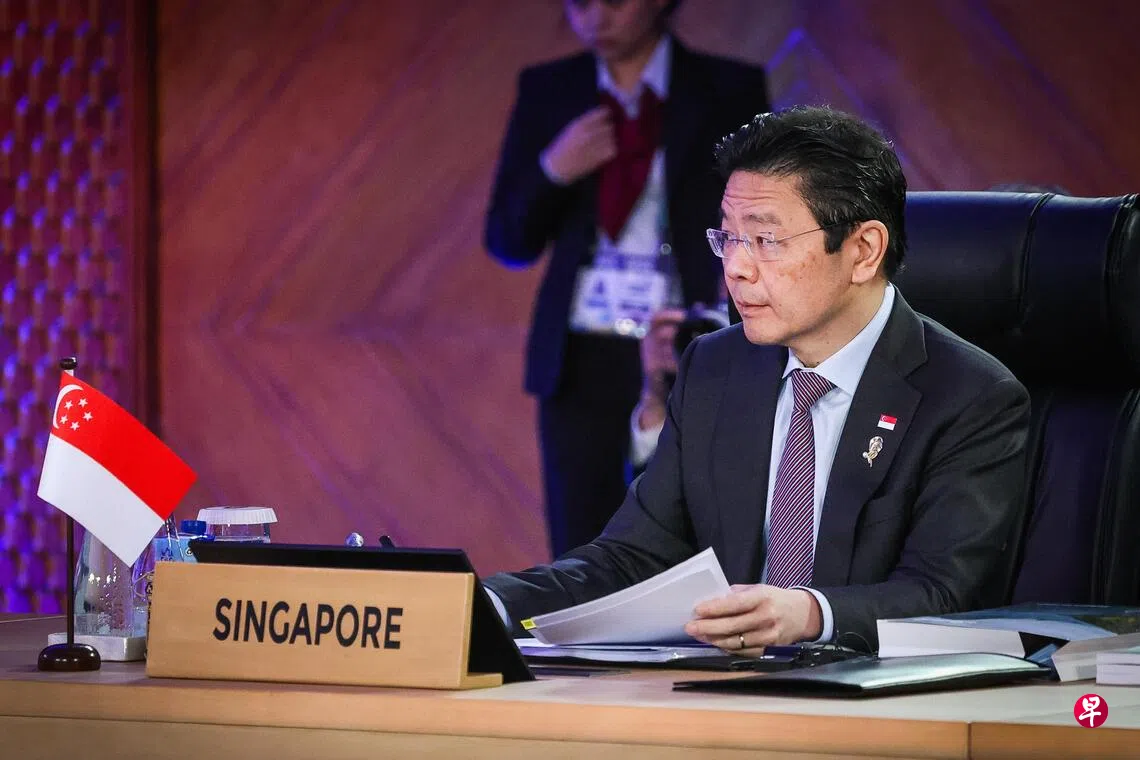
Prime Minister and Minister for Finance Lawrence Wong said at the plenary session of the 49th ASEAN Summit in Manila on Sunday (15 November) that, amid continuing global turbulence, ASEAN must remain united, deepen regional integration and advance practical cooperation on issues that matter to its people.
Wong noted that ASEAN’s economy has grown by about 4% to 5% a year in recent years. As International Monetary Fund Managing Director Kristalina Georgieva said at the summit, this was a good performance, exceeding the global average or expectations.
Lawrence Wong said ASEAN still has the potential to achieve faster, more substantial growth. One of its priorities is to broaden access to artificial intelligence (AI) tools and capabilities to drive economic growth, raise productivity and transform its members’ economies.
“If we can do so consistently over the next 10 to 20 years, we can make ASEAN a sizeable and considerable growth centre in our own right.”
ASEAN economic ministers signed the ASEAN Digital Economy Framework Agreement (DEFA) on Saturday (14 November). Philippine President Ferdinand Romualdez Marcos Jr. presented the agreement to ASEAN Secretary-General Kao Kim Hourn at the summit’s opening ceremony on Sunday.
The agreement covers nine areas: digital trade; cross-border e-commerce; digital identity and authentication; electronic payments; data protection and privacy; cybersecurity; competition policy; data and innovation; and stronger cooperation in emerging technologies such as artificial intelligence.
Wong said signing DEFA was only the first step. ASEAN should build on the agreement to connect its members’ digital economies, enabling businesses to operate more seamlessly across borders and reap the full benefits of a single regional market.
He noted that cross-border payments could be a priority for the next phase of practical cooperation. Singapore has established bilateral payment system linkages with Malaysia and Thailand. ASEAN could expand these into a regional cross-border electronic payment network, making transactions easier and cheaper for businesses and individuals, including tourists and those sending money home.
A resilient digital economy needs trusted, secure systems to support it. Wong said ASEAN should strengthen regional coordination to tackle cyber threats and online scams together.
Praise for Philippine lead in bringing dialogue partners together to combat online scams
He praised the Philippines for taking the lead at the East Asia Summit in drawing up a leaders’ statement on strengthening efforts to combat online scams and related crimes. The statement aims to spur joint action by ASEAN’s 11 members and dialogue partners, including the US and China, against the threat of transnational telecommunications and online scams.

As ASEAN countries accelerate their adoption of digital technology and artificial intelligence, economic activity will also drive greater demand for energy and electricity. Wong said the impact of recent developments in the Middle East had further underscored the importance of energy security, and ASEAN must strengthen its collective capacity to respond.
He hoped member states would ratify the ASEAN Petroleum Security Agreement (APSA) as soon as possible to respond jointly to energy crises, and prioritise the development of the ASEAN Power Grid as part of their shared agenda.
APSA is a regional cooperation mechanism for ASEAN to address disruptions to oil and gas supplies. It enables member states to share information, coordinate emergency measures and provide mutual assistance on a voluntary basis during supply crises. The current framework was signed in 2025 and is still awaiting ratification by member states.
Philippine President Ferdinand Romualdez Marcos Jr. also stressed at the ASEAN Leaders’ Retreat that ASEAN must strengthen regional energy connectivity, diversify energy sources, accelerate the development of renewable energy, and make energy systems more reliable and affordable.
He said regional projects such as the ASEAN Power Grid had laid an important foundation for these plans. “The question now is: How do we translate these commitments into greater resilience on the ground?”
Besides deepening internal integration, Wong also called on ASEAN to expand its circle of friends and network of partners. He noted that ASEAN had previously been an arena for proxy rivalry between major powers, had experienced the resulting hardships and did not want to repeat that experience.
“we should continue to reject zero-sum competition and engage with all major powers and ensure that they have stakes in a peaceful, open, and inclusive region.”
