

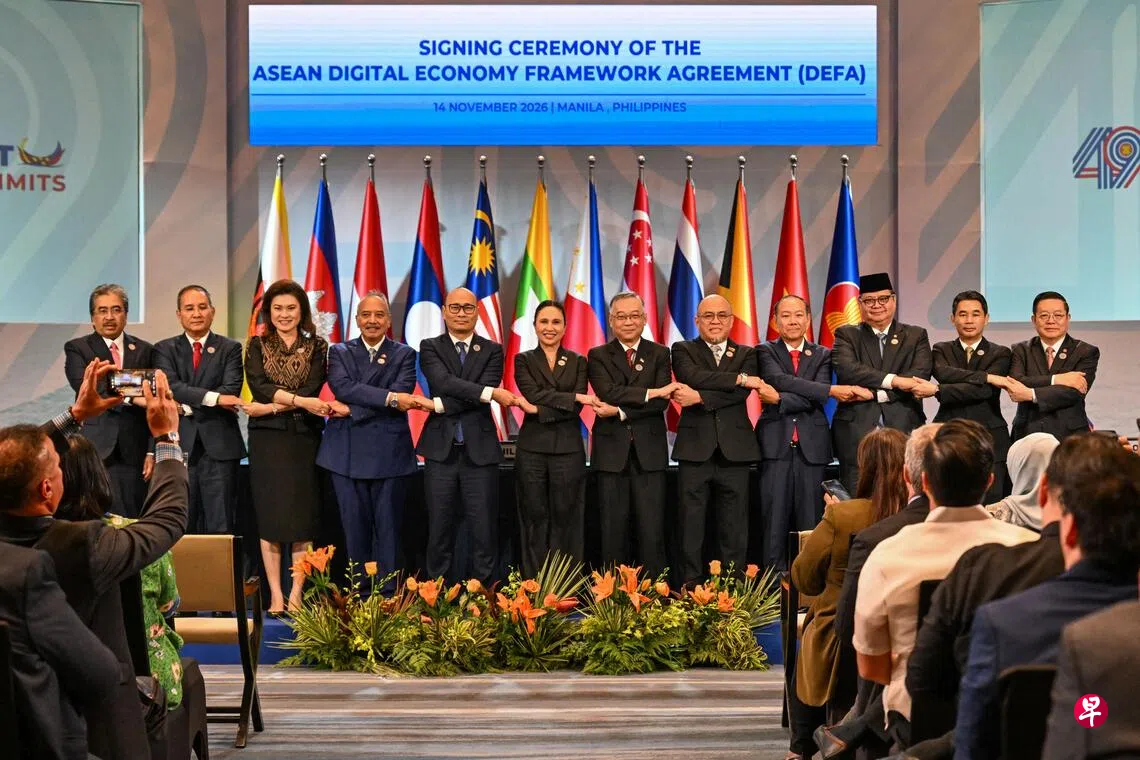
After nearly three years of negotiations, ASEAN member states have signed the ASEAN Digital Economy Framework Agreement (DEFA) in the Philippines, establishing common rules and frameworks for the region’s cross-border electronic transactions, digital payments and data flows, among other areas.
The DEFA is expected to reduce administrative procedures and costs for businesses operating across borders, while creating a more trusted and resilient digital environment so consumers can transact online with greater confidence.
Singapore’s Deputy Prime Minister and Minister for Energy, Trade and Industry (Trade) Gan Kim Yong attended the 28th ASEAN Economic Community Council Meeting with representatives from ASEAN countries in Manila on Saturday (14 November) and signed the agreement.
According to a statement from Singapore’s Ministry of Energy, Trade and Industry, DEFA is ASEAN’s first standalone, legally binding digital economy agreement. It lays the foundation for deeper regional digital economic integration and gives businesses opportunities to participate in the region’s expanding digital market. The agreement will enter into force 180 days after signing, with ASEAN moving next to implement its commitments.
The agreement covers nine areas: digital trade; cross-border electronic commerce; digital identities and authentication; electronic payments; data protection and privacy; online safety and cybersecurity; competition policy; data and innovation; and cooperation on emerging areas and technologies such as artificial intelligence.
Based on its members’ combined economic output, ASEAN is expected to become the world’s fourth-largest economy by 2030. The digital economy is an important area of regional growth. A study released by ASEAN in 2023 projected that the region’s digital economy would approach US$1 trillion (about S$1.29 trillion) by 2030.
By promoting greater interoperability between national rules and systems, DEFA aims to create a more seamless environment for businesses operating across ASEAN, particularly in sectors such as technology, e-commerce, payments, logistics and supply chains. Micro, small and medium-sized enterprises will be especially well placed to expand across the region. The agreement will also promote wider use of electronic trade documents, electronic signatures and electronic invoicing, reducing paperwork and transaction procedures.
The agreement will also promote interoperability between digital identity systems and encourage countries to strengthen cooperation on data protection, cybersecurity, combating online scams and repairing submarine telecommunications cables, among other areas important to the resilience of the region’s digital economy.
DPM Gan: Implementation is key, with careful and systematic planning needed
Speaking to Singapore media after the meeting, DPM Gan said signing the agreement was only the starting point for the next phase of work. ASEAN is drawing up implementation plans and exploring projects that could be prioritised, in the hope that some will be ready when the agreement takes effect, allowing businesses and the public to benefit sooner.
Projects that could be prioritised include digital payment systems, business digital identities and electronic trade documentation, making cross-border transactions easier and less costly. But Gan pointed out, “The details is always in the implementation, so it is important for us to work through the implementation very carefully and also very systematically.”
Singapore Business Federation chief executive Kok Ping Soon described DEFA as an important milestone in a statement, saying its success would be measured by businesses’ experience on the ground. “Businesses will want to see less paperwork at the border, more seamless digital payments and identities, and trusted data flows that make it easier for companies to operate across ASEAN.”
Ready countries can move first, with room for others to build capabilities
Kristina Fong, a fellow at the ASEAN Studies Centre of the ISEAS - Yusof Ishak Institute, told Lianhe Zaobao that businesses may not experience much difference immediately after the agreement is signed, but would have to wait until it is fully implemented. She said, “Member states will still need time to make the necessary changes to domestic laws and regulations. This [effective implementation] also depends on the respective ASEAN member states’ enforcement capabilities.”
One major implementation challenge is the uneven pace of digital development among member states. DPM Gan noted that countries differed in their infrastructure, regulations and business readiness. However, DEFA will allow countries that are more ready to move first, while keeping the door open for other countries to jump on board as and when they are ready. Member states will also continue helping those not yet ready to build their capabilities.
Compared with the Digital Economy Partnership Agreement (DEPA), which Singapore previously signed with individual countries, DEFA covers the whole of Southeast Asia and has a broader scope. It goes beyond standards and regulatory rules to emphasise building the region’s capabilities in areas related to digital trade, including talent development.
Asked whether DEFA would intensify competition for local small and medium-sized enterprises, DPM Gan said ASEAN economies did compete in some areas but complemented one another in many others, while competition from outside the region was even fiercer. “Our market is really the region and the world. And if the region can become more competitive, Singapore will become more competitive. And if the region is doing well, Singapore will also do well. So I think our future and our fate are tied together.”
