

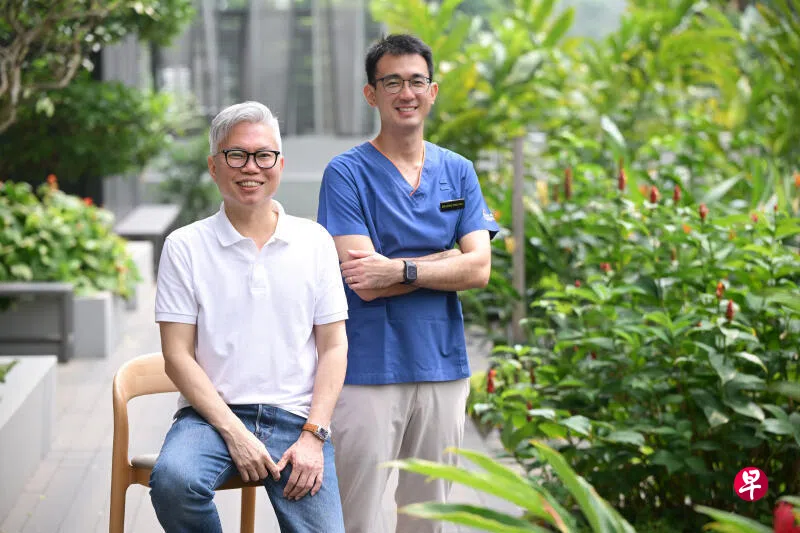
Unable to burp since childhood, a man began suffering severe daily bloating, abdominal pain and constipation in middle age. He was eventually diagnosed with “no-burp syndrome” — and found relief through Botox injections.
Shin Min Daily News reported that Daryl (not his real name), a 52-year-old cybersecurity manager, had been unable to burp since childhood but had never thought much of it. It was only in his 40s, when he began experiencing severe daily bloating, flatulence, abdominal pain and constipation, that he realised his inability to burp was a problem.
He began seeking medical help in 2018 and saw several doctors over eight years, but received differing diagnoses and largely ineffective treatments. Two years ago, he first came across a condition called retrograde cricopharyngeus dysfunction (RCPD) on social media.
He subsequently found an academic paper on RCPD online, written by Dr Leong Zhou Hao, a consultant in the Department of Otorhinolaryngology – Head and Neck Surgery at Singapore General Hospital.
Dr Leong later diagnosed Daryl with RCPD, also known as “no-burp syndrome”.
Dr Leong said the condition is relatively rare and often goes undiagnosed. It was only formally recognised by the medical community around 2019.
Dr Leong explained that people swallow air when eating, drinking or talking. Two sphincters along the digestive tract, one at the top and the other at the bottom, normally remain closed. When a person eats, the sphincters relax to allow food through. Gas produced during digestion often travels upwards, stretching the oesophagus.
“When the brain senses that the oesophagus has been stretched, it triggers the muscles to relax, producing a burp. But for some reason, some people never develop this burping mechanism.”
“According to medical literature, the prevalence of RCPD remains unclear. However, limited preliminary data suggests it may affect as many as 22% of people, with about 13% of those affected experiencing severe symptoms.
“Treatment for RCPD includes injecting botulinum toxin (Botox) into the oesophageal sphincter to help it relax, effectively ‘forcing the patient to be able to burp’.”
Dr Leong said the effects of each Botox injection usually last about three months, but most patients remain able to burp beyond that period. He nevertheless asks patients to “practise” burping so that their condition continues to improve.
About seven months after the injection procedure, Daryl can still burp easily and no longer experiences abdominal pain or bloating. He said with a laugh: “I’ve never felt so at ease. I feel like I’m finally normal.”
For the full report, see the 16 November 2026 edition of Shin Min Daily News.
