

Five days into a trial of a Shibuya-style diagonal crossing at the junction of Joo Chiat Road and East Coast Road, nearby businesses say footfall has risen by as much as 30%, bringing more new customers into their shops. The Land Transport Authority (LTA) is continuing to monitor pedestrians’ use of the junction and will make timely adjustments if needed.
The trial began on Monday (16 November) at the junction outside i12 Katong mall, where Joo Chiat Road meets East Coast Road. When the pedestrian lights turn green, people can cross diagonally as well as straight across.
The trial will last three months. Businesses in the area generally told Lianhe Zaobao during a visit on Friday (20 November) that the arrangement had boosted footfall.
Shopkeeper Chen Hecheng, 53, said the “Little Shibuya” crossing and an earlier car-free day event had drawn crowds to Joo Chiat. Many had come specifically to see the attraction, he said, estimating that footfall and business had increased by 25% to 30%.
Chen Jiaquan, 59, who runs a restaurant near the junction, estimated that footfall had risen by at least 10% to 20%. “With this arrangement, vehicles cannot turn right, so customers and pedestrians feel safer.” But he said business might return to previous levels once the novelty wore off.
Kishore Buxani, chief executive of the Buxani Group, which owns Katong Point, also said many people had come to take photos, but it was too early to say whether this would boost business.
Little Farms chief executive Joe Stevens also noticed more new customers, including tourists from Japan and South Korea. Weekday dinner crowds had also grown noticeably, and he expected the weekend to be even better. Other businesses interviewed also said the weekend would reveal the true impact.
Goh Pei Ming: Early feedback from pedestrians and drivers is positive
Drivers were divided over the new arrangement. Huang Dingxiang, 43, president of the Katong-Joo Chiat Business Association (KJCBA), found that traffic in the area had become smoother since the trial began. He also felt safer driving through the junction and hoped the arrangement would become permanent.
However, retiree Xiao Weini, 77, said the new no-right-turn arrangement had confused some drivers.
Pedestrians, meanwhile, welcomed the more convenient crossing arrangement. Preschool teacher Cai Shuxian, 54, said it saved her considerable time when crossing the road on her way to work.
The reporter observed that pedestrians had to wait about two minutes and 15 seconds to cross at the junction, with about 35 seconds allowed for crossing.
Responding to this, Goh Pei Ming, Senior Minister of State for Home Affairs and Social and Family Development and adviser to Marine Parade-Braddell Heights Group Representation Constituency grassroots organisations, said LTA had studied the crossing time and deemed it sufficient.
“But of course, it’s also part of the three-month trial that we’re looking into how much time is adequate, and we’ll calibrate accordingly. And in fact, I’ve approached LTA not to wait till the end of three months. If there are initial findings that we should adjust, we will tweak within the three-month period.”
He said early feedback from pedestrians and drivers during the trial had been positive. Pedestrians felt safer crossing the road, and traffic was less congested. As for drivers who were not used to being unable to turn right, he said they would need time to adjust and the authorities would continue to monitor the situation.
The reporter found that Google Maps had already updated its directions to reflect the trial measures, routing users along alternative roads rather than directing them to make the previously permitted right turns.
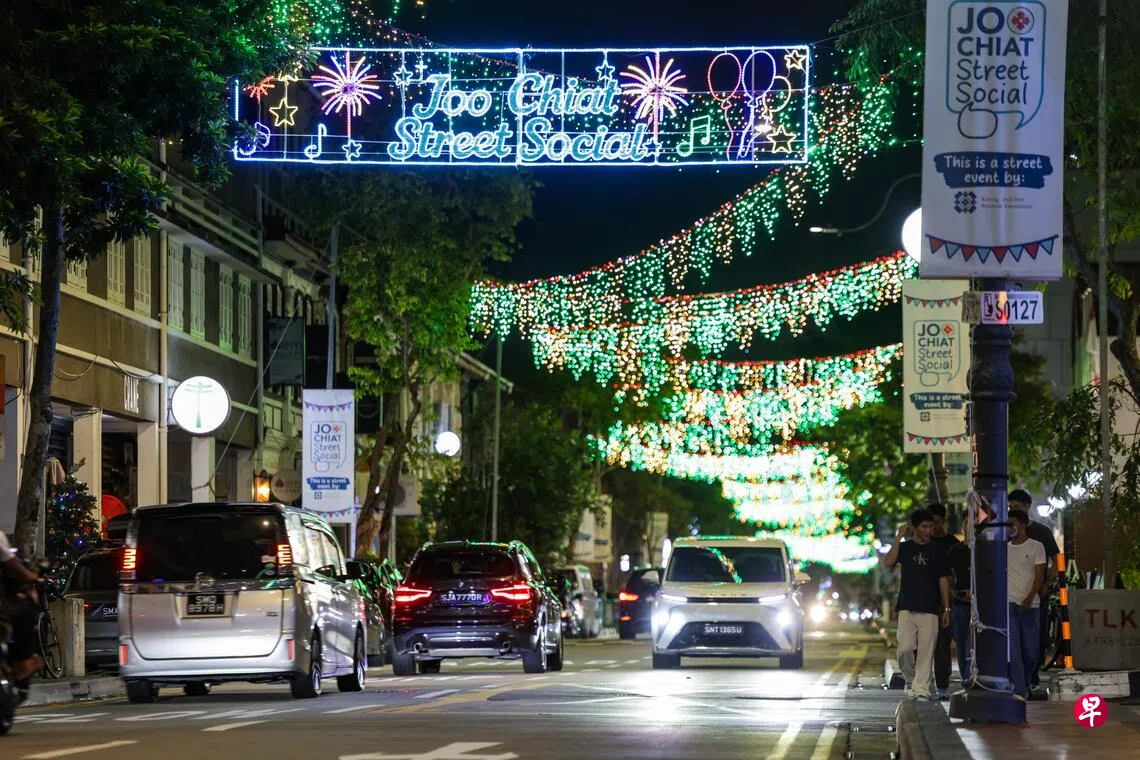
Goh also officiated at the Katong-Joo Chiat Business Association’s year-end festive light-up ceremony on Friday. This is the third time the association has put up festive lights in Joo Chiat. The dazzling display will run until 15 January next year.
