

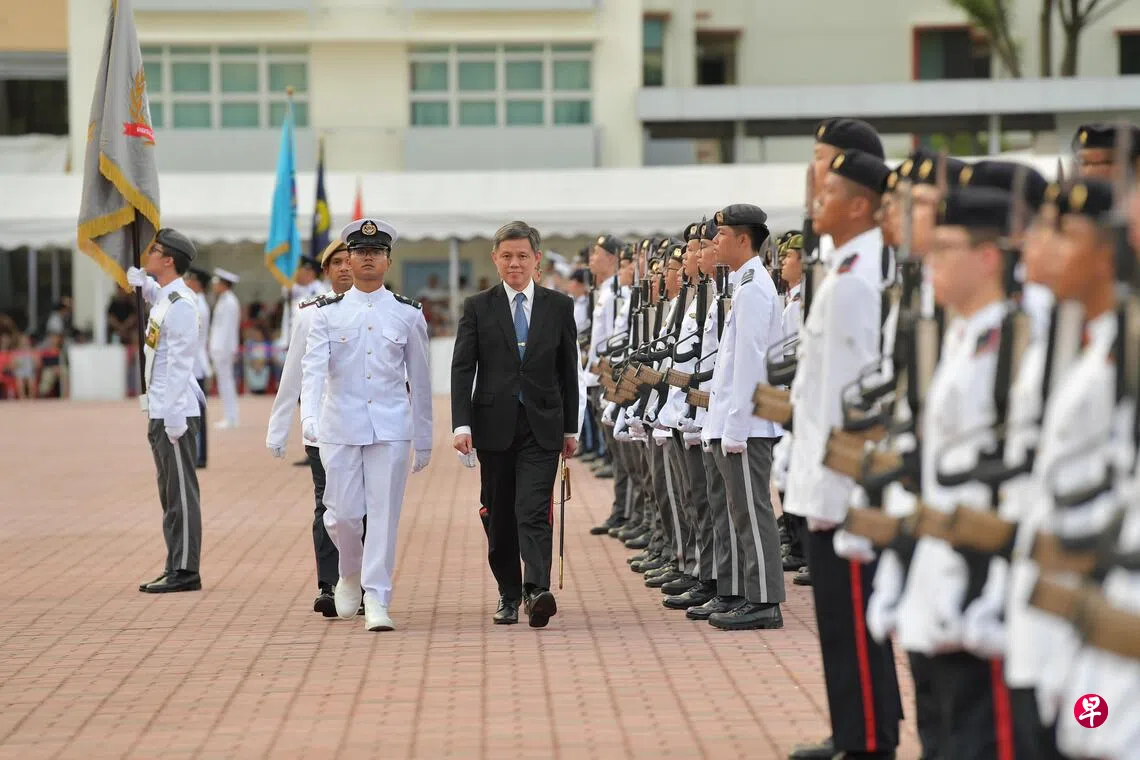
On the modern battlefield, better communications technology, unmanned systems, precision weapons and increasingly advanced technology are giving small combat units greater fighting capabilities. Coordinating Minister for Public Services and Minister for Defence Chan Chun Sing said that although Singapore faces declining birth rates and fewer service personnel, the number trained as officers or specialists will not change significantly, to meet the demand for commanders on a more dispersed battlefield.
Speaking at the Specialist Cadet and Military Expert Graduation Parade at Pasir Laba Camp on Friday (20 November), Chan also said a greater proportion of each generation of national servicemen would take on leadership responsibilities.
He said: “For all of you on parade today, this means something very simple: Singapore and the SAF will need more from each of you, not less. You will have greater technology at your disposal. You may command smaller teams, but you will carry greater responsibilities.”
A total of 958 specialists and military experts graduated from the 22-week course: 760 from the Army, 75 from the Navy, 79 from the Air Force and 44 from the Digital and Intelligence Service. This was also the first time military experts from all four services of the Singapore Armed Forces (SAF) had taken part in the same graduation parade.
Commanders must be able to operate across domains: Chan
Chan also said that warfare is becoming increasingly networked. Commanders can no longer understand only their own weapons systems, units or operational domains; they must be able to operate across domains. The Singapore Armed Forces cannot operate alone either. Military commanders must understand how to work with partners beyond the SAF and contribute to whole-of-government and whole-of-nation operations.
He stressed that the strength of the network depends on whether commanders know how to integrate and deploy these capabilities at the right time and for the right purpose. Commanders should therefore not be content with mastering their own specialities, but must develop a deep understanding of the support other arms and agencies can bring to the battlefield. “The commander who sees only his own part of the battlefield will never make full use of the network and capabilities that we have across the entire SAF.”
Chan also said that today’s battlefield has become a contest over which side can learn and adapt faster. Tactics and doctrine cannot remain static. Commanders must challenge their assumptions through rigorous two sided exercises and learn faster when an opponent defeats them. This is because it is far better to discover our weaknesses in training against a thinking enemy of our own than to discover them in real operations.
He also reiterated that despite the changing landscape, the Singapore Armed Forces’ enduring principles are to look after their people, embrace lifelong learning, live out their values and remember their mission of defending Singapore themselves.
