

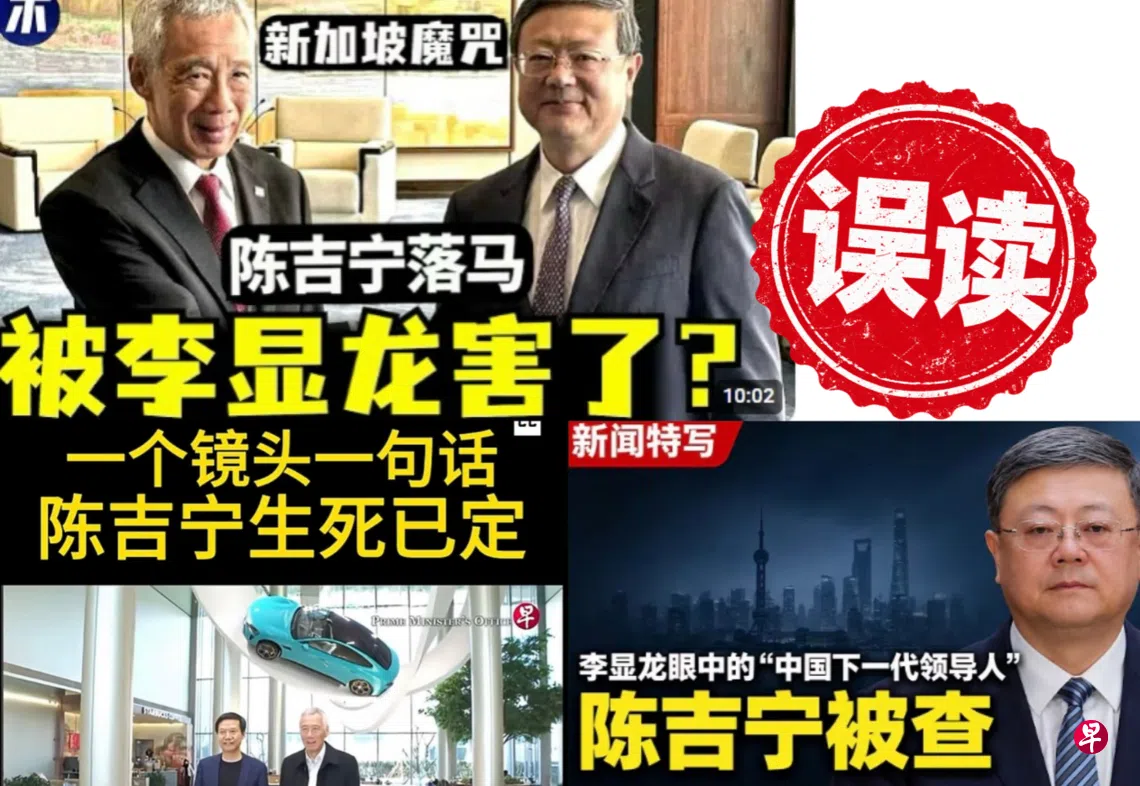
Singapore is being drawn into the discussion again — and this time, Senior Minister Lee Hsien Loong has been dragged into it.
Just two days ago (24 November), Shanghai Communist Party secretary Chen Jining fell from power. Remarks made by Singapore’s Senior Minister Lee Hsien Loong during a visit to China two years ago were soon resurfacing online.
At the time, Lee spoke of his hope to build ties with “the next generation of Chinese leaders”, while the accompanying video showed his meeting with Chen. Many independent social media accounts linked the two, claiming that Lee’s words had “proved prophetic” or even “sealed his fate”.
Yet a review of his full remarks shows that “the next generation of Chinese leaders” did not refer to any one individual. Linking those remarks to Chen’s political future misrepresents their original meaning.
Who did “the next generation of Chinese leaders” refer to?
From 24 to 29 November 2024, Lee made his first visit to China as Senior Minister after stepping down as Prime Minister. Over six days, he visited Suzhou, Beijing and Shanghai, meeting Chinese President Xi Jinping, Chinese People’s Political Consultative Conference chairman Wang Huning and Vice-Premier He Lifeng. In Shanghai, he also met Chen for the first time.
Before the visit ended, Lee gave an interview in Shanghai to the accompanying Singapore media, including Lianhe Zaobao.
A review of the interview transcript by the SPH fact-checking team found that the remarks now being discussed were in response to a journalist’s question: How did his first visit to China as Senior Minister differ from his previous visits as Prime Minister?
Lee replied: “Coming here in this capacity [as Senior Minister], I am able to get a sense of the situation and reconnect with people I knew before. I also hope to establish new links with the next generation of Chinese leaders.”
Notably, Lee answered the question in English, using the phrase “the next generation of Chinese leaders”. The word “leaders” was plural and did not refer to any one leader.
Chinese nouns do not distinguish between singular and plural. While the Chinese translation was not itself inaccurate, it left room for interpretations taken out of context.
Video footage does not establish whom the remarks referred to
Another potential source of misunderstanding is the choice of footage in the news video.
As Lee spoke of “the next generation of Chinese leaders”, the news video showed footage of his meeting with Chen.
Using footage of related events to accompany interview remarks is a common editing practice in news video production.
Lee took only about four seconds to say, “I also hope to establish new links with the next generation of Chinese leaders.” A news video would not normally switch shots repeatedly within such a short span.
Dozens of accounts shared the content
In tracing the timeline, the SPH fact-checking team found that the two-year-old video resurfaced, accompanied by interpretations of it, on the day of Chen’s downfall (24 November). The content first appeared on social media platform X, before also appearing on YouTube.
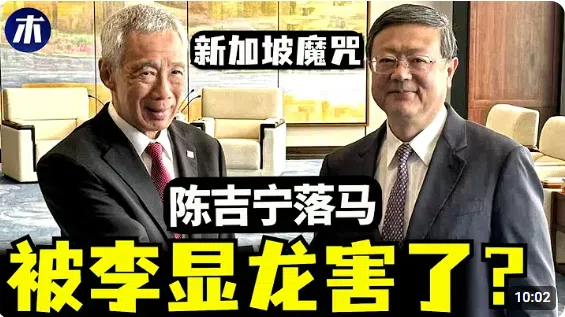
A count found that dozens of accounts on X alone had posted related content. Their follower counts varied widely, from small accounts with just a handful of followers to independent social media accounts with tens of thousands or even more than a million.
Some accounts also broadened the discussion beyond Chen’s political future to Singapore’s diplomacy towards China.
For example, “Teacher Li Is Not Your Teacher”, an X user with more than 2.2 million followers, claimed that Singapore wanted to build ties with China’s “sixth-generation leadership”, but that the Chinese officials it engaged with had run into trouble one after another. YouTuber Xiaomu Tantian even called it the “Singapore curse”.
There is currently insufficient evidence to determine whether these accounts coordinated the dissemination of the content.
