

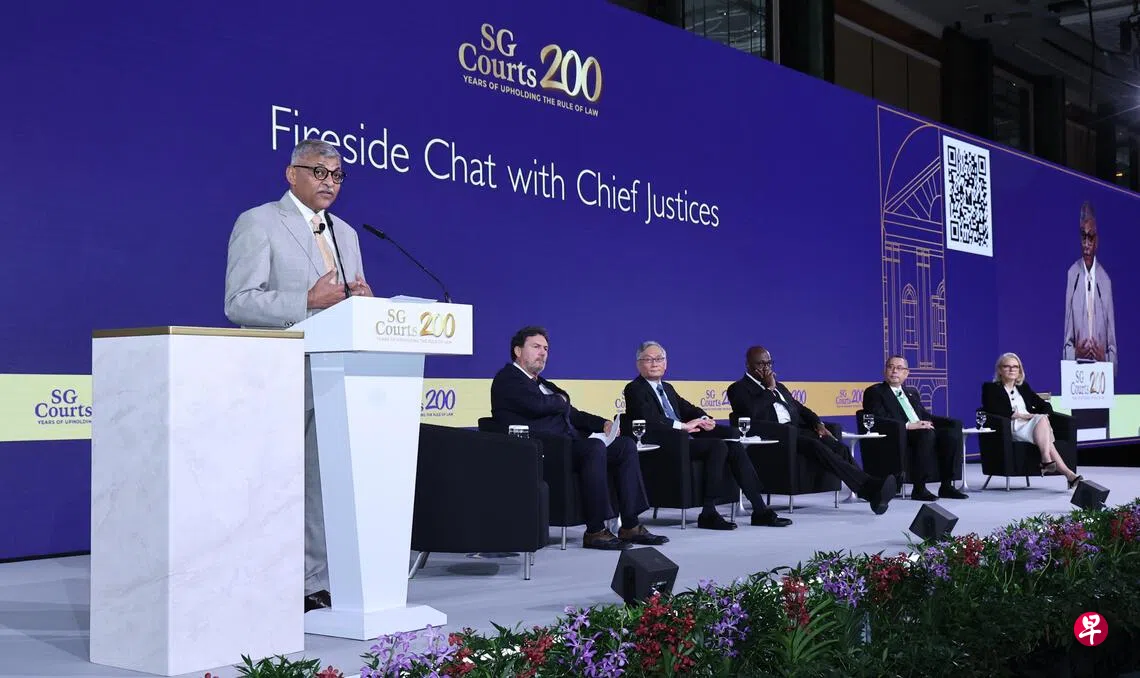
Chief justices from six jurisdictions, including Singapore, stressed that judicial independence is fundamental to the rule of law and must never be subject to improper interference. The rule of law must also deliver tangible benefits to people, rather than remain an abstract ideal or a set of legal provisions. They acknowledged that while artificial intelligence offers opportunities for judicial work, it also poses new challenges to justice systems, judges’ decision-making and judicial efficiency.
Chief justices from Singapore, Canada, Hong Kong, Jamaica, Malaysia and New Zealand took part in a fireside chat held alongside the Global Rule of Law Conference on Thursday (26 November). They shared the challenges facing their jurisdictions and discussed how to further uphold the rule of law and judicial independence.
Singapore Chief Justice Sundaresh Menon said the rule of law is not an abstract ideal, but a practical enterprise. Singapore considers the rule of law as providing a framework, a basis and a foundation for ordered freedom, within which people can live together, pursue their aspirations and resolve their differences peacefully in accordance with the law.
He said judiciaries have a responsibility not only to uphold the rule of law through the adjudication of disputes, but also to ensure that the system as a whole remains sound and effective. Despite differing conceptions of and approaches to the rule of law across jurisdictions, there is much common ground for them to work towards similar ends and learn from one another.
Canada’s Chief Justice Richard Wagner said the latest data from the World Justice Project, an international research organisation, showed that the rule of law had declined in most countries and territories for the ninth consecutive year, while government interference in justice systems had also increased. He noted that safeguarding the rule of law is not simply about ensuring the independence of judiciaries; it is also about making sure the public understands and trusts them.
Malaysia’s Chief Justice Wan Ahmad Farid said judicial independence could be affected by online opinion. If judges worry about the online reaction before delivering an unpopular ruling, judicial independence could be eroded. He stressed that judges’ job is not to chase public approval, but to make the right decisions.
The rise of artificial intelligence will inevitably affect work to uphold the rule of law. Hong Kong’s Chief Justice of the Court of Final Appeal, Andrew Cheung, said generative AI can assist with legal research, case preparation and translation, but also raises questions about accuracy, confidentiality and accountability. For example, some litigants use AI to generate large quantities of inaccurate or irrelevant material for submission to courts, adding to the judicial workload.
New Zealand’s Chief Justice Helen Winkelmann stressed the importance of access to justice. Courts must not serve only the wealthy and large corporations, but must ensure that all sections of society have access to fair legal protection.
Jamaica’s Chief Justice Bryan Sykes said the judiciary must take account of the country’s history and social circumstances to make the principles of judicial independence and impartiality real and effective in people’s daily lives. It must also improve court processes to strengthen accountability and efficiency.