

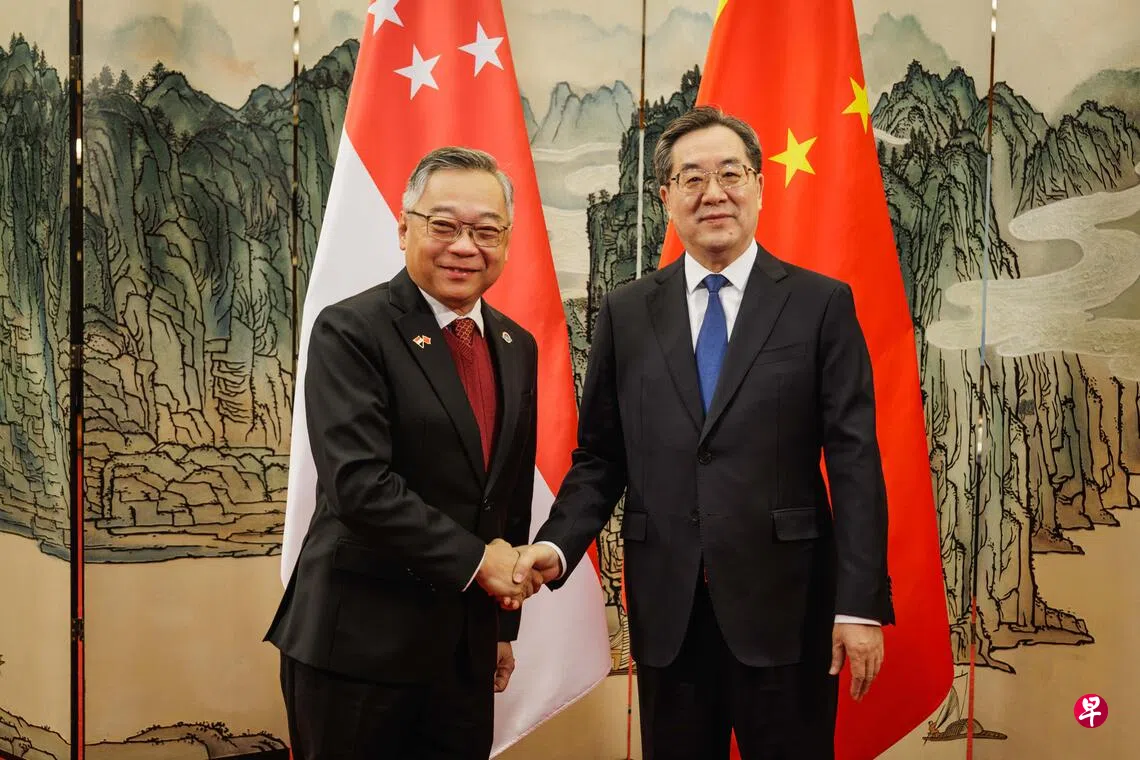
Chinese Vice-Premier Ding Xuexiang will visit Singapore from Sunday and co-chair the latest Joint Council for Bilateral Cooperation meeting with Singapore Deputy Prime Minister Gan Kim Yong. The meeting is expected to yield more than 20 outcomes.
During bilateral talks with Chinese Premier Li Qiang in Beijing on Saturday (21 November), Singapore Prime Minister Lawrence Wong said of the upcoming Joint Council for Bilateral Cooperation (JCBC) meeting: “At the JCBC, we expect to conclude more than 20 deliverables spanning areas like trade, digitalization and financial integration to research and innovation in the health care and education industries and that reflects the depth and breadth of our cooperation.”
According to a statement from Singapore’s Prime Minister’s Office, Ding, a member of the Communist Party of China’s Politburo Standing Committee and Chinese Vice-Premier, will make a two-day official visit to Singapore from Sunday (22 November) at the invitation of Deputy Prime Minister and Minister for Energy, Trade and Industry (Trade) Gan Kim Yong. The two will co-chair the 22nd JCBC meeting on Monday (23 November).
This will be the third time DPM Gan and Ding have co-chaired the meeting as the Singapore and Chinese co-chairs respectively. The previous meeting was held in Chongqing, China, in December last year.
The JCBC is the highest-level annual bilateral cooperation platform between Singapore and China. Its inaugural meeting was held in 2004, and meetings have since alternated between the two countries to review practical cooperation and chart its future direction.
This year’s JCBC theme is “Innovating Together for New Opportunities”, reflecting both countries’ commitment to deepening cooperation and exploring new areas of growth for mutual benefit.
Besides the JCBC meeting, DPM Gan and Ding will also co-chair the Joint Steering Council (JSC) meetings for the three government-to-government projects: the Suzhou Industrial Park, the Tianjin Eco-City and the China-Singapore (Chongqing) Demonstration Initiative on Strategic Connectivity. The JSC meetings will review progress on these three flagship projects and discuss how to take them forward.
DPM Gan will also hold a bilateral meeting with Ding on Monday and host a welcome lunch for him and his delegation.
During his visit, Ding will also meet PM Wong and Senior Minister Lee Hsien Loong.
In a bylined article titled “Innovating Together for New Opportunities”, published on the Prime Minister’s Office website on Sunday, DPM Gan echoed this year’s JCBC theme, saying the two countries’ willingness to innovate together was an important factor in the continued development of their partnership.
DPM Gan welcomed the continued progress of the three government-to-government projects, which have kept pace with the times and opened up new areas of cooperation. He wrote: “Today, Singapore-China cooperation has expanded further into areas such as the digital and green economies, health care, biotechnology and third-country markets. We should continue to embrace the spirit of innovating together to seize these new opportunities.”
On science, technology and innovation, Gan said Singapore and China each had their strengths, creating opportunities for their research institutions and businesses to work together on solutions to shared challenges. He said the two sides could further deepen existing cooperation, better align research with business and societal needs, and help bring promising technologies out of the laboratory and into practical use.
On economic and trade ties, DPM Gan said Singapore and China “can build on our close economic and trade links to help businesses commercialise innovations and enter new markets”.
DPM Gan stressed that people were at the heart of innovation, and that Singapore and China had maintained extensive and close people-to-people exchanges, particularly in education and research. “We should encourage continued exchanges between the two sides, enabling participants to gain a deeper understanding of each other’s economies and societies. The networks and connections forged through these exchanges can also develop over time into research and business partnerships, providing lasting impetus for future innovation and cooperation.”
Amid an increasingly volatile international environment, DPM Gan called on Singapore and China to remain steadfast in upholding international law and the rules-based multilateral system. He said the situation in the Strait of Hormuz highlighted the vulnerability of global trade, particularly for open, trade-dependent economies. “Upholding the right of transit passage is vital to all countries, including Singapore and China. Safeguarding these rights and keeping trade flowing serve the shared interests of both countries.”
DPM Gan concluded that by continuing to innovate together and upholding an open, inclusive and rules-based international order, Singapore and China could jointly build a better future for the next generation. “Such a future is worth working towards together.”
