

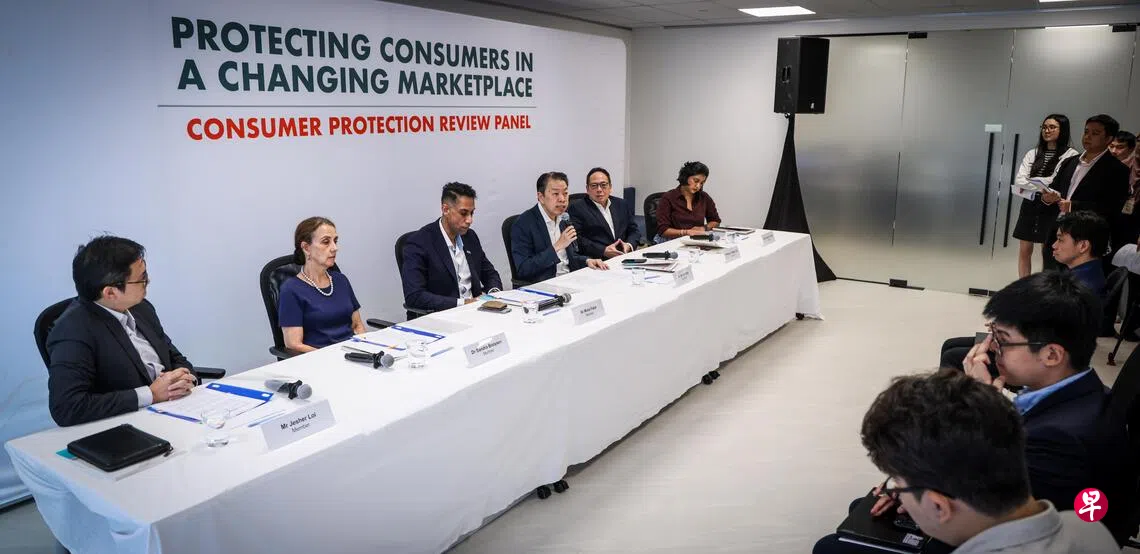
The Consumer Protection Review Panel has submitted seven key recommendations to the government, including mandatory cooling-off periods for prepaid packages in high-risk sectors such as beauty and wellness services; requiring influencers to disclose paid advertising in their social media marketing; and requiring secure digital tickets for large-scale concerts.
The Consumer Protection Review Panel released its report, Recommendations for Singapore’s Consumer Protection and Fair Trading Environment (《新加坡消费者保障与公平交易环境建议书》), at a press conference on Friday (27 November). It submitted the report to the government on the same day, seeking to further strengthen safeguards for consumers and protect them from losses.
The eight-member panel, formed last year, made seven recommendations covering four main areas: e-commerce, prepayment losses and pressure-selling tactics, ticketing for concerts and other entertainment events, and improvements to avenues for redress.
The report drew on surveys and focus group discussions involving more than 8,000 consumers, as well as feedback from nearly 250 business and industry representatives.
Eight in 10 support mandatory cooling-off periods
The survey found that 81% of respondents supported mandatory cooling-off periods to address pressure-selling tactics.
The panel identified beauty and wellness services as a priority, recommending mandatory cooling-off periods for high-value prepaid packages in these high-risk sectors. This would allow consumers to reconsider their purchases once they are no longer under pressure from sales staff. Industry feedback generally indicated that a cooling-off period of five to seven working days would be the most practical.
Last year, the Consumers Association of Singapore (CASE) received 2,113 complaints relating to the beauty industry. Reported prepayment losses reached $2.71 million, up 40.4% from the year before, with 78.6% linked to the beauty industry, largely because of sudden business closures. The panel recommended that CASE work more closely with relevant trade associations and businesses to adopt consumer-centred business practices and strengthen the role of the CaseTrust accreditation scheme.
Stronger oversight of influencer marketing on social media
The survey also found that, as influencer marketing becomes increasingly common, about 80% of consumer respondents had encountered products and services recommended by influencers on social media. They sometimes found it difficult to distinguish personal recommendations from paid promotions, and 72% supported greater accountability for influencers.
The panel therefore recommended that the Advertising Standards Authority of Singapore strengthen its oversight of influencer marketing on social media, requiring influencers to clearly disclose commercial partnerships with advertisers, brands, agencies or sponsors. It also encouraged influencers to voluntarily undergo training to improve their understanding of the relevant rules and requirements.
Panel member Musa Fazal, chief policy and operations officer at the Singapore Business Federation, explained that many influencers were unfamiliar with existing advertising standards. Training could help them better understand marketing requirements, including what information they should disclose when promoting products and services to the public.
Secure digital tickets should take priority for large-scale concerts
In the first 10 months of last year, CASE received at least 722 reports of concert ticket scams, involving losses totalling $615,000.
To combat such scams and opaque ticket resales, the panel recommended that official ticketing providers and organisers prioritise secure digital tickets for large-scale concerts and high-demand events. These tickets should be linked to identity-verified accounts, with two-factor authentication (2FA) and dynamic or real-time refreshing entry codes, rather than paper tickets or static electronic tickets that can easily be copied and resold multiple times.
The panel also recommended accelerating the launch of authorised ticket resale platforms, where buyers can check the original ticket price, resale price and associated fees before purchasing, reducing the risk of ticket fraud and duplicate sales.
To improve avenues for redress, the panel recommended raising the Small Claims Tribunals’ claim limit from $20,000 to $30,000, and the limit for claims heard with both parties’ consent from $30,000 to $60,000. It also proposed expanding the types of eligible claims to cover emerging transactions, including car-sharing services and disputes over vehicle rental deposits.
Melvin Yong, Co-Chair of the Consumer Protection Review Panel and CASE President, said consumer protection should not begin only after consumers have suffered losses. It should keep pace with changes in their shopping habits, payment methods and consumption patterns.
He said the panel’s seven recommendations marked an important shift. “We want consumers to shop with greater peace of mind and spend with greater confidence. A fair and trustworthy consumer environment benefits not only consumers, but also businesses and Singapore as a whole.”
