


Domestic violence cases in Singapore are on the rise, with new cases of child, spousal and elder abuse last year exceeding those in each of the previous two years.
Low- to moderate-risk cases handled by social service agencies also rose from 3,918 in 2023 to 4,686 last year. Child abuse accounted for more than half at 2,476 cases.
The Ministry of Social and Family Development (MSF) released its Domestic Violence Trends Report 2026 on Thursday (29 October), the third year it has published the report.
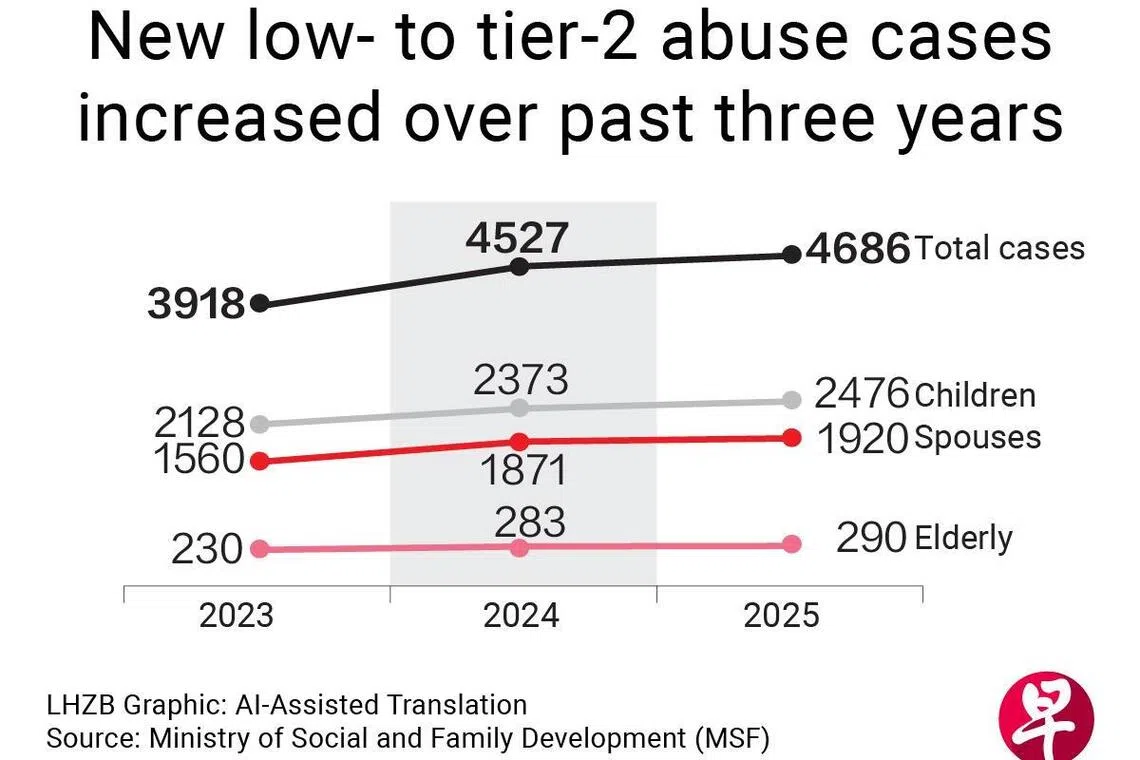
According to the report, low- to moderate-risk child abuse cases have increased for three consecutive years, from 2,128 in 2023 to 2,373 the following year and 2,476 last year.
In 2024, children aged seven to 12 accounted for the largest number of cases last year, at 1,024, followed by children aged six and under, with 765 cases. Among abused children aged seven to 12, boys accounted for more cases, at 547.
Physical abuse was the most common form of low- to moderate-risk child abuse last year, with 1,421 cases, followed by emotional & psychological abuse (562), neglect (317) and sexual abuse (126). Children are defined as those under 18.
Sexual abuse cases classified as low- to moderate-risk are those not serious enough to require intervention by the Protective Service.
One example is an older brother touching his younger sister inappropriately. If the parents remain able to protect the child and prevent a recurrence, social service agencies can follow up and provide support.
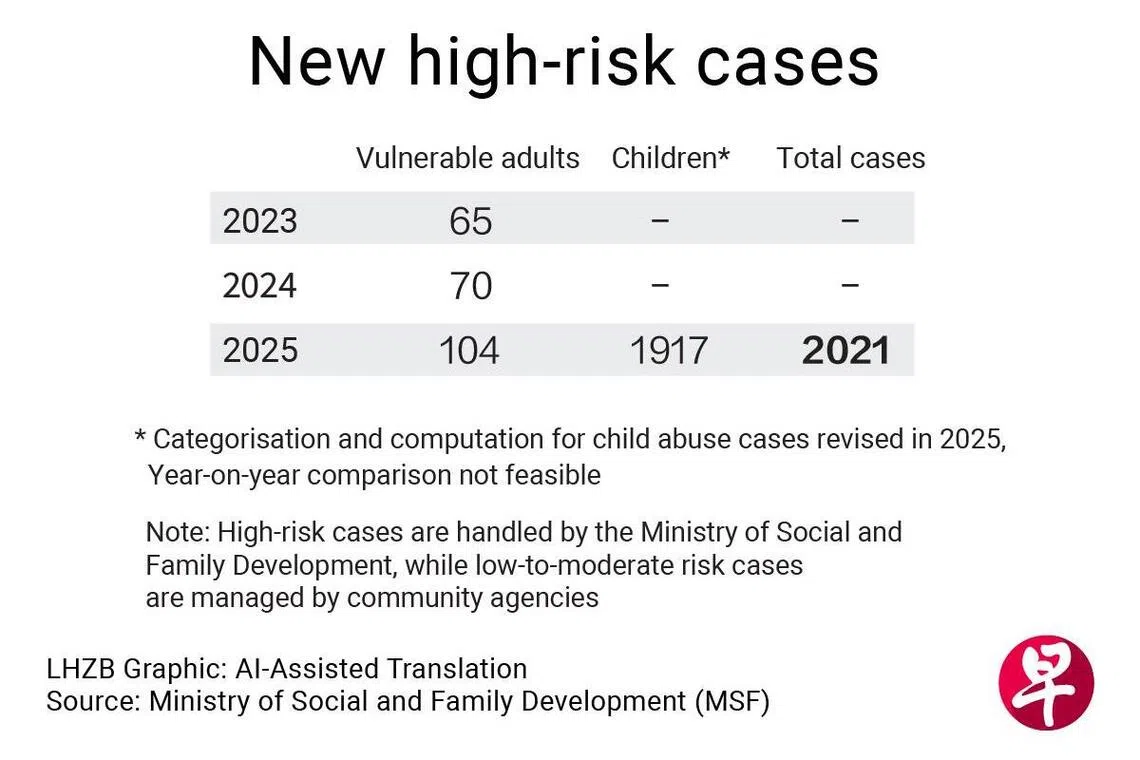
There were 1,917 high-risk child abuse cases last year, around half of which involved children witnessing abuse. Children aged seven to 12 accounted for 721, the largest number of cases.
Physical abuse was the most common form, with 885 cases, many involving excessive corporal punishment by parents.
The report noted that Singapore’s rate of high-risk child abuse remained relatively low overall compared with other countries, at 2.3 per 1,000 children.
There were another 104 high-risk cases of abuse involving vulnerable adults last year, bringing the total number of high-risk abuse cases for the year to 2,021.
Based on preliminary data for the first half of this year, the authorities expect most types of abuse cases, including those involving children and vulnerable adults, to continue increasing year on year.
Reports to domestic violence helpline rise nearly 50%
This year’s report also includes new data on domestic violence response mechanisms, detailing the use of the National Anti-Violence & Sexual Harassment Helpline (NAVH) and the number of interventions by the Domestic Violence Emergency Response Team (DVERT).
NAVH received 16,525 reports last year, nearly 50% more than the 11,068 in the previous year and the highest number since the helpline was launched in 2021.
Following the nationwide expansion of the round-the-clock DVERT in September 2024, the number of incidents it handled also rose from 675 that year to 1,439 last year. It also issued 1,151 Emergency Orders against perpetrators.
The report noted: “As awareness, detection and reporting continue to improve, reported domestic violence cases may remain elevated in the short to medium term . While this may not immediately translate into lower case numbers, it reflects a system that is becoming more proactive at surfacing concerns and connecting those affected to help.”
MSF stressed that the ministry will continue to strengthen upstream preventive efforts, address risk factors earlier and work towards reducing the incidence of domestic violence and preventing repeated and escalation of harm.
The death of four-year-old Megan Khung Yu Wai in 2020, following prolonged abuse by her biological mother and her mother’s boyfriend, drew widespread public attention. The government subsequently introduced several new measures to strengthen child protection.
Report revises counting methodology to avoid double-counting cases
To provide a more consistent and accurate picture, the Ministry of Social and Family Development revised its counting methodology this year.
Previously, for Tier 1 low- to moderate-risk cases of violence against children, all children in the family involved were counted. The new method counts only child victims, excluding children who were neither abused nor witnessed abuse.
For Tier 2 high-risk child abuse cases requiring intervention by the ministry’s Protective Service, only children who were abused or neglected, or who witnessed abuse, are counted. Previously, all children in the family were counted.
The final adjustment prevents cases from being counted twice. Previously, a case could be counted twice if a change in its risk level meant it was handled by both a community agency and the Protective Service within the same year. This year’s report has removed such duplicate records.
To allow comparisons following the change in methodology, the authorities recalculated low- to moderate-risk cases from 2023 onwards using the new method in this year’s report.
However, high-risk child abuse cases in previous years were not broken down into children who suffered abuse and those who witnessed it, making retrospective calculations impossible.
