

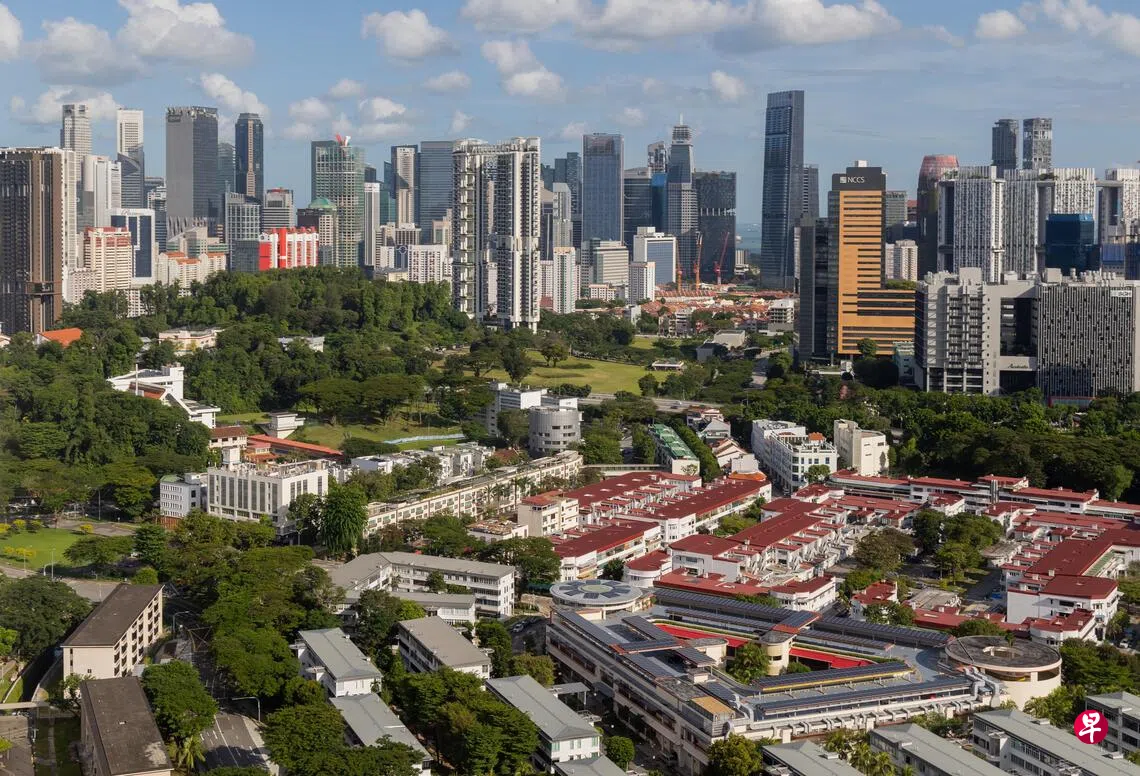
Over the past 10 years, new high-end private housing developments in Downtown Core have attracted many high-income residents, driving significant population growth in the area.
Academics interviewed said incomes among residents in that planning area were sharply polarised: households in private housing largely earned at least $10,000 per member monthly, versus under $2,000 for those in HDB flats, with a notably thin middle segment.
An article titled “A Geospatial Analysis of Singapore’s Resident Population” released by the Singapore Department of Statistics on Wednesday (28 October), showed that household market incomes generally rose across planning areas over the past 10 years.
The highest-income planning areas were mainly in the central region. The Downtown Core planning area topped the country with median monthly household market income per household member reaching $13,396 last year.
Downtown Core’s resident population also grew from 3,710 in 2016 to 6,230 in 2026. Its average annual growth rate of 5.3% was the highest nationwide. The Department of Statistics said this was partly due to adjustments to the area’s boundaries in the Urban Redevelopment Authority’s master plans from 2014 to 2025.
Sing Tien Foo, provost’s chair professor of real estate at NUS Business School, said several private condominium developments, including Wallich Residence, had been completed in Downtown Core over the past 10 years. These homes were popular with wealthy foreigners and commanded prices starting at $3,000 to $4,000 per square foot or more. Local residents who could afford such high-end private homes would necessarily also be high earners.
He noted that no new HDB flats had been built in the Downtown Core for many years. The area’s existing flats were few in number and relatively old, with residents likely to be mainly retirees or older people.
Data showed that in 2025, 68% of households in the Downtown Core had monthly household market incomes of at least $10,000 per household member — the highest proportion nationwide and significantly above the 41.9% recorded in 2015. Meanwhile, 22.8% of households in the area had monthly household market incomes below $2,000 per household member in 2025, close to the 21.2% recorded in 2015.
The middle-income group between these extremes comprised households with monthly household market incomes per household member of $2,000 to $9,999. Together, these households accounted for 36.9% of the total in 2015, falling to 9.2% in 2025.
Academics: Building HDB flats on the fringes makes more sense
Walter Theseira, associate professor of economics at the Singapore University of Social Sciences’ School of Business, said the phenomenon was due mainly to the polarising of housing supply in Downtown Core, with its small number of older HDB flats and more high-end private developments. The same pattern was evident in some other high-income planning areas.
But he pointed out that in Singapore’s context, low incomes did not necessarily mean a low standard of living. Some retired or semi-retired people might have financial resources and might not rely on market income for support.
Asked whether the government should take steps such as launching Prime Location Public Housing projects to ease income polarisation in the area, Sing noted that the government introduced the Prime Location Public Housing model in 2021, followed by a new flat classification framework with Plus and Prime flats in 2024. The aim was to make homes in choice locations affordable to Singaporeans across different income groups through additional subsidies. It was possible that such projects could be built in Downtown Core in future.
“However, Downtown Core is mainly a commercial district, where land is expensive. If Prime flats are built there in future, their numbers are likely to be small, and buyers will likely have to return a larger amount of housing subsidies when they resell their flats.”
Theseira noted that the Downtown Core was also small, with few sites available for HDB developments. Attracting the middle-income group to such a commercial district would also be challenging, as amenities in the area catered mainly to residents of high-end private homes and there is a generally limited access to polyclinics, primary and secondary schools, and affordable preschools.
He said it would likely not be useful to build a small HDB project in the Downtown Core without amenities to serve its residents. “But the Downtown Core itself borders areas with more HDB flats, including Outram and Rochor, so developing sites along its fringes may make more sense.”
Dr Leong Chan-Hoong, head of the Social Cohesion Research Programme at the S. Rajaratnam School of International Studies at Nanyang Technological University, noted that Downtown Core was not currently densely populated. Some food and beverage businesses relied mainly on lunchtime or weekday trade to stay afloat. New HDB projects could revitalise business in the area, while a more diverse mix of public housing options could foster interaction among residents from different economic backgrounds.
