

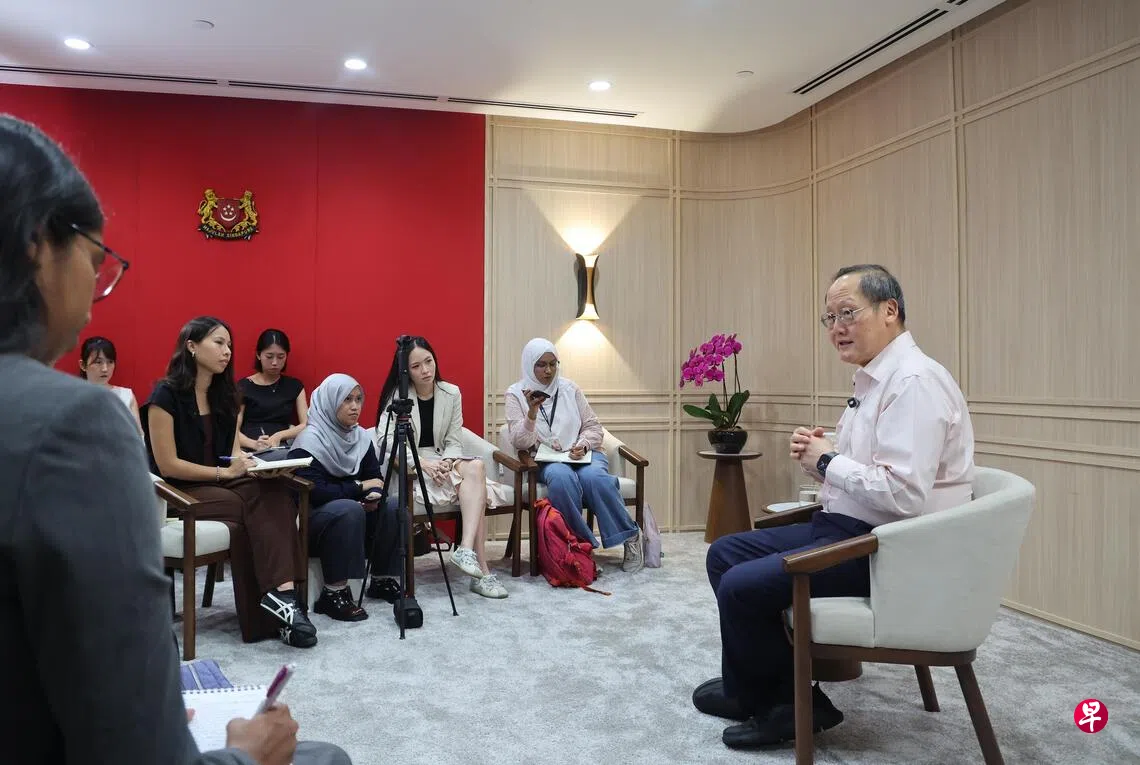
Countries are actively decarbonising their energy sectors to meet collective climate goals. Minister-in-charge of Energy and Minister for Trade and Industry (Energy and Industry) Dr Tan See Leng said no country in the world can go 100% green. It is not realistic to completely diversify away from gas, which makes nuclear energy an exciting potential substitute.
About 95% of Singapore’s electricity comes from natural gas. Speaking in a joint media interview last Friday (13 November), Dr Tan said Singapore would remain heavily reliant on gas for power generation over the next five years. But with the country aiming for net-zero emissions by 2050, gas could account for half or less of its total electricity supply by then.
He said having 40% to 50% of energy come from renewable or clean sources would be sufficient to achieve decarbonisation. In his view, no country can go 100% green in electricity generation.
He explained that renewable energy sources such as solar, wind and hydropower are all constrained by natural conditions. Solar panels, for example, can capture sunlight only during the day and cannot generate electricity during storms or at night. While batteries can store renewable energy, storage systems often require large areas of land.
Dr Tan said: “The max, max, max we can reach is we probably only solve for 10% of all of our power needs.”
He noted that many countries continue to use natural gas or even coal because these fuels provide base load power, maintaining a stable supply under all conditions. “You cannot completely diversify away from gas, and that's what makes nuclear energy so exciting, because nuclear energy can substitute your gas, right?”
In the scenario Dr Tan outlined for 2050, natural gas would account for half of Singapore’s power generation and solar for 10%. The remaining 40% could come from green hydrogen, green ammonia, geothermal energy and nuclear energy.
Nuclear energy has attracted renewed global discussion in recent years, and Singapore is closely monitoring developments. Dr Tan stressed, however, that Singapore has not decided whether to adopt nuclear energy and is studying the option very carefully. “If it does become a reality, then that will contribute a share. I cannot commit as to what it is.”
He noted that the nuclear reactors currently in operation are conventional reactors. The commercial viability of the next generation of small modular reactors (SMRs) has yet to be established, and developments will need to be monitored.
Dr Tan See Leng: No decision yet on nuclear plant site; micro reactor developments being watched
An earlier poll of 1,145 people led by Lianhe Zaobao found that if Singapore eventually decided to build a nuclear power plant using safer SMR technology, 75.4% of respondents would support locating it on an offshore island. Only 1.3% favoured a site on Singapore’s main island. Another 7.5% had no preference over the location, while 15.8% opposed building a nuclear power plant.
On the choice of a site for a nuclear power plant, Dr Tan said: “The obvious choice is as far out as possible... the reason why I cannot give you a straight answer is because they are even smaller modular reactors, they are called micro reactors.”
Micro reactors generally have a power output of no more than 10 megawatts and a smaller footprint than SMRs. They are better suited to areas without access to clean, reliable and affordable energy. If micro reactors become commercially viable, they could offer greater flexibility in deploying nuclear energy.
Dr Tan said developments in nuclear technology should continue to be monitored, from micro reactors potentially no bigger than a shipping container to safer tristructural-isotropic (TRISO) particle fuel.
He said developments in nuclear energy were exciting. Singapore’s challenge was to ensure society was ready, with the next phase of work including the training of local nuclear scientists and engineers.
Singapore plans to undergo a Phase 1 review by the International Atomic Energy Agency next year to determine whether its capability-building efforts are adequate for the possible deployment of nuclear energy in future. The final report, expected next year or the following year, will recommend improvements.
