

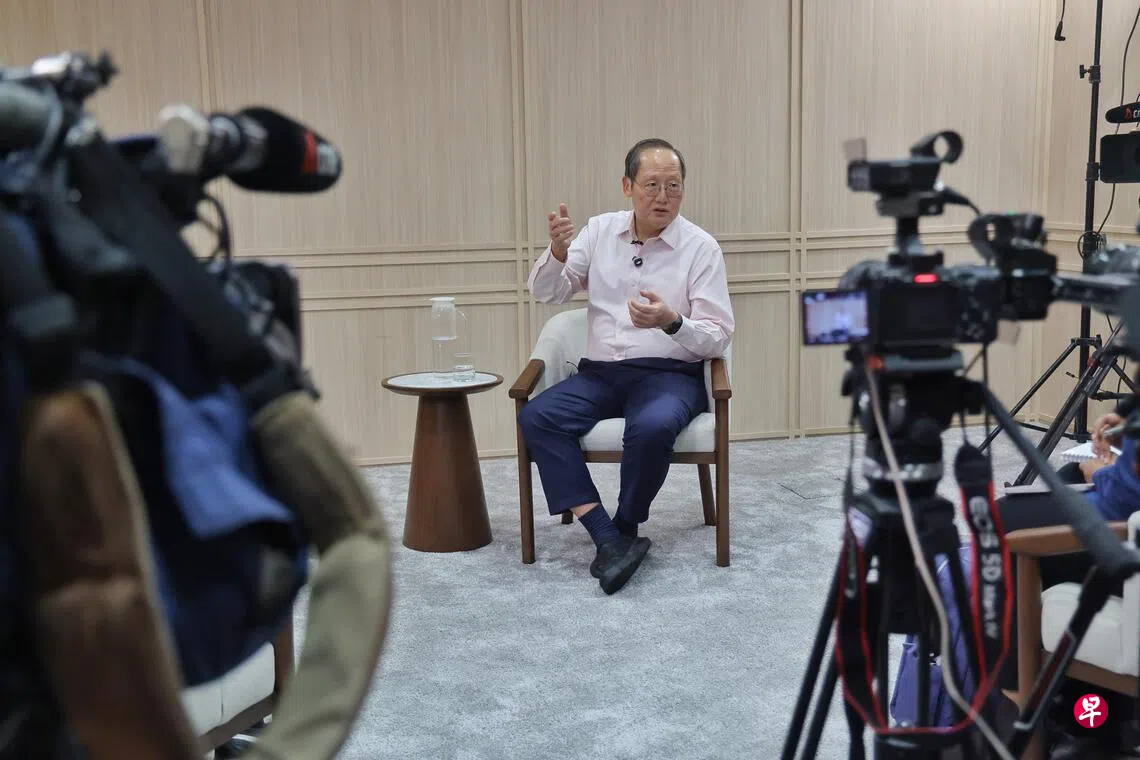
Singapore will continue to diversify its energy sources to ensure a stable electricity supply while working to decarbonise the energy sector. However, Minister for Trade and Industry (Energy and Industry) Dr Tan See Leng stressed that Singapore would not decarbonise at all costs. Keeping electricity affordable and the market competitive remains key.
In a joint media interview, Dr Tan reiterated: “We are very very focused on ensuring that we don't price ourselves out of market, and I think that I don't think any amount of what we say we reassure people. I think the key thingh is to make sure that we put action into our words.”
He said Singapore had set clear benchmarks and used them to build a transparent, trustworthy and consistent framework. This means businesses know what to expect of Singapore’s investment environment when they invest here.
Drawing on his frequent trips abroad to attract investment, Dr Tan said many businesses had told him candidly that Singapore was not the cheapest place in the world to do business. But its stable business environment allowed them to plan for the next ten to 20 years.
By contrast, while energy and land may be cheap in some places, an earthquake, typhoon or power outage could result in losses running into hundreds of millions of dollars. Businesses have to factor these risks into their business plans and account for them to shareholders and directors.
Dr Tan said businesses cannot take the kind of excitement, and what they want is a consistent, safe place. Many business leaders tell him: “The new good is boring.”
Singapore has never subsidised electricity consumption. Instead, businesses and households are required to bear a reasonable marginal cost of electricity, encouraging them to take more active steps to reduce consumption.
Dr Tan said Singapore’s approach was to price electricity based on long-run marginal costs, while offering a range of rebates to ease the burden. “The rebates are very laser focused, very targeted. For those that need the most support, we will give the maximum amount of rebate to them.”
For example, the government announced in April this year that it would expand the Energy Efficiency Grant. Previously limited to six sectors — food services, retail, manufacturing, construction, maritime and data centres — its base tier now covers all industries. The scheme has also been extended by a year to 31 March 2028 so that more companies can benefit.
If costs are low, the ideal is to capture all carbon emissions from natural gas
Carbon capture technology is regarded as an essential tool for decarbonisation, and Singapore is closely monitoring developments and actively pursuing cooperation in this area. Dr Tan said that although the technology had been proven elsewhere, deploying it required sufficient scale.
About 95% of Singapore’s electricity is generated from natural gas. Dr Tan said that capturing carbon emissions from burning natural gas required first pooling and concentrating the emissions further. Increasing the concentration of carbon dioxide would make capture and storage economically viable.
He said Singapore could not commit to how much of its carbon emissions from natural gas it would capture and store in future until it had established the achievable scale and ensured that costs were competitive. “If the cost is very low, ideally I would like to capture all of it.”
However, Dr Tan stressed the need for caution. Alongside safeguarding energy security and pursuing decarbonisation, keeping energy affordable was also a top priority. “We will decarbonise, but we will never decarbonise at all costs...... today, given where we are, the cost is prohibitive.”
