

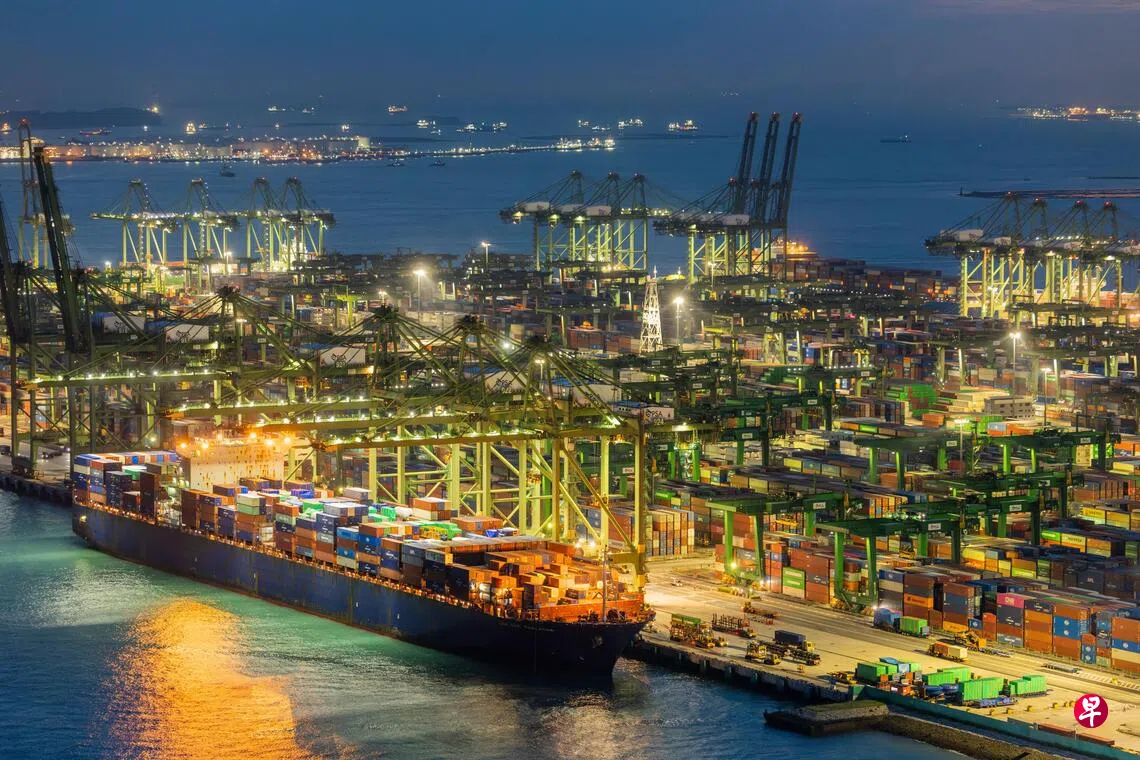
The Maritime and Port Authority of Singapore has stepped up efforts in recent years to diversify sources of marine fuel as it works towards achieving net-zero emissions by 2050. As a member of the International Maritime Organization (IMO), Singapore is also actively involved in discussions on its Net-Zero Framework.
Following approval of the new framework last year at a special session of the Marine Environment Protection Committee in April, the legal text still required approval from the IMO’s nearly 180 member states. It was originally slated for formal adoption at a meeting last October, but discussions were postponed by a year, to a session on Monday (30 November).
How exactly will this framework drive decarbonisation in the global maritime sector? And how will it affect Singapore, one of the world’s largest bunkering ports?
What is the IMO Net-Zero Framework?
It is a set of international regulations designed to reduce greenhouse gas emissions from ships worldwide. The framework uses ships’ greenhouse gas fuel intensity (GFI) as the basis for pricing, charging vessels that exceed emissions limits while rewarding those that use green energy. GFI measures greenhouse gas emissions relative to energy output.
Teo Teng Seng, President of the Singapore Shipping Association, noted that the framework is not simply about the label attached to a fuel. The industry does not yet know which fuels will ultimately achieve the greatest scale across every shipping segment. He said building optionality and capabilities across several credible pathways allows Singapore to adapt as technology, lifecycle emissions performance, availability and economics evolve.
“For Singapore, a workable global framework could therefore strengthen rather than diminish its role, provided Singapore continues to offer safe, competitive and trusted solutions as the global fuel mix evolves.”
How does the framework’s pricing mechanism work?
The framework is intended to apply to all oceangoing ships over 5,000 gross tonnage (GT). These ships are responsible for over 85% of global shipping emissions. The pricing mechanism has four tiers: ultra-low, low, high and ultra-high emissions.
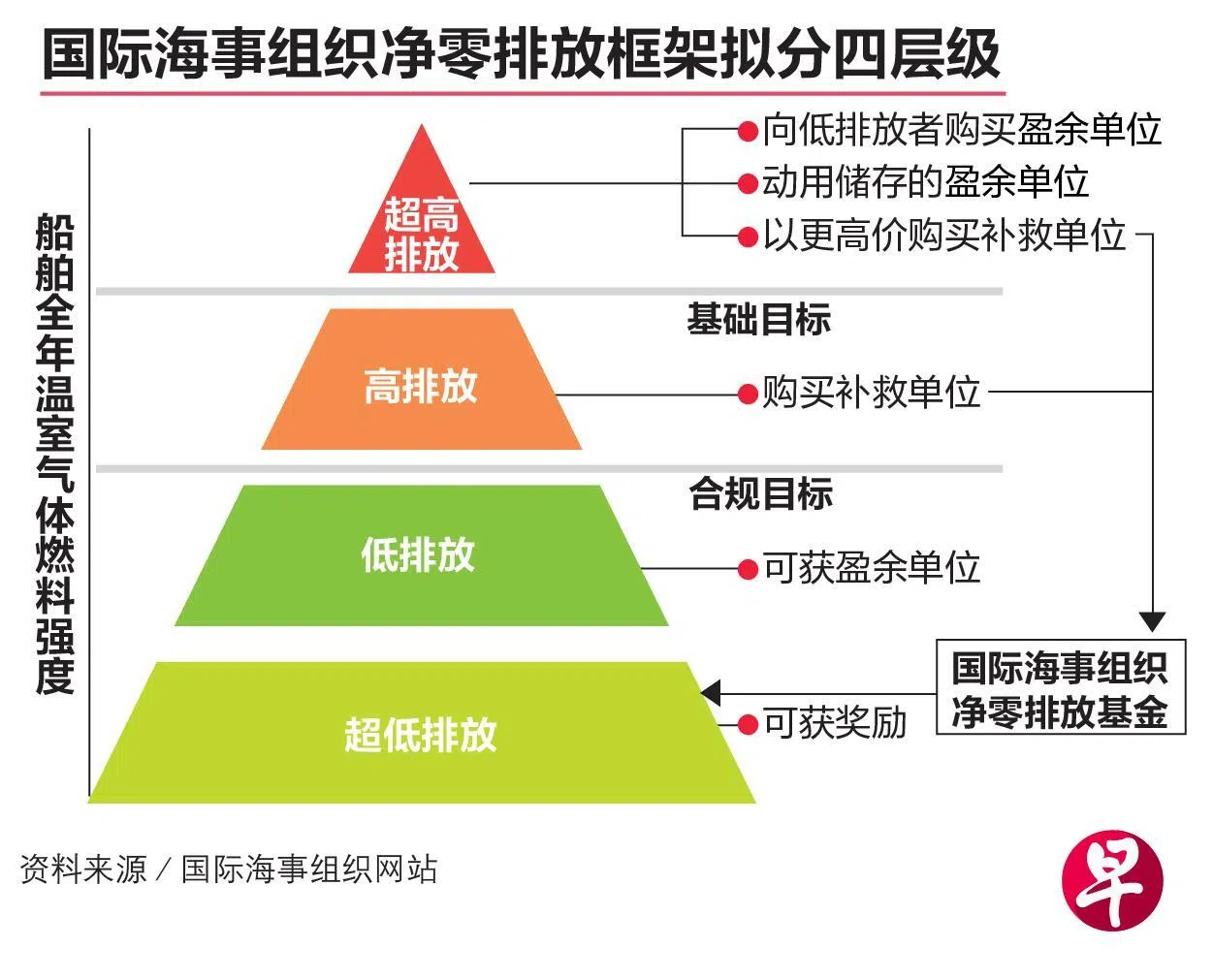
Ultra-low-emission ships can receive financial rewards;
Low-emission ships can earn “surplus units”, which can be banked for up to two years, traded or transferred;
High-emission ships must buy “remedial units” to offset excess emissions, provisionally priced at US$100 (about S$129) per tonne of carbon dioxide equivalent (tCO2e);
Ultra-high-emission ships have three options for offsetting excess emissions: using compliance units banked in previous years, buying surplus units from low-emission ships, or buying remedial units at a higher price. The US$100 per tCO2e rate applies only to a portion of excess emissions; emissions beyond the threshold are provisionally priced at US$380 per tCO2e.
Prof Ng Szu Hui, Research Track Leader for shipping transport and efficiency at the Centre of Maritime Studies, NUS, said rewards and surplus units for ultra-low- and low-emission vessels belong to the ships, rather than the ports or countries they call at. She pointed out that Singapore cannot earn carbon credits itself as a port, but has an opportunity to become the preferred bunkering hub for international vessels, supplying low-carbon fuels that help ships earn rewards or surplus units.
What counts as “ultra-low emissions”?
Ships running entirely on zero- or near-zero-emission fuels generally have a GFI of no more than 19 grams of carbon dioxide equivalent per megajoule (gCO2e/MJ). This is about 80% below the current average of 93.3 grams, placing them in the ultra-low-emission category.
However, the details of the rewards, penalties and standards are still under discussion. If the framework is implemented, the IMO will also progressively tighten the GFI reduction requirements to encourage ships to begin transitioning early.
Ng said in her analysis that, from a practical standpoint, the framework’s compliance architecture is broadly realistic, with only the IMO Net-Zero Fund remaining relatively underdeveloped. The fund will handle the buying and selling of remedial units and the disbursement of rewards. It is expected to manage billions of dollars annually, far beyond the sums the organisation has managed in the past. Member states therefore still need to discuss the fund’s governance, disbursements and reward mechanisms.
When will the framework take effect?
If the framework is adopted at this special session of the Marine Environment Protection Committee, the regulations are expected to enter into force 16 months later. Governments will then be responsible for enforcing them.
Teo said it was too early to speculate on the outcome of the meeting. “From an industry perspective, the important outcome from these negotiations is not simply whether an agreement is reached, but whether the eventual framework provides a credible, practical and sufficiently predictable pathway for the transition.”
He said that although countries’ maritime sectors are developing at different speeds, a clear and unified regulatory framework would benefit the global shipping industry.
