

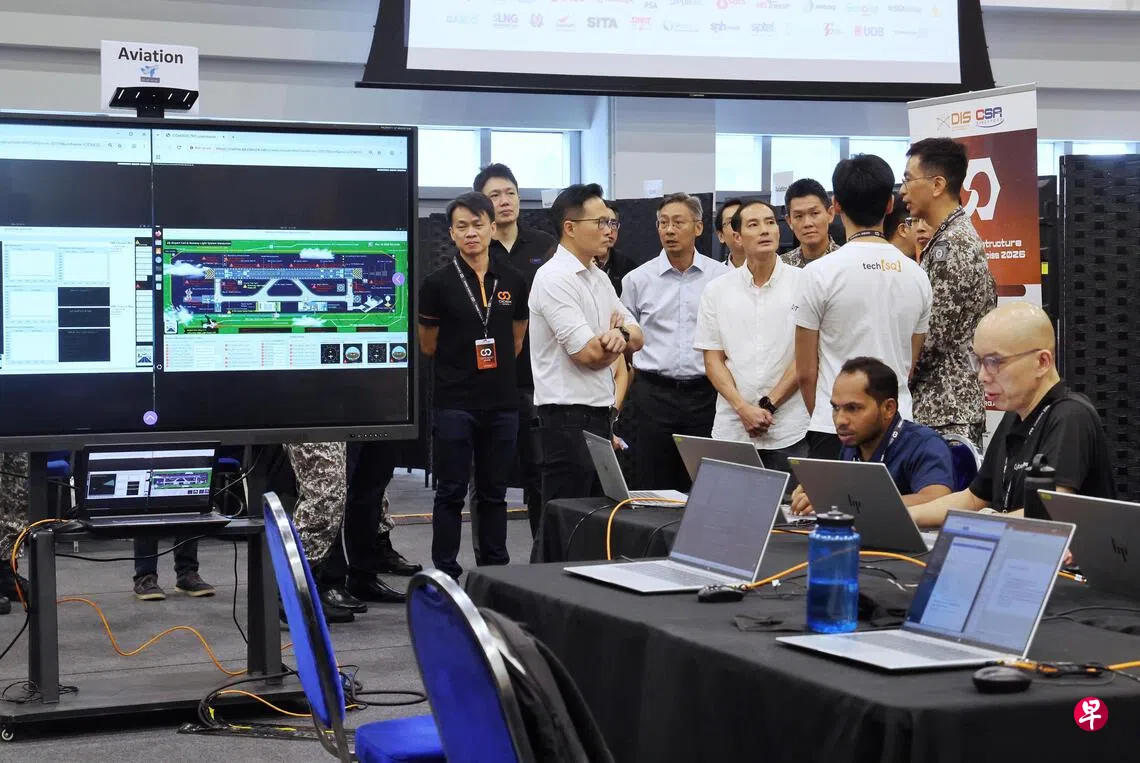
To address cyber threats in the age of artificial intelligence (AI), the government has staged its first “AI attack and defence battle” as part of the annual Critical Infrastructure Defence Exercise. It simulated large-scale AI-driven cyberattacks and tested a defensive team made up of AI agents.
Tan Kiat How, Senior Minister of State for Digital Development and Information and Health, and Desmond Choo, Minister of State for Defence, visited the fifth Critical Infrastructure Defence Exercise (CIDeX) on Thursday (19 November). They received briefings and watched a demonstration of AI defence tools developed in-house by the Singapore Armed Forces (SAF).
Jointly organised by the Digital and Intelligence Service and the Cyber Security Agency of Singapore, this year’s exercise is themed “Cybersecurity in the AI Era”. For the first time, the exercise simulated a large-scale AI-enabled cyberattack, with a coordinated “swarm” of AI agents attempting to disrupt testbeds across different sectors concurrently at rapid speed.
The exercise also tested a defensive team made up entirely of AI agents for the first time. These AI tools were developed in-house by the SAF’s Cyber Defence Test and Experimentation Centre (CyTEC) to test whether AI can detect, investigate and respond to cyber threats at machine speed.
AI completes investigation reports in under 10 minutes; humans often take hours
Participants in the exercise were divided into an attacking red team and a defending blue team. The red team comprised personnel from the Digital and Intelligence Service, the Cyber Security Agency of Singapore, the Defence Science and Technology Agency, the Government Technology Agency, the Infocomm Media Development Authority and the Land Transport Authority. They launched cyberattacks against the various testbeds.
The blue team was responsible for protecting digital infrastructure across the sectors. This year, it included a defensive team made up of AI agents for the first time.
Reporters at the exercise observed nearly 40 personnel defending the multi-cloud testbed, compared with nearly 20 at each of the testbeds for other sectors. By contrast, only two personnel were stationed in the area testing AI’s autonomous defence capabilities.
A screen at the venue showed that the AI system had opened cases for 135 simulated cybersecurity incidents over the past three days of the exercise and completed nine investigations. The entire process, from launching an investigation to generating a report, took less than 10 minutes. The same work is understood to often take human personnel several hours.
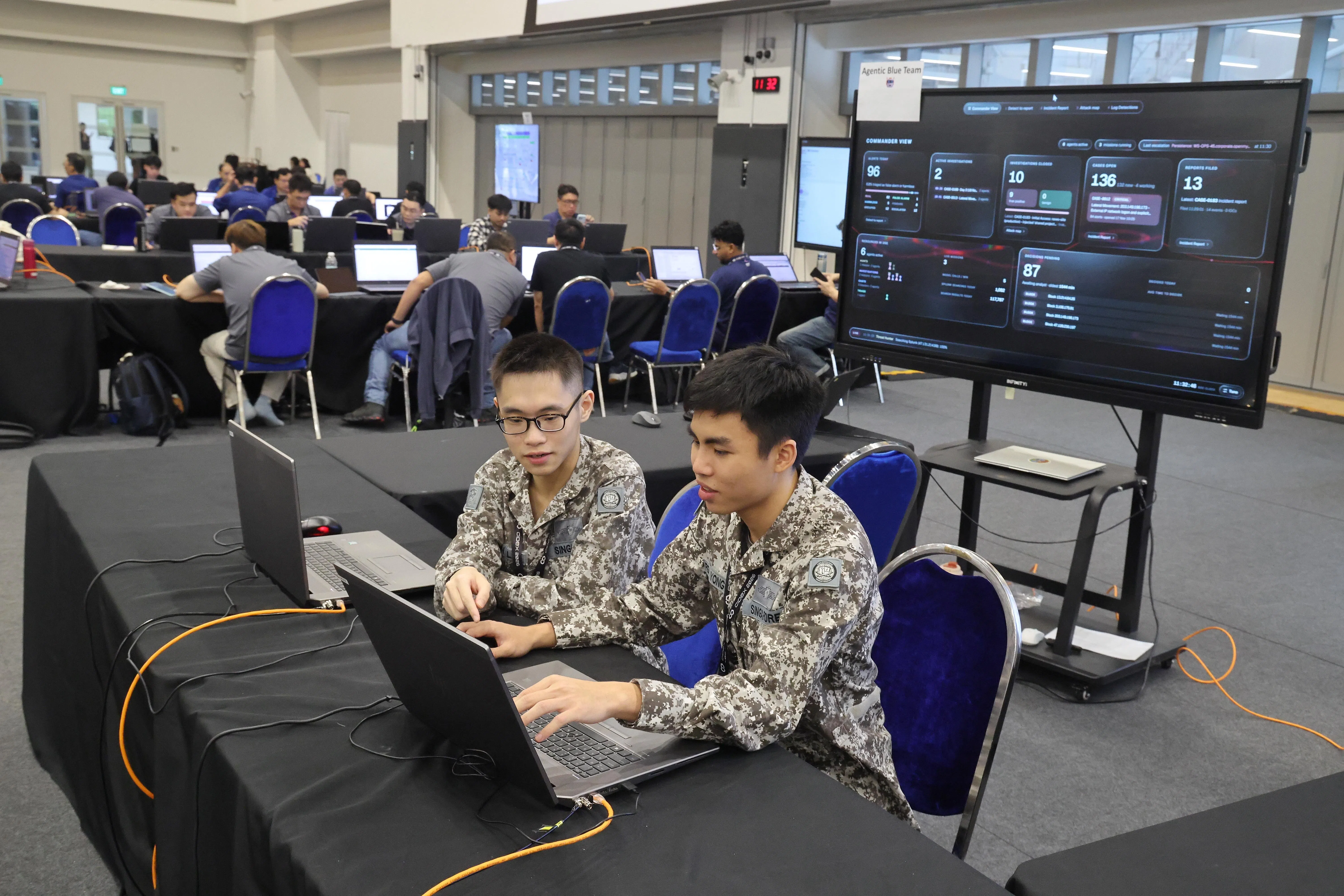
Military Expert 6 Sim Swee Horng, director of CyTEC, said that the attacker is able to harness AI, and so can the defenders. This year, the centre provided all defenders with an in-house AI tool to help them not only fight AI with AI, but also work alongside it, combining machine processing speed with human judgement.
She noted that the AI defensive team can autonomously detect and respond to cyber threats, and take steps to contain attacks. “This is to help us understand the strength and weaknesses of such AI tools, and understand where are the limits for AI in terms of cyber defense.”
Commander Defence Cyber Command/Defence Cyber Chief Brigadier General Clarence Cai said in an interview that AI enables faster cyberattacks on a larger scale, and defensive capabilities must keep pace. He stressed that the SAF would continue working with agencies responsible for critical infrastructure and industry partners to test and develop AI cyber defence capabilities.
Aviation and healthcare testbeds added for first time; operationally ready national servicemen join defence teams
This year’s exercise also expanded its scope, adding aviation and healthcare testbeds for the first time. These bring the total to eight, alongside the existing six covering multi-cloud environments, maritime, energy, telecommunications, land transport and water supply.
These testbeds simulate the operating environments of critical infrastructure, allowing participants to practise responding to cyberattacks without affecting actual services. The attacks target information technology systems as well as industrial control systems that control physical equipment and facilities.
Operationally ready national servicemen from the Digital and Intelligence Service’s sectoral cyber defence teams also joined the exercise for the first time this year. They led blue teams across the sectors in defensive operations, strengthening collaboration between the Singapore Armed Forces and critical infrastructure operators.
The four-day exercise runs from Tuesday to Friday (17 to 20) at the Singapore Institute of Technology’s Punggol campus, with more than 250 participants from 46 organisations.
