

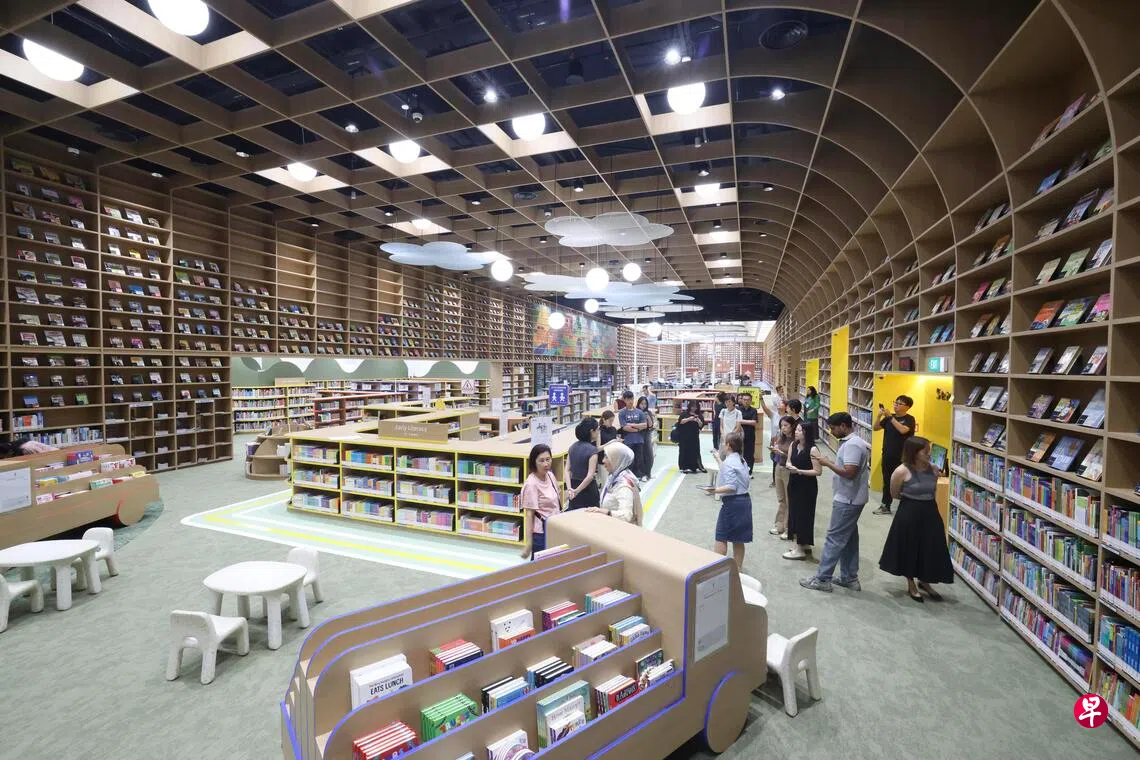
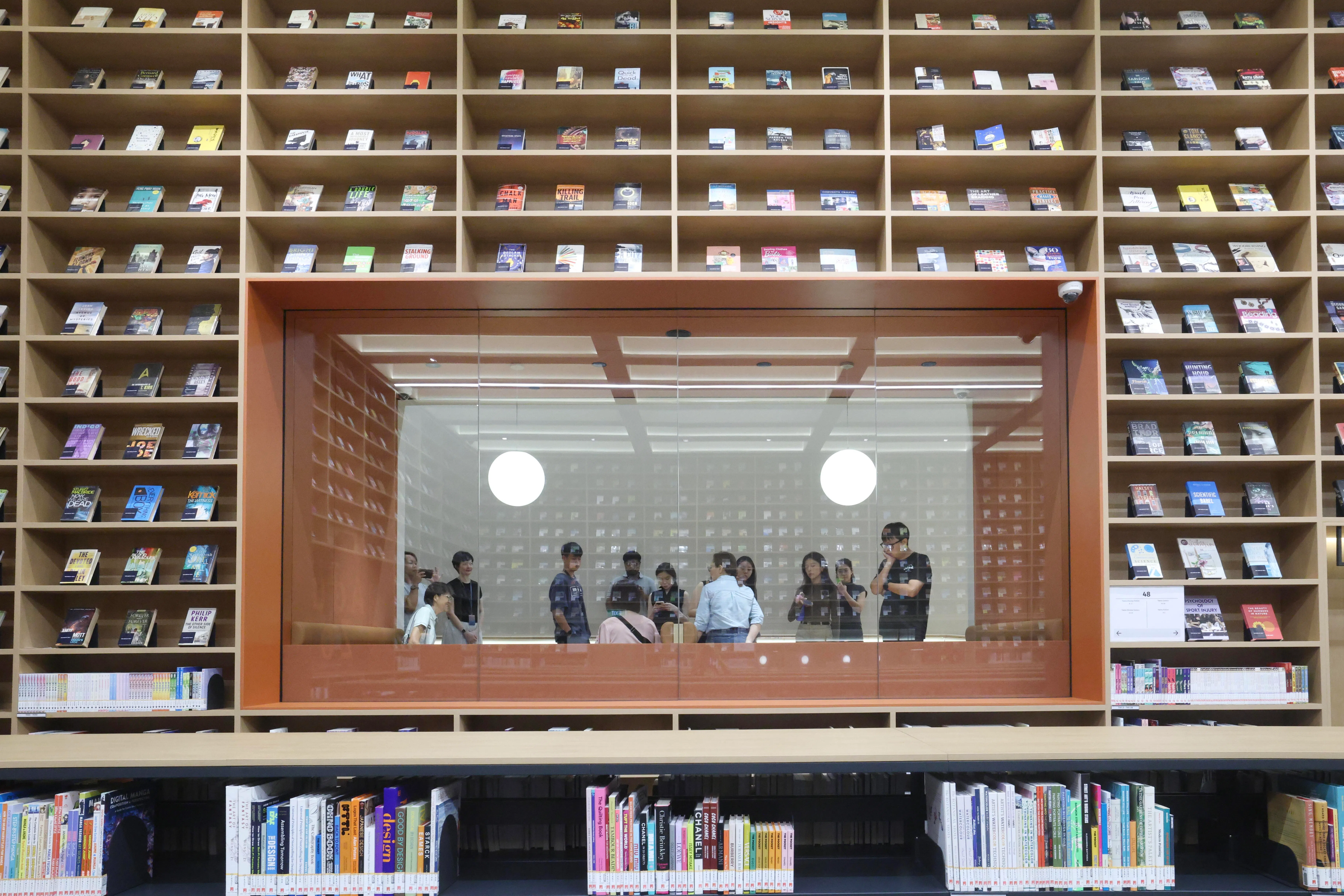
A former cinema in Ang Mo Kio has been transformed into a striking new library. With six-metre-high bookshelves stretching from floor to ceiling, it is Singapore’s first public library with a double-height design.
In another first for Singapore’s libraries, it has a 360-degree curved screen that uses artificial intelligence (AI) to tell Ang Mo Kio’s stories through old photographs. Familiar local landmarks have also been incorporated into the design to make residents feel at home.
Ang Mo Kio Public Library officially opened on Friday (20 November) in its new premises on the fourth floor of AMK Hub. The new location is easily accessible on foot from Ang Mo Kio MRT station and Ang Mo Kio Bus Interchange. The previous library was in Ang Mo Kio Avenue 6, farther from AMK Hub and the MRT station.
Yan Xiuqing, senior project manager for planning and development at the National Library, said making good use of the former cinema’s high ceilings was a challenge. But the design team came up with an inventive double-height reading space, giving Singapore’s public libraries a fresh look.
More than 5,500 second-hand books line the upper shelves, surrounding visitors with walls of books.
The library is divided into children’s and adults’ sections. The children’s section draws inspiration from Ang Mo Kio’s traffic garden of the 1980s, with vehicle-shaped bookshelves, roads and traffic signs.
The multimedia and study areas evoke the lotus pond in Ang Mo Kio Town Garden West, with lotus-leaf-shaped ceiling features, tables and chairs.
The library entrance takes its design cues from Block 259 in Ang Mo Kio Avenue 2. Seen from above, the HDB block resembles a four-leaf clover, earning this local landmark its “clover block” nickname.
AI and 360-degree screen bring Ang Mo Kio’s past and future to life
Arguably the new library’s biggest highlight is its immersive centre. Its six-metre-high exterior walls are decorated with second-hand books, while its curved design draws on Ang Mo Kio’s hilly terrain before the area was developed.
The centre’s 360-degree curved screen displays a range of digital content about Ang Mo Kio’s history, including an interactive experience called Ang Mo Kio Memories Alive (《让宏茂桥回忆鲜活起来》). Visitors can select archival photographs on the screen and watch the scenes come to life. These introduce the neighbourhood’s past, present and future, showing how it developed from kampungs into today’s modern town.
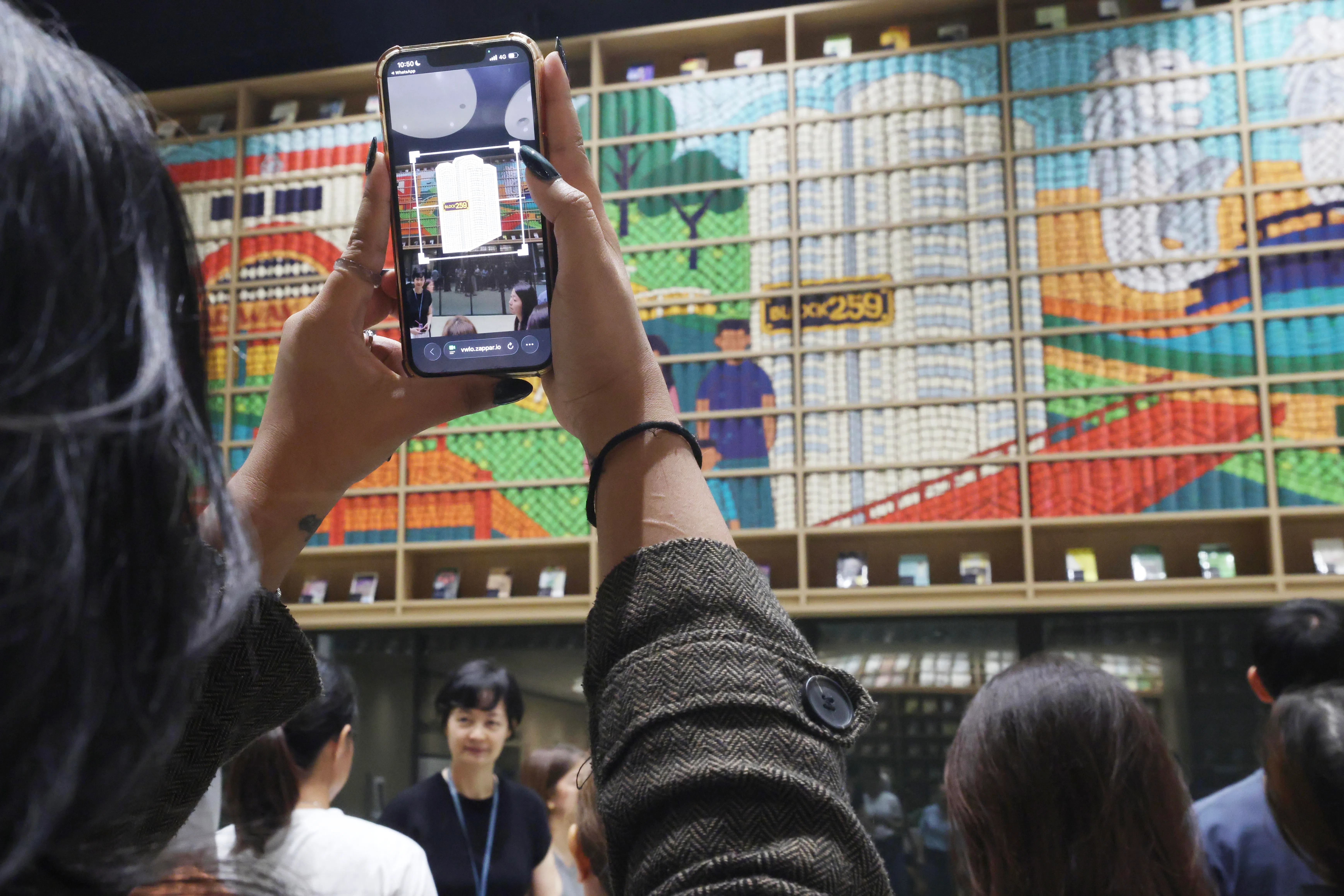
The new library also has an 18-metre-long interactive augmented reality (AR) mural depicting several Ang Mo Kio landmarks, including the lotus pond in Ang Mo Kio Town Garden West, the clover block and Broadway Cinema.
The mural also features the “nine bridges”, as early residents called them in Hokkien. In the past, residents travelling from what is now Lorong Chuan to Upper Thomson Road had to cross nine bridges.
The mural includes an AR QR code that visitors can scan with the National Library Board’s NLB Mobile app to browse curated reading lists in the four official languages.
Longer opening hours
A former dark passageway in the cinema has been refurbished as a collaboration bridge, leading to seven bookable study spaces for group study or work.
The library previously opened from 11am to 9pm. From 21 November, visitors can enter the new library from 9am to use its self-service facilities. The study area will also open for longer, from 9am to 10pm daily, including public holidays.
A historical display wall along the collaboration bridge showcases items used before libraries went digital, such as book stamps, typewritten catalogue cards, due-date slips and time-and-date stamps.
Ang Mo Kio resident Xu Xiulan, 66, said: “I usually exercise at the lotus pond near my home, so seeing lotus leaves inspire the new library’s design felt very familiar.”
After watching a film about Ang Mo Kio’s history, she discovered much that she had not known and felt it would help more people learn about the town.
Lin Xiulan, 69, worked at Ang Mo Kio library before retiring. On visiting the new premises, she was struck by the novel design and spacious interior. She said: “The old library occupied just one floor, and visitors had to climb the stairs or take the lift to get there. It was also a standalone building, so we needed an umbrella to get there in rainy or hot weather. With the new library inside AMK Hub, we no longer have to worry about the sun or rain.”
