

The government has announced the members of an expert panel investigating transboundary haze. Comprising three investigation firms, three law firms and a legal adviser, the panel will help the authorities determine whether 10 Singapore-registered companies that have been named bear responsibility for haze pollution.
In a joint statement on Friday (30 October), the Ministry of Law and the National Environment Agency (NEA) said the appointed members have expertise in forensic investigations, financial analysis, corporate intelligence, risk consulting and legal services. More members may be added to the panel if necessary.
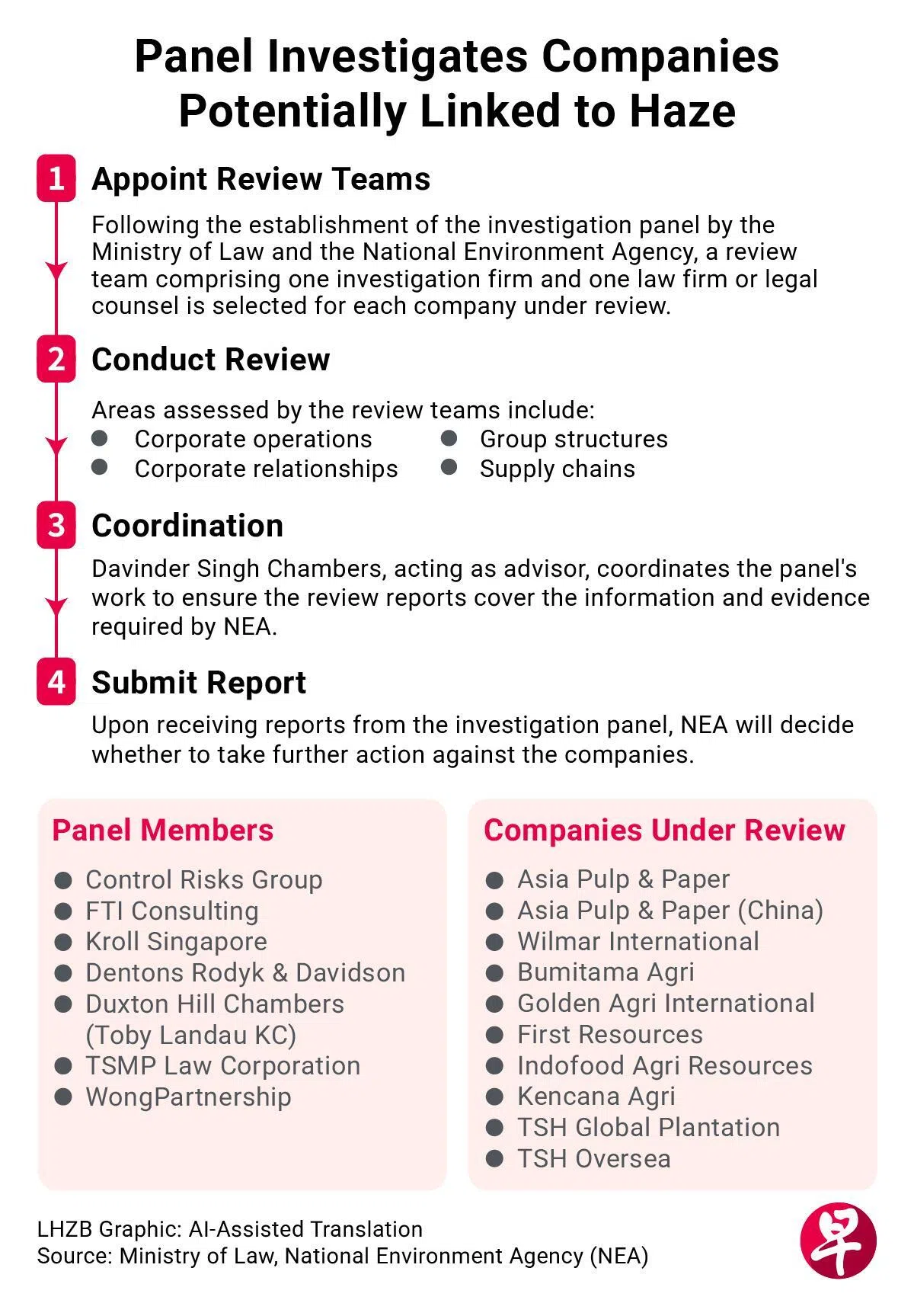
For each company named, NEA will select one investigation firm and one law firm or legal adviser from the panel to form a review team. The teams will assess the companies’ operations, corporate links and supply chains. The companies must bear the costs of the reviews and cooperate fully with the investigations.
Once the review teams have completed their work, they will submit assessment reports to NEA. The authorities will consider the findings in deciding whether further action is needed.
Davinder Singh Chambers, which the government appointed earlier, will serve as an adviser and coordinate the panel members’ work, ensuring that the assessment reports address the relevant issues and contain the information and evidence NEA needs for its assessment.
The three investigation firms appointed are Control Risks Group, FTI Consulting and Kroll Singapore.
The members providing legal services are Dentons Rodyk & Davidson, Queen’s Counsel Toby Landau of Duxton Hill Chambers, TSMP Law Corporation and WongPartnership.
Some major law firms are absent from the panel. The statement said some firms could not join because they were already providing legal advice to the companies named.
In response to queries, WongPartnership said it welcomed the opportunity to draw on its multidisciplinary expertise to contribute to this work of national importance.
Dentons Rodyk & Davidson told Lianhe Zaobao (LHZB) that transboundary haze was a serious issue affecting the health and well-being of communities across the region, and it was pleased to support this important effort.
Establishing corporate links, land ownership and control is a major challenge in determining responsibility for haze. Speaking recently at a sustainable procurement forum, Minister for Sustainability and the Environment Grace Fu noted that much of this information was held overseas and was difficult for the Singapore government to obtain.
Liu Nengye, associate professor in the Yong Pung How School of Law, Singapore Management University, also said in an interview that verifying information and evidence across borders was the most difficult part of the investigation. He welcomed the establishment of a specialist panel to investigate the 10 Singapore-registered companies, noting that the move is intended to strengthen the enforcement of the Transboundary Haze Pollution Act through evidence-based action.
On environmental, social and governance (ESG) reporting, he noted that previously, only companies listed on the Singapore Exchange (SGX) were required to submit ESG reports and declare the sustainability and environmental practices of their supply chains to the government. Now, any Singapore-registered firm may be called upon to cooperate with investigators regarding its sustainability practices, and specifically its forest management abroad.
“To me, this is like a ESG 2.0, which creates more transparency for companies to do business globally. Although it is stated that at this stage no liability is attributed to any of those 10 companies, pressures are mounting to those who are engaged in business practice that might cause fire in Indonesia.”
On Wednesday (28 October), the government summoned senior executives from 10 Singapore-registered companies that had earlier received statutory notices and asked them to cooperate with the investigation. Speaking after the meeting, Senior Minister, Coordinating Minister for National Security and Minister for Home Affairs K. Shanmugam, who chairs the Homefront Crisis Ministerial Committee, stressed that the government was not looking for scapegoats. Rather, it wanted to establish whether the companies bore responsibility and hold them accountable under the law.
Last Friday (23 October), NEA invoked Section 10 of the Transboundary Haze Pollution Act to issue statutory notices to 10 companies in the palm oil and forestry sectors, requiring them to disclose information on their affiliated companies in Singapore and Indonesia, their land concessions in Indonesia, and their fire prevention and firefighting measures.
The government plans to table amendments to the Transboundary Haze Pollution Act when Parliament resumes next week, giving the review mechanism legal force. The amendments will empower NEA to direct companies suspected of causing or being linked to forest fires to appoint reviewers. Failure to comply with such directions will be an offence.
