

The government is reviewing how family services operate, with plans to adopt a family-centred approach to provide more coordinated and comprehensive support for families in difficulty.
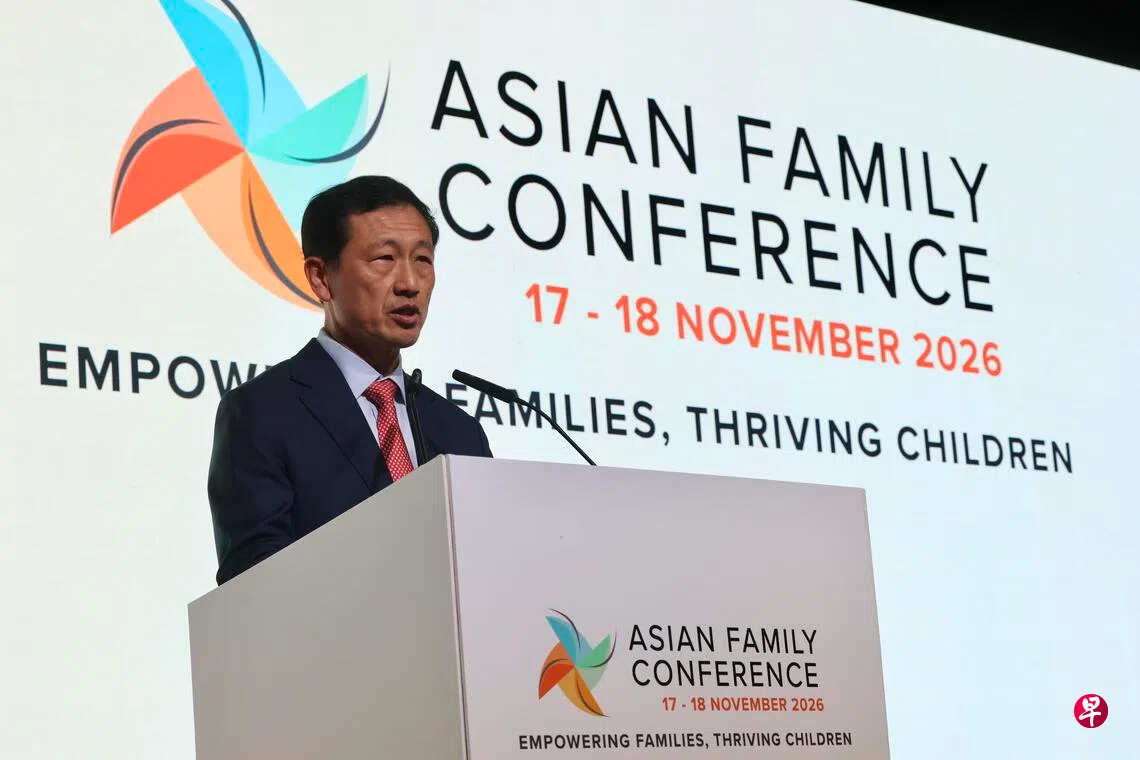
Coordinating Minister for Social Policies and Minister for Health Ong Ye Kung outlined the upcoming changes to family services in his opening address at the Asian Family Conference on Tuesday (17 November).
He said Singapore had introduced many programmes and services over the years to address the different needs of vulnerable families. The problem with that approach is that we have become programme-centric, instead of focusing on the person or family in need.
For example, he said, one programme might help a child cope with anxiety and return to school after prolonged absenteeism. Another might help the child's mother deal with a violent husband, while a third helps the unemployed husband find work.
With a family-centred approach, however, service providers should recognise that financial difficulties may be driving the husband's violence, which in turn may cause the child to fear and resent the parents. The family's problems are intertwined, and addressing their root causes requires first repairing fractured relationships within the family.
Ong said: “We are therefore changing our approach, to bring the many helping hands together, integrate and synergise the efforts, so that the individual or family experiences support as one coherent whole.”
He noted that Singapore had begun adopting this approach in eldercare and would extend it to mental health services. Currently, community teams providing mental health services support different groups of patients, such as young people, adults and seniors.
We are bringing all service providers and programmes under one integrated network. Under this structure, all service providers should have the ability to triage and determine the needs of patients, and direct them to the appropriate support, be it a counsellor, psychologist, doctor or psychiatrist. They should be resourced to build and retain those capabilities, rather than deliver programmatic targets. Everyone should be connected via a shared information system.
Ong said: The Ministry of Social and Family Development is now applying the same thinking to family services, in recognition of the inter-connected problems within a troubled family. It is reviewing the family services landscape with the intent to bring providers of family services together to take a whole-family view rather than through the lens of individual programmes.
Minister for Social and Family Development Masagos Zulkifli elaborated on the new approach in a subsequent speech at the conference.
He cited the example of a secondary school student who repeatedly ran away from home. She faced domestic violence, and her mother was also abused by her husband. The family frequently moved from one domestic violence shelter to another. A Family Service Centre provided extensive assistance, with a youth worker helping the student address behavioural problems and social workers helping her parents deal with spousal violence and marital conflict. However, the youth worker and the Family Service Centre's social workers might not coordinate or share information. They might also be unaware that the student's behaviour stemmed from her parents' conflict, making it difficult to help the family holistically.
Masagos Zulkifli said: This involves shifting from interventions organised around individual programmes to one coordinated system where professionals and Social Service Agencies work together to support families. “We want to intervene earlier rather than focus only on remedial work. This means identifying at-risk individuals and families and providing early intervention before risks escalate.”
Social service workers will also need to adopt new ways of working, supporting families in multidisciplinary teams. The authorities must therefore help them develop the relevant capabilities.
