


To crack down on scams, the government is proposing legislation to make clear that offenders who commit or facilitate scams should generally be sentenced to imprisonment or corrective training even if they are under 21. They should no longer receive lighter sentences solely because of their youth.
Goh Pei Ming, Senior Minister of State for Home Affairs and Social and Family Development, tabled the Sentencing (Scams) Bill in Parliament on Tuesday (3 November), underscoring the government’s stance on imposing tougher penalties for scam offences to strengthen deterrence.
The Bill is primarily a response to a ruling by a three-judge Supreme Court panel in an appeal case on 10 September this year. The panel noted at the time that “reformative training or imprisonment should not be the default sentencing approach for young offenders who commit ‘scam-enabling offences’”.
In a statement issued after the Bill’s first reading, the Ministry of Home Affairs (MHA) stressed that scams remain the most common type of crime in Singapore. In the first half of this year, police received an average of about 90 scam reports a day, with daily losses reaching S$2 million. Among victims across all age groups, those aged 65 and above continued to suffer the highest average losses.
This is not the first time the government has introduced legislation in response to court rulings that diverged from the original intent of its policies. MHA said Parliament had long recognised the severity of the scam problem and the harm caused by scam offences, and therefore considered swift and decisive action necessary to curb scams and scam-enabling offences.
The statement said Parliament’s position has remained consistent: When hearing such cases, courts should give priority to imprisonment or corrective training and use these as the starting point for sentencing, to serve as a deterrent.
Over 1,000 youths investigated over scams last year, up 37%
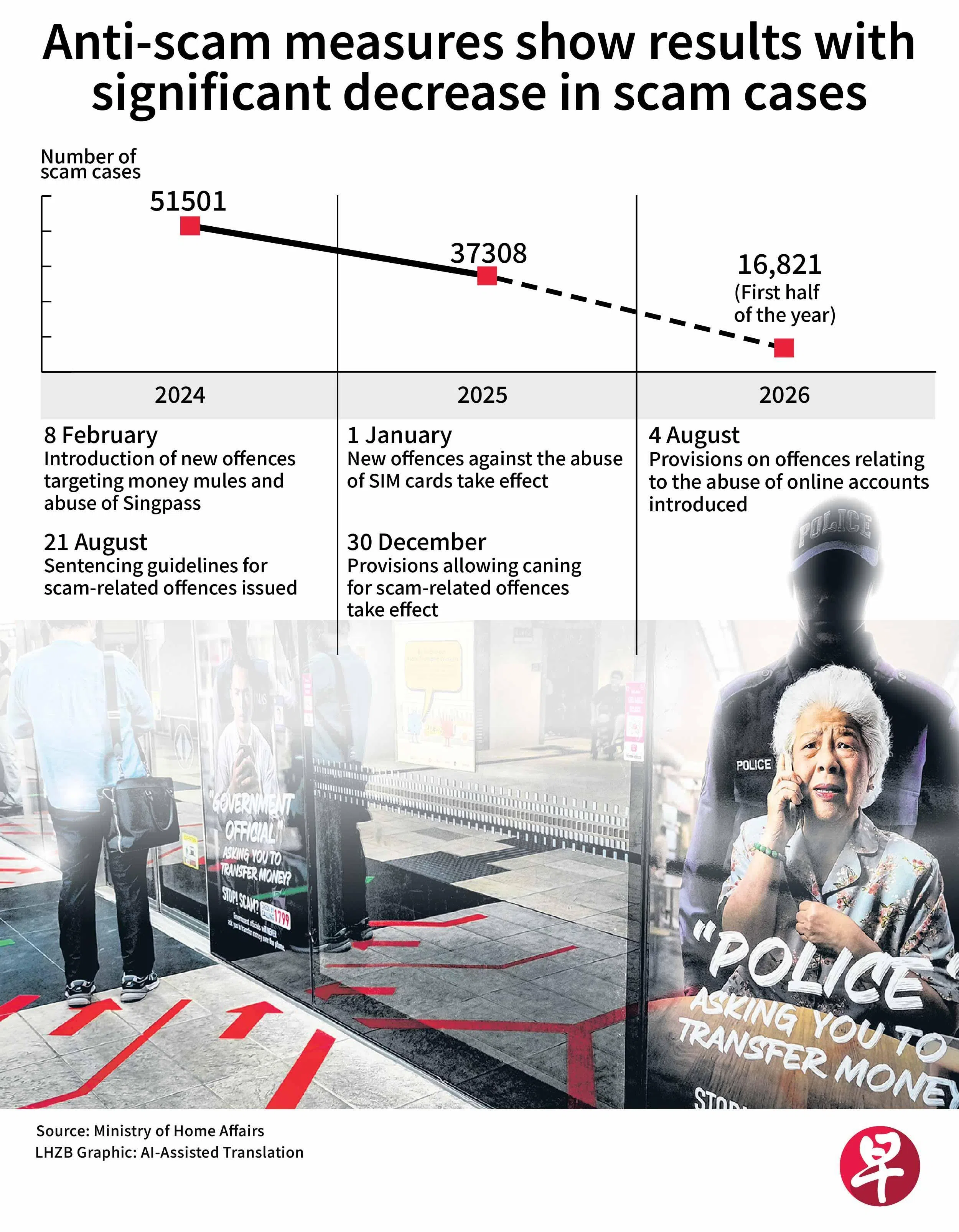
The government has stepped up enforcement and penalties in recent years to tackle money mules who facilitate scams. Since 2023, Parliament has passed five related Bills, establishing as offences activities such as helping scammers launder money and supplying them with SIM cards or Singpass accounts. The laws also mandate that certain scam-related offences be punishable by caning.
Despite these measures, scams remain rampant. In the first half of this year, the number of scam cases reported to police was more than 1.5 times that of physical crime cases. Older people are particularly vulnerable to substantial losses. In 2025 alone, more than 5,000 older people were scammed, losing about S$200 million in total. Most of these victims were retired or not working.
As scam syndicates rely heavily on local bank accounts, SIM cards and Singpass accounts to carry out scams, the government considers cutting off the supply of these tools an important step in curbing scams.
However, growing numbers of young people are being recruited by scam syndicates as money mules. In 2025, more than 1,000 youths were investigated for suspected involvement in scams, accounting for about 14% of all scam and scam-enabling offenders.
MHA said that although most offenders involved in scams and scam-enabling offences are adults, youth involvement cannot be overlooked. The Ministry of Social and Family Development’s Supporting Youth Rehabilitation Trends Report, released this year, showed that cheating and related offences were consistently the most common category of youth crime from 2021 to 2025. The number of youths involved in such offences rose from 814 in 2024 to 1,114 in 2025, an increase of nearly 40%.
In response to queries from Lianhe Zaobao, MHA said enforcement outcomes depend on the circumstances of each case. Cases assessed as warranting prosecution will be heard in the appropriate court, while others may be dealt with through warnings or composition fines.
Lighter sentences for young offenders could fuel scams: Government
Senior Minister, Coordinating Minister for National Security and Minister for Home Affairs K. Shanmugam told Parliament in response to MPs’ questions in October that Parliament had amended the law five times over the past three years to strengthen the fight against scams, including introducing caning. In considering these Bills, Parliament had not deliberately distinguished between younger and older offenders.
The inter-agency Sentencing Advisory Panel had also issued guidelines recommending imprisonment or corrective training for offenders who act as money mules.
SM Shanmugam stressed at the time that deterrence was the key reason for imposing tough penalties on scam offenders. If young people receive lighter sentences such as probation solely because of their age, this would not only be unfair to older victims who have lost their life savings, but could also embolden scam syndicates to recruit young people as money mules.
Parliament will continue sitting on Wednesday (4 November).
Not the first time legislative response to rulings at odds with policy intent: MHA

MHA said the government had legislated on at least three previous occasions in response to court rulings that did not align with its policy intent. The high-profile City Harvest Church case was one example.
On 5 February 2018, Shanmugam, the Minister for Home Affairs and then-Minister for Law, delivered a ministerial statement in Parliament on the judgment in the case. The Court of Appeal had ruled that aggravated criminal breach of trust under section 409 of the Penal Code only applied to professional agents. In his statement, SM Shanmugam highlighted that the judgment presented a legal lacuna and that the government’s assessment was that the sentences were too low. Parliament therefore amended the Penal Code to expand the aggravated criminal breach of trust provision so that it would apply not only to persons holding specified professional positions, but more broadly to persons entrusted with property in circumstances warranting higher punishment.
In 2025, the Ministry of Home Affairs also introduced the Road Traffic (Miscellaneous Amendments) Bill in response to a Court of Appeal ruling, to restore the prosecution’s discretion in deciding which charges to bring. The High Court had previously ruled that where an accused’s driving resulted in grievous hurt, the prosecution could only bring a charge of dangerous or careless driving causing grievous hurt, rather than less severe charges carrying lighter penalties such as causing hurt, under the Penal Code. The government amended the law to restore the prosecution’s discretion, allowing it to determine the appropriate charge based on the specific circumstances of each case.
Another example is the Civil Law (Amendment) Bill, passed in 2020. Earlier, in a dispute between a doctor and a patient, the Court of Appeal had established a new standard for the extent to which doctors must explain treatment risks to patients. This left many doctors concerned that they could face legal action if their explanations were not detailed enough.
The government subsequently amended the law to make clear that doctors need only provide patients with information reasonably necessary to make medical decisions and to answer their questions. In determining whether doctors had fulfilled their duty of care, courts must also take into account professional standards recognised by other doctors. The new law thus superseded certain principles set out in the Court of Appeal’s ruling.
