


Messages from scammers on WhatsApp or Telegram may seem normal at first, but warning signs can gradually emerge as the conversation unfolds. A new anti-scam app uses artificial intelligence (AI) to analyse conversations and proactively alerts users when it detects suspicious signs.
The app, called AntiScam Pango, or Pango for short, was jointly developed by Singapore’s Government Technology Agency (GovTech) and Google DeepMind. It is now open for public testing, and Android users can download it free from the Google Play Store.
Acting Minister for Manpower and Senior Minister of State for Digital Development and Information Jasmin Lau announced this in her opening address at GovTech’s STACK 2026 conference on Wednesday (4 November). She urged the public to download the app, try it out and provide feedback.
Pango takes its name from the pangolin, which curls up to protect itself when under threat. The authorities hope users will similarly learn to protect themselves against scams.
Unlike conventional anti-scam tools that check only individual suspicious messages, Pango runs in the background on a phone with the user’s permission. It analyses notifications from WhatsApp, Telegram and SMS messages, linking successive messages from the same sender to assess whether the conversation shows signs of a scam.
This means that even if scammers begin with casual conversation to build trust before gradually coaxing users into transferring money or revealing personal information, the app can analyse the exchanges to identify potential scam tactics.
When it detects a suspicious conversation, the app displays a warning on the phone screen and explains which content may indicate a scam, prompting users to be cautious before replying or taking further action. It does not automatically block or delete messages; users decide whether to continue the conversation.
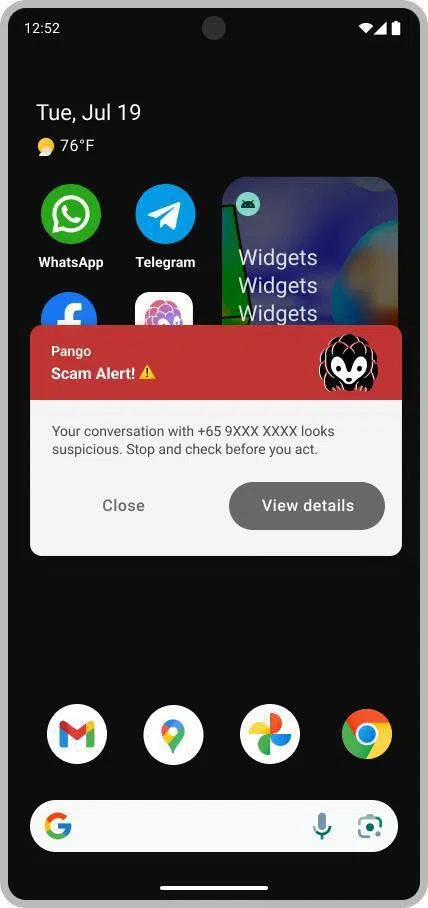
Conversations analysed only on the phone to protect privacy
Rather than directly reading chat histories within WhatsApp or Telegram, Pango analyses the push notifications these apps display on the phone. Safeguarding users’ privacy is therefore a key consideration.
GovTech stressed that Pango reads notifications only with users’ permission. All analysis takes place directly on the phone, and no messages are uploaded to external servers. Unless users choose to report suspicious conversations, neither the authorities nor their partners can access these private messages.
Lau noted that messaging platforms such as WhatsApp use end-to-end encryption. While this helps protect user privacy, it also makes it difficult for others to detect suspicious conversations and warn potential victims in time.
Pango seeks to close this gap in scam prevention while protecting privacy. GovTech used local scam cases and Google DeepMind’s AI technology to train the model to recognise scams targeting Singaporeans, including the language scammers commonly use and their tactics for manipulating victims.
However, the app is currently available only on Android phones, as the operating system allows apps to read push notifications with users’ permission. GovTech is studying how to offer similar protection on Apple’s iOS, while also exploring extending coverage to other messaging platforms.
Government or a single company ‘cannot tackle complex problems such as scams alone’
GovTech celebrates its 10th anniversary this year. In her address, Lau said government technology products should start with solving the practical problems people face, while ensuring the technology is safe and reliable.
However, she stressed that complex problems such as scams cannot be solved by the government or any single company alone; they require expertise and resources from different organisations. She specifically called on technology companies that operate messaging platforms to take an active role in jointly developing more effective anti-scam measures.
She said, “The government can bring clearly defined real-world problems. Industry and practitioners bring the expertise, and the honesty about what has and has not worked. Then we test things together and keep what works.”
Lau said technology was changing rapidly, and some products developed today might be outdated in a few years, but one principle should remain unchanged, which is to always ask, “what problem are we solving, and whose life gets better?”
Complementing ScamShield, with possible integration in future
Pango is not intended to replace the existing ScamShield anti-scam app, but to provide an additional layer of protection.
ScamShield primarily helps users block scam calls and filter suspicious SMS messages. Pango goes a step further by analysing suspicious conversations on messaging platforms that have not yet been flagged.
GovTech encourages the public to use both apps for more comprehensive protection. During public testing, the authorities will gather user feedback to continually improve Pango’s detection capabilities. Once the technology matures, they will explore integrating these features into ScamShield.
Discussing the thinking behind the app’s design, GovTech’s Assistant Director of Engineering Management Chong Chee Siang, who leads the Pango development team, said in an interview that many victims become anxious when caught up in a scam and do not think to verify what they are being told. The team therefore wanted to develop an app that could warn victims in time.
Chong said that while it was technically possible to monitor chat screens around the clock, this would seriously infringe on privacy. The team therefore chose to deploy the AI model directly on the phone and analyse only push notifications. Records are uploaded only when users report a scam, and their private information is concealed before the upload.
Asked how the team ensured the app could detect scam messages effectively, Chong said it had processed millions of tokens and more than 100,000 messages to train the model. He said the team had overcome many challenges during testing. For example, early versions of the model were “overly sensitive” to terms relating to job searches and loans, and even produced random false alerts because they could not understand Generation Z (Gen Z) internet slang.
Given that older people are a key target of social engineering scams, Chong said the team had made specific adjustments to the interface and alerts. Early internal testing found that older users often overlooked warnings amid a build-up of notifications. The team therefore designed a full-screen overlay alert that displays a prominent red warning box when the screen lights up. With users’ permission, the app also checks their phone’s contacts to help the model distinguish messages from strangers from those sent by friends and family.
Pango began as a prototype at an internal GovTech hackathon a few months ago, built by an Agile team comprising three engineers, a user interface designer, a data scientist and a product manager. Product Manager Kelly Ng said the product was named after the pangolin not only because the animal is native to Singapore and curls into a hard ball to protect itself when threatened, but also because it is shy and values its privacy — much like the way it quickly slips away when it encounters people along the Rail Corridor.
“And the third reason is that it’s really cute.”
