

The Housing and Development Board (HDB) plans to develop a new residential area in Woodlands, and although the site contains an area of moderate ecological value, it has a low density of plants of conservation significance and is unlikely to survive in the long term as an independent green space; therefore, no conservation zone will be designated.
The report recommends mitigation measures such as creating linear green spaces along the edges of the future residential area, managing lighting at night, and avoiding tree felling during the bird breeding season.
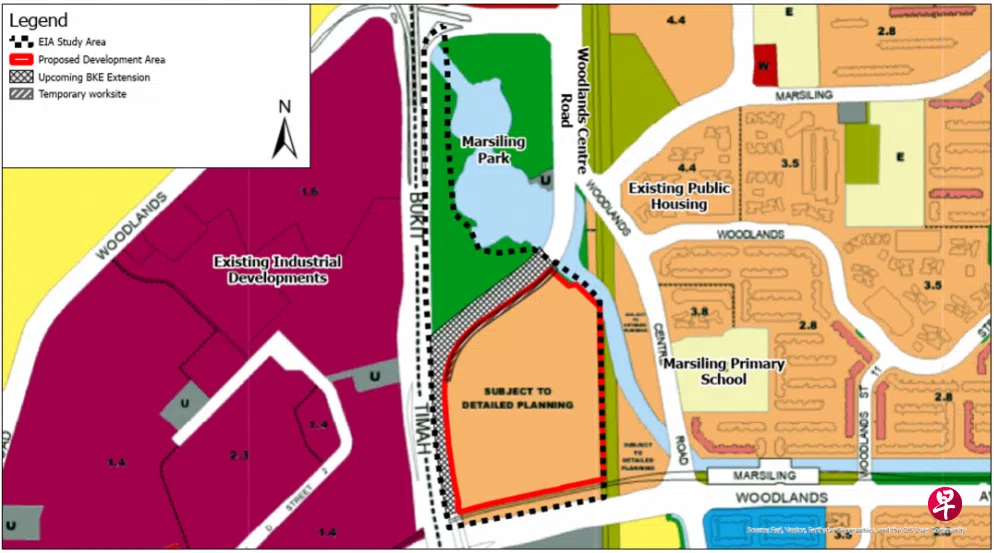
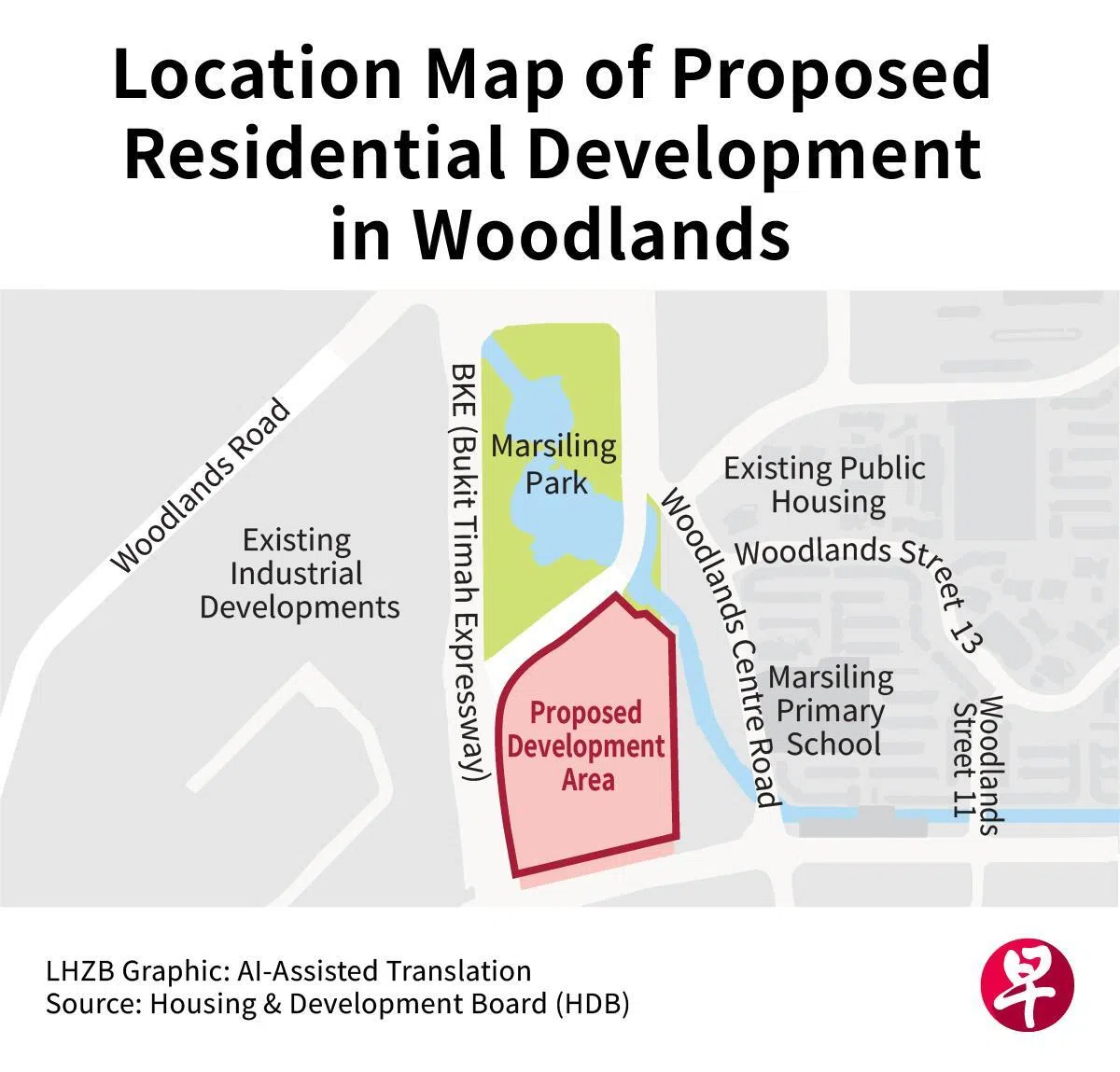
According to the environmental impact assessment (EIA) report published online by HDB, the proposed development site, Woodlands N2, lies at the junction of Woodlands Avenue 3, the Bukit Timah Expressway (BKE) and a future BKE extension leading to Woodlands Checkpoint. The assessment covers 14.4 hectares, extending to parts of the BKE extension and Marsiling Park to the north.
The site has been formally zoned for residential use since 1998.
HDB commissioned engineering consultancy AECOM to conduct the EIA. The team recorded 156 plant species across the study area, of which 90 were native. Eleven species were of conservation significance, including three classified as critically endangered locally, such as the crabapple mangrove. However, only three locally vulnerable plant species were recorded within the proposed development site: Ficus vasculosa, Horsfieldia polyspherula, and Litsea umbellata.
A total of 154 animal species were found in the study area, including 15 of conservation significance. However, only two species of conservation significance were recorded within the proposed housing site: the locally vulnerable bamboo bat and the globally endangered long-tailed macaque.
The proposed development site contains an area of moderate ecological value comprising non-native trees and native secondary forest. However, the assessment found that it has a low density of plants of conservation significance and lies in the centre of the site. Retaining it would leave it as an “island” surrounded by high-rise buildings, vulnerable to edge effects that could accelerate degradation and with very limited prospects for long-term survival. The report therefore recommends mitigation measures instead.
These include creating linear green spaces along the eastern and western boundaries of the development, supplemented by naturalistic planting nodes, to help animals move between the Mandai mangroves and mudflats to the north and the Central Catchment Nature Reserve to the south.
The report also recommends strict management of lighting for night-time construction to minimise disturbance to wildlife, avoiding noisy work between 7am and 9am, fitting noise barriers around noisy equipment, and avoiding tree felling during the peak bird breeding season from March to July as far as possible.
The report notes that the mangroves in Marsiling Park to the north are of high ecological value but will not be directly affected as they lie outside the development site.
HDB is inviting public feedback on the report until 7 December.
Conservation groups raise concerns over ecological connectivity
Tony O'Dempsey, a conservation committee member of Nature Society Singapore (NSS), agreed that areas with moderate ecological value had relatively limited conservation value, as the vast majority of plants and animals of conservation significance were found in forests dominated by non-native trees and vegetation on abandoned land.
“It is regrettable to lose these areas, but we also understand the need to strike an overall balance between housing needs, preserving ecological habitats and ecological connectivity.”
On the proposed linear green spaces along the eastern and western boundaries of the development, he said their effectiveness would be quite limited as they would be only 2 to 3 metres wide. “Scientific literature recommends green corridors at least 10 metres wide to provide connectivity for birds, while small mammals need about 60 metres.”
He also noted that the EIA had not considered the possibility of an ecological revamp of the stormwater drain to the east of the study site. “We are disappointed that this area was not considered by the EIA for enhancement. This is a common problem with EIA projects, where the study is limited to the proposed development area and opportunities for ecological enhancements immediately outside it are not fully explored.”
Environmental group LepakinSG co-founder Ho Xiang Tian also expressed concern about ecological connectivity between the area north of the Central Catchment Nature Reserve and the Mandai mudflats and mangroves. “Future development at Kranji Racecourse and the new Kranji Water Reclamation Plant could further affect ecological connectivity in this area,” he said.
