

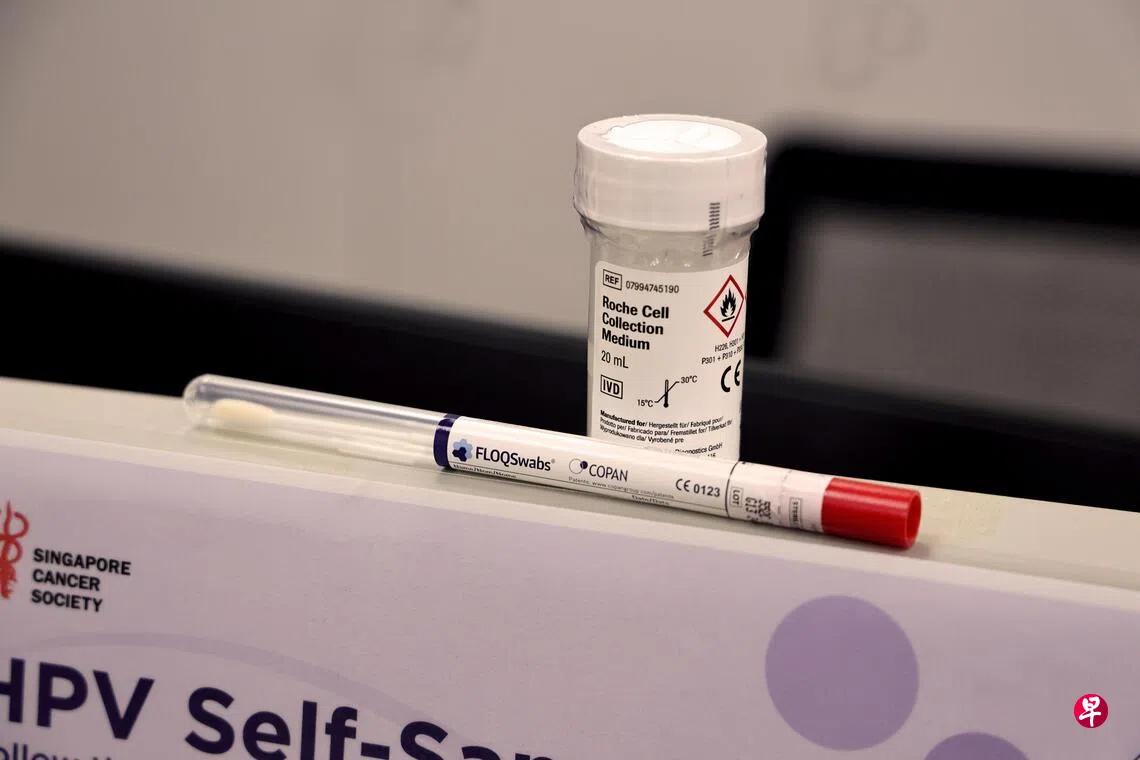
A growing number of healthcare institutions are offering human papillomavirus (HPV) self-sampling without a speculum, giving women a more private and gentler option for cervical cancer screening. Experts say self-collected samples are as accurate as those taken by doctors, but higher costs and exclusion from Healthier SG remain barriers to wider adoption.
Cervical cancer is almost entirely preventable through screening. The World Health Organisation’s targets for eliminating cervical cancer include having at least 90% of girls fully vaccinated against HPV by age 15, and 70% of women screened once by age 35 and again by age 45, by 2030.
According to the Ministry of Health’s National Population Health Survey 2025, 47.1% of Singapore residents had undergone cervical cancer screening, slightly higher than 44.9% in 2024. Despite the increase, the rate remains below that of many developed countries. A major barrier is women’s concern about pain, discomfort or embarrassment during conventional screening.
Masi, a 32-year-old clinic assistant, experienced severe pain and even bleeding during her first Pap smear at 23. The experience left her deeply distressed, and she did not undergo screening again for several years.
“I later started working at a gynaecology clinic, where I was always surrounded by doctors and colleagues who encouraged women to go for screening.”
It was only about two years ago, with encouragement from colleagues, that she tried self-sampling and tested positive for HPV. Further tests revealed precancerous changes in her cervix, and she subsequently underwent a cervical cone biopsy.
For many women like Masi, the barrier to screening is not necessarily a lack of awareness of its importance, but fear of the pain and psychological discomfort associated with a metal speculum, commonly described in Chinese as “duckbill forceps”.
Singapore Cancer Society and SGH introduce HPV self-sampling
To ease these concerns, more hospitals and clinics are offering HPV self-sampling. Women can collect a sample themselves with a soft swab in a private space, without a speculum examination, and submit it for laboratory testing.
The Singapore Cancer Society began offering self-sampling at SCS Clinic @ Bishan in July this year, becoming the first and only organisation to provide the service at a community clinic. Singapore citizens and permanent residents aged 30 and above can be tested free of charge, regardless of whether they receive Community Health Assist Scheme (CHAS) subsidies.
Last year, the society and the Alliance for Active Action Against HPV (A4HPV) began piloting self-sampling in the community, reaching out to women who rarely undergo screening. The clinic’s senior manager, Renie Liestary, told Lianhe Zaobao (LHZB) that nine of about 200 women tested so far, or 4%, had received positive results.
Singapore General Hospital (SGH) spent about two years studying whether HPV self-sampling could reduce women’s reluctance to undergo screening, before introducing it at its gynaecology outpatient clinic in July this year.
Dr Yvonne Wong, a consultant at the department of obstetrics & gynaecology at Singapore General Hospital, said the hospital still sees women who have not undergone screening for years and are found to have precancerous cervical changes or even invasive cancer when diagnosed.
Dr Wong stressed that self-collected samples are as accurate as those taken by doctors. The hospital has also conducted internal validation, confirming that self-collected samples can be tested reliably using its existing HPV testing platform.
Some general practitioner clinics have also begun offering self-sampling. Dr Lai Wern Sheng, medical director of The Good Clinic, which introduced the test this year, said one consideration was that the clinic is staffed by male doctors. It wanted to offer another option for patients who are uncomfortable having an intimate examination performed by a doctor of the opposite sex.
However, Dr Lai said fewer than 3% of the clinic’s patients currently opt for self-sampling. The most common concern is the test’s accuracy; healthcare staff are also particularly concerned about the risk of false negatives.
Experts: Comparable accuracy, but cost remains a challenge
Clinical assistant professor Zhang Zewen, a consultant at the division of medical oncology at the National Cancer Centre Singapore, said data from multiple clinical studies show that self-collected samples have comparable sensitivity to samples taken by doctors in detecting high-risk HPV DNA.
“In Singapore, patients generally still prefer to have health checks performed by a doctor. However, self-testing kits are a helpful and accessible alternative for those who are apprehensive of a Pap smear and I would not be surprised to see uptake grow over time as more women become aware of this option.”
Zhang said cost remains a barrier to widespread adoption of self-sampling in Singapore. Conventional tests using samples taken by doctors are covered under Healthier SG and receive government subsidies, with citizens paying between a few dollars and $20. Self-sampling generally has to be paid for out of pocket and costs upwards of $100.
Dr Ida Ismail-Pratt, a specialist and medical adviser to A4HPV, also sees the exclusion of self-sampling from Healthier SG as one of the main barriers to wider adoption. She hopes that, as public awareness grows, self-sampling will eventually be included in government-subsidised healthcare.
DTAP EXPRESS, part of Republic Healthcare, was among the first providers to offer HPV self-sampling at its “doctorless” clinic.
As more clinics consider introducing the test, Dr Jonathan Ti Shih Yeung, Group Chief Medical Officer, Republic Healthcare, cautioned that, besides ensuring patients know how to collect samples correctly, providers must also ensure they understand their results and have a clear pathway for follow-up care if they test positive.
“Self-sampling is a useful additional option that can complement conventional cervical screening performed by healthcare professionals, rather than necessarily replace it.”
