

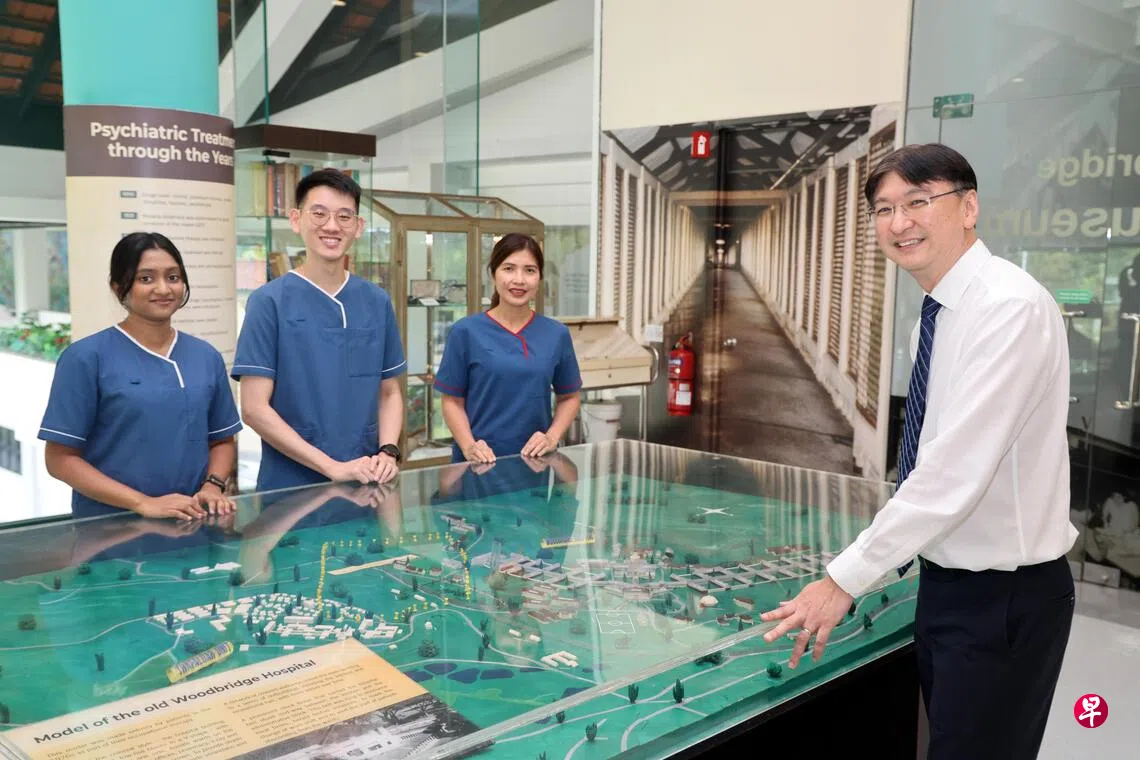
The Institute of Mental Health (IMH) will be renamed the National Centre for Mental Health Singapore next April and work closely with Changi General Hospital, Woodlands Hospital and Alexandra Hospital to strengthen Singapore’s psychiatric care network. Each of the three hospitals plans to set aside about 100 psychiatric beds over the next few years to provide inpatient treatment for people with mental health conditions in their respective regions.
Dr Jamie Mervyn Lim, who officially became chief executive officer of the Institute of Mental Health in February this year, recently outlined its priorities as it transforms into a national specialist centre, in an interview with Lianhe Zaobao (LHZB) and The Straits Times.
IMH is Singapore’s largest psychiatric hospital, with nearly 2,000 beds, caring for patients with severe and complex mental health conditions. Coordinating Minister for Social Policies and Minister for Health Ong Ye Kung announced last month that IMH would be renamed the National Centre for Mental Health Singapore, with responsibility for leading research, coordinating psychiatric care across hospitals and developing professional capabilities.
Dr Lim said the hospital’s new name reflects a broader mission: to move beyond the hospital into the community and strengthen mental health services and care at the neighbourhood level.
National specialist centre to integrate existing platforms and strengthen community networks
Dr Lim shared how establishing a national specialist centre does not mean creating another standalone system. Rather, it means taking a leadership role, integrating existing platforms and improving the coordination of community care.
He said: “It needs to provide leadership in shaping mental health service delivery, from wellness through to illness.” It is also important to intervene early to ease distress when people first begin to experience symptoms.
He noted that many social service agencies now provide mental health support. While support from multiple sources is a good thing, it has also indirectly created the challenge of “many helping hands”, where different services are doing “good things”, but “doing their own good thing in isolation or in silos”, leaving people seeking help unsure whom to approach or where to turn. He stressed the need to play a “leadership role” in shaping the entire delivery of mental health services, so that Singaporeans can find the support they need without struggling to navigate a fragmented system.
To this end, IMH set up a Community Connect (ComConnect) office last month, focusing on community services and bringing the hospital’s community initiatives, partnerships and outreach efforts under one team.
For programmes not run by the hospital, ComConnect will work closely with healthcare providers, social service agencies and community organisations to improve links between services. This will make it easier for the public to seek help and move between different forms of care.
Over the past six months, IMH has held discussions with various parties to examine gaps in the current community support system and ways to better coordinate resources. One recent event brought together 122 representatives from 34 organisations for active discussions.
Dr Lim said: “The principle of ‘many helping hands’ is right, but those hands need to be coordinated so we avoid duplication, make better use of limited resources and strengthen the community of care. This was the first discussion of its kind at this scale, and the first of many.” He noted that there will be more work to be discussed together, and “the National Centre cannot do everything alone”.
In recent years, some local nursing homes have introduced psychiatric care services, while many general practitioners and community organisations have stepped up support for these patients. IMH’s long-stay patient population has consequently fallen from nearly 900 to about 650.
Public hospitals to share demand for psychiatric inpatient care
Changi General Hospital, Woodlands Hospital and Alexandra Hospital will offer psychiatric inpatient treatment, taking on some of the demand for inpatient care among patients with moderately severe conditions. This will allow IMH to focus its resources on more complex psychiatric cases, while patients with milder symptoms can receive inpatient care directly in the community.
Dr Lim cited the example of stroke patients, who may develop depression during rehabilitation because they have lost the physical ability to carry out everyday activities. A hospital’s psychiatric team can then intervene promptly to address their mental health needs.
He explained that although these three hospitals already offer outpatient psychiatric services, patients who need inpatient care would still be referred to the IMH. Having psychiatric wards at these public hospitals would not only give patients access to more comprehensive physical and mental healthcare in one place, but also help distribute psychiatric caseload more effectively across community healthcare systems.
IMH will work closely with the three hospitals on staff training, infrastructure, diagnostic standards and referral processes.
IMH to strengthen general medical capabilities
Meanwhile, the hospital is also looking at how to retain and build its capabilities in comprehensive general medical diagnosis and treatment.
Dr Lim said: “Patients admitted to us may have psychiatric conditions as well as other, age-related medical conditions. We need to strengthen our medical capabilities, including manpower, diagnostics and imaging.”
He said the hospital is discussing how to achieve this with the Ministry of Health, so that patients with less complex medical conditions will no longer need to be transferred to Tan Tock Seng Hospital or Sengkang General Hospital.
“We need to look at the whole person, not separate physical and mental health. If IMH has these capabilities, we can better care for psychiatric patients who are ageing and have other medical conditions.”
