

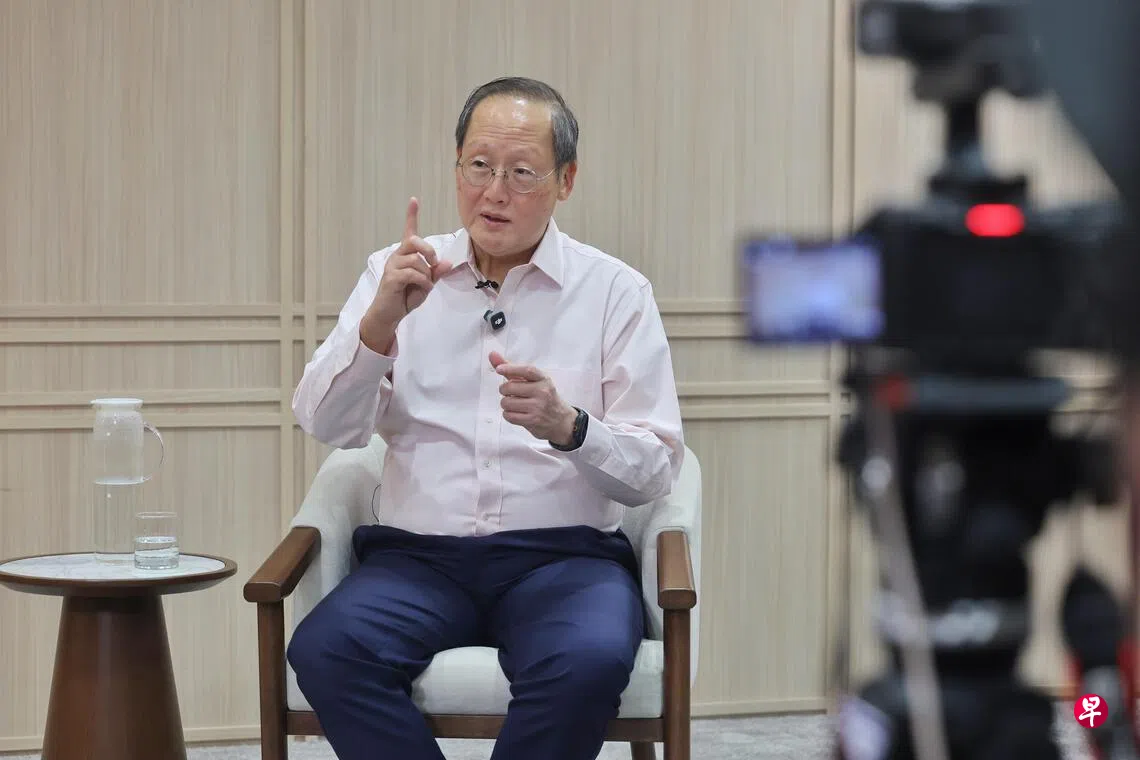
Indonesia fully restored its piped natural gas supply to Singapore on 12 November. Minister for Trade and Industry (Energy and Industry) Dr Tan See Leng said Singapore had not tapped its liquefied natural gas reserves so far, despite the volatile situation.
Global geopolitical instability poses a threat to energy security. In a joint media interview last Friday (13 November), Dr Tan stressed that Singapore was actively diversifying its electricity sources, including seeking cooperation with all ASEAN countries on cross-border low-carbon electricity imports, to reduce the risk of energy supply disruptions through multiple approaches.
Diversifying energy sources to ensure supplies are as dependable and sufficient as water
He said Singapore’s ambitious long-term goal was to achieve energy self sufficiency, pursuing energy diversification on multiple fronts so that future generations of Singaporeans will always find Singapore energy self-sufficient, secure, reliable, at the same time affordable, with energy supplies remaining as dependable and sufficient as water.
For example, Singapore had established standby liquefied natural gas facilities before the outbreak of the Russia-Ukraine war to provide a buffer against energy supply disruptions. Dr Tan said he could not disclose the size of the liquefied natural gas reserves, but confirmed that Singapore had not tapped them so far. “Those are the multi layers of of security, safety that we put up to everyone.”
About 95% of Singapore’s electricity is generated from natural gas. Singapore is actively seeking more import sources, including Australia, the US, Mozambique and countries in the Middle East, and is even exploring imports from Latin America.
In 2025, piped natural gas accounted for 43% of Singapore’s total natural gas imports, while liquefied natural gas made up 57%. Dr Tan said work on the second liquefied natural gas terminal was progressing steadily. It is due to begin operations by 2030 at the latest, allowing the share of piped natural gas to be reduced further.
Singapore also established Gasco last year to centralise natural gas procurement on the global market for local power plants, replacing the previous decentralised approach. Aggregating gas purchases helps strengthen Singapore’s bargaining power and diversify supplies.
Low-carbon electricity imports are another way for Singapore to diversify its energy sources and strengthen energy resilience. Singapore has granted conditional approvals to 14 low-carbon energy import projects with a combined capacity of 10.55 gigawatts. Six projects that have received conditional licences are in Indonesia, with a combined capacity of 3.4 gigawatts.
Dr Tan: We are not putting all our eggs in one basket
The Indonesian government announced on 23 October that it would reduce piped natural gas supplies to Singapore. In response to queries from Lianhe Zaobao, the Ministry of Trade and Industry said: “The piped natural gas (PNG) supply has fully resumed on 12 November 2026. At this point in time, there has been no further notification of PNG supply reduction.”
Indonesia's Coordinating Minister for Downstreaming and Energy Transition Bahlil Lahadalia also told the media on 2 November that Indonesia would not export electricity to Singapore unless the price was “right”.
Asked about this, Dr Tan said Singapore was committed to working with all ASEAN member states on cross-border low-carbon energy imports, and Indonesia was one of its partners. “We are not just putting all of our eggs in just one basket.”
He added: “Different countries have different needs, and we respect, right, first and foremost, the country prioritizing their own domestic needs because every single country, I think they are they are accountable for their own people, but at the same time, it is really not a zero sum game. It doesn't mean that if you if you work with your neighbors means that your domestic needs will be compromised in any way.”
Dr Tan stressed that Singapore has always upheld the principle of “prosper thy neighbour”, ensuring that its partners set aside sufficient resources to meet domestic needs before exporting to Singapore.
Singapore to advance ASEAN Power Grid as next ASEAN chair
At the recently concluded ASEAN Summit, member states signed an enhanced memorandum of understanding on the ASEAN Power Grid, paving the way for the regional grid’s implementation.
Dr Tan said Singapore would continue to advance the ASEAN Power Grid when it assumes the rotating ASEAN chairmanship next year. This includes establishing a regulatory framework and drawing up guidelines for laying, maintaining and repairing subsea cables.
Singapore has also stepped up solar deployment in recent years to strengthen energy resilience. As of the second quarter of this year, its installed solar capacity stood at about 2,339 megawatt-peak, making steady progress towards its target of 3,000 megawatt-peak by 2030.
Studies have also confirmed substantial geothermal energy resources deep beneath Singapore. Preliminary estimates suggest that their technical potential is more than 60 times Singapore’s current annual electricity consumption of 60 terawatt-hours. Singapore will begin the next phase of studies to assess the feasibility of using geothermal energy for electricity generation, cooling and heating.
Dr Tan said every generation of Singaporeans had a responsibility to build a future for those who came after them. The government would continue to manage and diversify energy sources, and invest in research and innovation, to ensure that successive generations of Singaporeans enjoy secure, reliable, affordable and sustainable energy.
