

Since its establishment, the Johor–Singapore Special Economic Zone (JS-SEZ) has recorded more than RM88.8 billion (about S$28 billion) in approved investments, of which about 45% has been implemented, with the potential to create nearly 12,800 jobs.
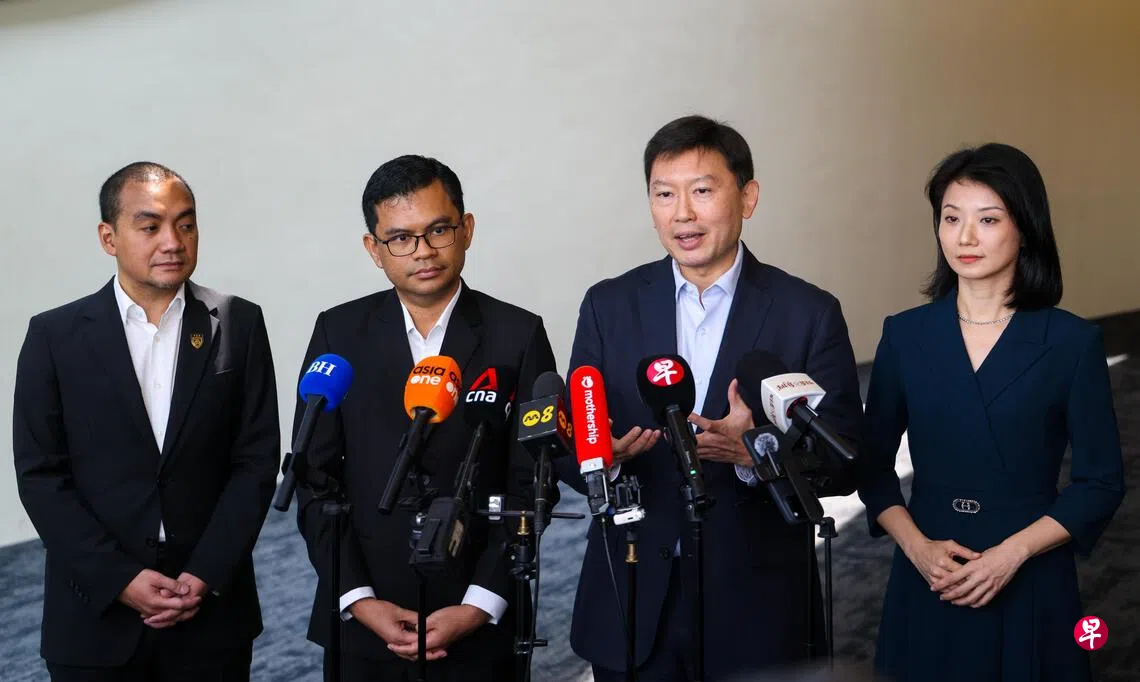
Singapore and Malaysia held the inaugural Johor–Singapore Cooperation Ministerial Committee (JSCMC) meeting on Monday (2 November). Minister for National Development Chee Hong Tat and Malaysian Economy Minister Akmal Nasrullah (Haji Akmal Nasrullah Bin Haji Mohd Nasir) co-chaired the meeting. Johor Menteri Besar Onn Hafiz Ghazi and Singapore’s Senior Minister of State for National Development and Transport Sun Xueling also attended.
In a joint statement issued after the meeting, the two countries said the JS-SEZ recorded RM88.83 billion in approved investments under the purview of the Malaysian Investment Development Authority from January last year to June this year. Of this, RM40.3 billion, or about 45%, had been implemented.
These approved investment projects are expected to create 28,755 jobs, including 12,796 associated with projects that have been implemented.
Speaking to the media after the meeting, Chee said the zone had made good progress in attracting investment, with investors coming from Singapore and around the world. He attributed the business community’s sustained interest in the zone to the close partnership and collaboration between Singapore and Malaysia, as well as between Singapore and Johor.
“We would certainly want to continue this partnership, work even more closely together, and see how we can take this collaboration forward and do more together for the benefit of our people, our communities, and our businesses.”
Akmal said the investment figures demonstrated the zone’s potential, but turning investment into tangible results was more important. He said Singapore and Malaysia had agreed to jointly hold an investment forum in the first quarter of 2027 to sustain the current investment momentum.
Leaders of both countries expected to launch JS-SEZ development blueprint in December
Singapore and Malaysia signed an agreement in January 2025 to formally establish the JS-SEZ. Covering several areas in southern Johor, the zone aims to combine Singapore’s capital and international networks with Johor’s strengths in land and human resources to attract investment and promote cross-border trade.
The JS-SEZ master plan and development blueprint are expected to be jointly launched by Singapore Prime Minister Lawrence Wong and Malaysian Prime Minister Anwar Ibrahim at the Singapore–Malaysia Leaders’ Retreat in December this year.
Chee said the blueprint would set out both sides’ medium- to longer-term vision for the zone. But he stressed that achieving these goals would require the relevant agencies in both countries to strengthen coordination to develop and implement specific measures on talent development, facilitating the movement of people and goods, promoting trade and investment, and improving transport connectivity.
New committee broadens cooperation, strengthens cross-border transport links
The JSCMC was formed from the former Malaysia–Singapore Joint Ministerial Committee for Iskandar Malaysia. The joint statement said the inaugural meeting marked a new phase in bilateral cooperation, with its scope further broadened and deepened.
The new committee will provide strategic direction, strengthen bilateral coordination and oversee the implementation of key projects in the JS-SEZ.
Singapore’s members on the committee include the Minister for National Development, the Minister for Energy, Trade and Industry (Energy and Industry), and the Minister for Transport. Malaysia’s members include the Economy Minister, the Minister of Investment, Trade and Industry, and Johor’s Menteri Besar. Both sides may add representatives as needed in future.
Responding to a question from Lianhe Zaobao (LHZB), Chee said the new committee would provide a platform for ministers, officials and relevant agencies from the Singapore and Malaysian governments and the Johor state government to meet regularly and explore ways to deepen cooperation.
As an example, he said both sides had begun improving cross-border taxi services. The Johor Bahru–Singapore Rapid Transit System, expected to begin operations in February next year, would further strengthen transport links between the two sides. Both countries are also exploring ways to improve ferry services.
Chee also said in a Facebook post that both sides were developing measures to facilitate the movement of people and goods, including QR-code immigration clearance and streamlined customs procedures for land intermodal transshipments.
Singapore and Malaysia had also previously agreed to establish working groups to address issues concerning the JS-SEZ, transport and other areas of mutual interest. These working groups will report their progress to the ministerial committee.
Both sides will discuss specific arrangements and continue discussions on the terms of reference for the committee and working groups ahead of the next committee meeting in Malaysia next year.
Chee said: “In the time like this, when the world is more uncertain, less predictable, actually like-minded partners and close neighbors, we need to work even more closely together, and achieve this growth, prosperity, and benefits, good jobs for our people.”
Singapore will assume the rotating ASEAN chairmanship next year. Akmal said he hoped this would provide an opportunity to further showcase the results of Johor–Singapore cooperation and the zone’s potential as a gateway to regional markets.
