

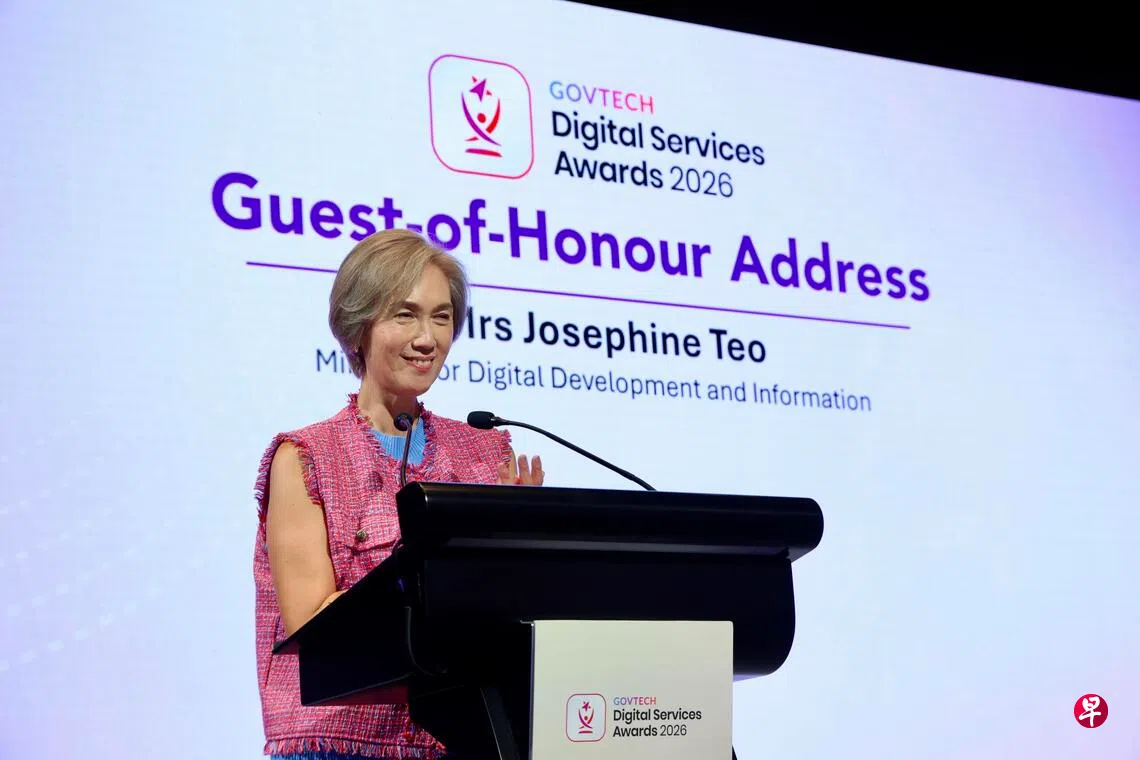
The public service is increasingly using artificial intelligence (AI) to improve efficiency, but most people still want a human helping hand when giving feedback or seeking assistance. Minister for Digital Development and Information Josephine Teo said the government’s next steps would focus on redesigning work with AI while ensuring agencies use it responsibly, without eroding public trust.
In conjunction with the Digital Services Awards, the Government Technology Agency released some findings from the State of Singapore Government Digital Services Report 2026 on Friday (20 November).
A survey of 450 citizens conducted in April this year found that 92% of respondents rated government digital services as on a par with or better than those offered by private companies. However, respondents also wanted government agencies to provide more seamless and consistent online services, allowing them to find the information and services they need easily without switching between multiple websites.
Although 87.6% of respondents felt reasonably comfortable using AI-powered government chat services, only 50.9% agreed that AI could provide useful information. Nearly seven in 10 said being able to contact a human officer would increase their trust in AI-powered government online services.
In her speech, Teo said that beyond efficiency and effectiveness, the public service must retain a human dimension that AI cannot replace. “efficiency is not a substitute for empathy, and effectiveness must include the citizens’ sense of fair treatment.”
As AI is used more widely in the public service, Teo said Singaporeans should find it easier to seek help, feel more heard and understood and, most importantly, be confident that they are being cared for.
She said AI might help individual agencies handle matters more quickly. But if someone whose problem involves several agencies still has to repeat their account, submit the same information and wait for referrals, the government has not gone nearly far enough. “Instead, we must look at the full process from the citizen's perspective, and use AI to help officers work better together.”
The time saved should also allow officers to give more attention to people in need, particularly those facing difficult or complex circumstances.
Teo noted that as AI takes on more routine tasks, the government must make a conscious effort to adjust officers’ roles so they have greater capacity for responsibilities requiring human care.
She also said public officers must be given the right tools, training and support to make good use of AI. Young officers, in particular, need the judgement to question answers, identify exceptional cases and understand the consequences of each decision.
Launched in 2021, the Digital Services Awards are now in their sixth year. This year’s awards, themed “Engage, Empower, Evolve”, recognise 43 government agencies, organisations and individuals. They emphasise understanding public needs, involving the public in designing digital services and continually improving digital experiences as public expectations evolve.
