

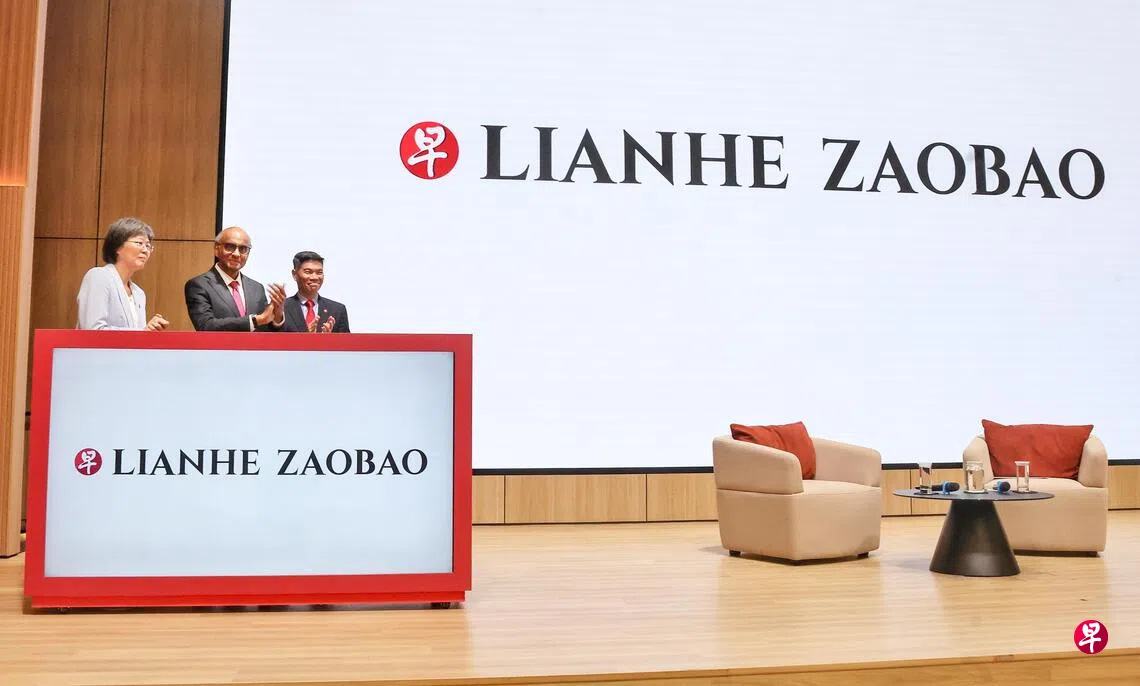
To reach readers from a wider range of backgrounds, Lianhe Zaobao (LHZB) has launched an English-language website, using advanced artificial intelligence translation models alongside human proofreading, review and editing to translate its Chinese-language content into English. The aim is to help young people and readers of all races cross language barriers and gain a deeper understanding of the views and perspectives presented by LHZB.
President Tharman Shanmugaratnam officiated at the launch of Lianhe Zaobao English Edition (www.zaobao.com.sg/en) at the SPH News Centre auditorium on Thursday (5 November). Lianhe Zaobao English Edition is currently available only on the website; the LHZB app does not yet offer English content.
Speaking at a fireside chat afterwards, President Tharman said LHZB and Lianhe Zaobao English Edition could play a role in promoting social harmony. He said a very large part of the readership of its English edition would come from Singapore’s Chinese community, whose younger members largely speak English at home or outside. “Your English language edition of Lianhe Zaobao will be a useful way of allowing them to benefit from this different pair of eyes on social issues as well as international issues.”
“The aim is not simply connecting different communities, or thinking of differences between communities that need to be bridged, but developing within each community and developing among Singaporeans generally, that flexibility of mind and that openness of mind.”
Malay and Tamil editions to be rolled out progressively
The launch of LHZB’s English-language website is part of SPH Media’s plans to use artificial intelligence translation technology to progressively make content from its major newspapers available in Singapore’s four official languages.
The English-language newspapers The Business Times and The Straits Times launched Chinese-language editions in March and October this year respectively. LHZB is the first mother tongue newspaper to launch an English edition. Once the English website’s operations have stabilised, LHZB will progressively roll out Malay and Tamil editions.
The group’s other mother tongue newspapers, Berita Harian and Tamil Murasu, will also explore how to offer content for other language communities.
This is an important step by SPH Media towards bringing Singapore’s language communities closer together. It aims to help readers, through a language they are familiar with, gain deeper insights into how other communities see the world, the issues they care about and the core views they hold.
Lee Huay Leng, editor-in-chief of SPH Media’s Chinese Media Group, was unable to deliver her speech at the launch because of a vocal cord problem. Her speech was read by Lianhe Zaobao editor Ang Yiting.
LHZB’s English website helps readers understand the diversity of Singapore society
Lee Huay Leng noted that technology has now lowered the cost of translation and content production, and it is no longer unusual for international media outlets to offer news in different languages. As a public service media outlet, LHZB has even more reason to take this step, making good use of technology to proactively offer editions in other languages.
She said: “We should make it easier for Singaporeans from different communities to understand one another. We should also help international audiences gain a deeper and more nuanced appreciation of the diversity of Singaporean society.”
Only about 30% of the content in LHZB and The Straits Times currently overlaps. Lee noted that this means each newspaper carries a substantial amount of reporting, analysis and commentary that readers of the other may not ordinarily have the opportunity to encounter. “From the broader perspective of SPH Media, translation is therefore not simply about redistributing the same content. It is about making a much wider range of information, ideas and perspectives accessible to more people.”
Through English translations, LHZB also hopes to help more young readers understand its journalism, including those less accustomed to reading in-depth reports in Chinese.
Lee said the aim was not to replace Chinese-language journalism, but to offer another way for more people to access LHZB’s content and understand the value of local Chinese-language journalism.
LHZB upholds editorial principles and keeps younger readers engaged with Chinese-language media
Lee acknowledged concerns that the launch of LHZB’s English edition could affect readership of mother tongue newspapers and pledged to take them seriously. She said LHZB would remain committed to growing its younger audience, producing more videos and continuing to invest in student publications to keep the younger generation engaged with Chinese-language media.
Lee stressed that LHZB remains, at its core, a Chinese-language media outlet. “Our editorial identity, our journalistic traditions and our commitment to Chinese-language journalism remain unchanged. The journalists we recruit will still be expected to report and write in Chinese.”
Chow Yian Ping, editor of ThinkChina and Lianhe Zaobao English Edition, said LHZB’s English edition harnesses the capabilities of artificial intelligence to share LHZB’s reporting and articles with the English-speaking world. “This is a gradual process. We are still experimenting and exploring; it cannot be achieved overnight. Quite a few readers have already told us they would like to see more commentary and cultural articles. These are precisely the areas AI finds most challenging, and where we will focus our efforts.”
