

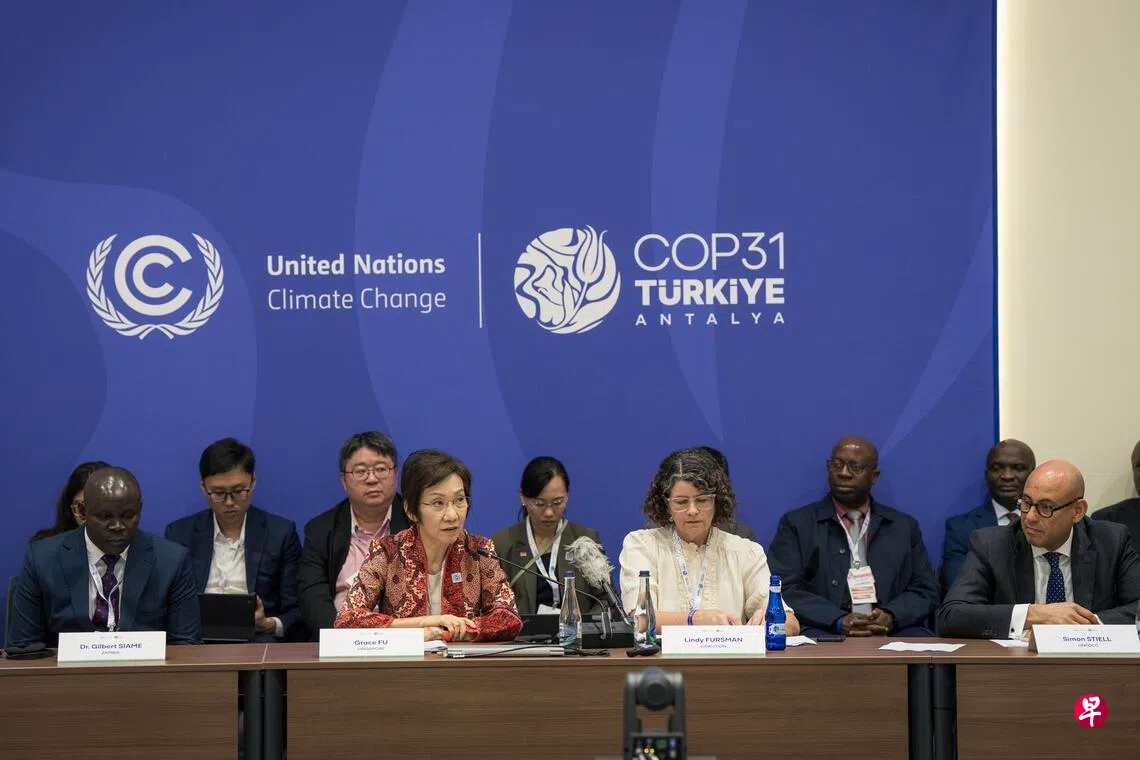
The previous meeting was running late. Ministers waiting for the next session gradually gathered outside the venue, forming a circle and taking the opportunity to chat. Petite and dressed in a red batik jacket, Minister for Sustainability and the Environment Grace Fu stood out among the male ministers in dark suits.
They were waiting for the Coalition to Grow Carbon Markets ministerial roundtable at the 31st UN Climate Change Conference (COP31). Singapore co-chairs the coalition, which seeks to drive demand for high-quality carbon credits among businesses and the private sector.
The wait was brief, but Singapore had spent years working to reach this door.
Behind it, countries would discuss climate cooperation. In an interview before leaving for this year’s climate conference in Antalya, Türkiye, Fu had stressed that Singapore had to be “in the room”. Only by taking part in person could it effectively advance its positions on the international stage.
Yet a voice at the international negotiating table is never a given. For the Little Red Dot to be heard among nearly 200 participating countries takes more than speaking up. It also rests on the credibility and partnerships painstakingly built over the years.
The Coalition to Grow Carbon Markets is one example. Singapore launched the international coalition with the UK and Kenya during London Climate Action Week in 2025. It now has 18 member countries. That same year, Singapore also hosted the inaugural Global Cooling Pledge conference, bringing together national representatives, experts, academics and industry leaders to draw up a sustainable cooling plan for the following two years.
Beyond promoting multilateral cooperation, Singapore also offers practical solutions to global climate challenges, particularly by helping developing countries with limited resources.
Over the past two weeks, Singapore has announced two new initiatives at COP31. One, the Singapore Green Cooperation Programme, will offer assistance tailored to developing countries’ needs, including technology, climate finance, subsidies and advisory support, to strengthen their capacity to tackle climate change.
The other, SPIRE Asia, a programme to scale up climate resilience projects and investment in Asia, brings together data, technical support and financing to help South-east Asian farmers adapt better to climate change and strengthen regional food security.
Singapore had also launched Financing Asia’s Transition Partnership (FAST-P), a major blended finance initiative for climate action, at COP28 in 2023. It seeks to attract more public and private capital to support Asia’s green transition.
Building the standing to speak up and help drive climate dialogue
These efforts, built up step by step, have given Singapore the standing to make its voice heard on the international climate stage today.
Back at the Coalition to Grow Carbon Markets ministerial roundtable, the meeting finally began about 30 minutes late. When the doors opened and ministers filed in, Singapore was not merely “in the room”, but helping to drive the dialogue.
In the spacious meeting room, Fu and Simon Stiell, executive secretary of the United Nations Framework Convention on Climate Change and a key figure at the climate conference, sat on either side of Lindy Fursman, executive director of the coalition’s secretariat.
Fu delivered her opening remarks with composure, setting the stage for the high-level dialogue.
Like a duck gliding across the water, the calm on the surface belies the constant paddling beneath. Singapore’s place at the international negotiating table today, and its role in shaping the agenda, similarly rest on sustained efforts that often go unseen.
Those efforts are also beginning to yield more tangible responses.
Speaking in a wrap-up interview on Friday (20 November), Fu said that each time Singapore announced a new initiative or partnership, it drew interest from other countries. During the conference, countries including Bolivia, Solomon Islands and Sierra Leone had approached Singapore to explore taking part in the relevant initiatives.
From securing a seat at the negotiating table to putting forward proposals and forging partnerships, Singapore is steadily translating years of work into tangible influence. The meetings will eventually end, but Singapore’s efforts on the international climate stage will not stop when the doors close.
