

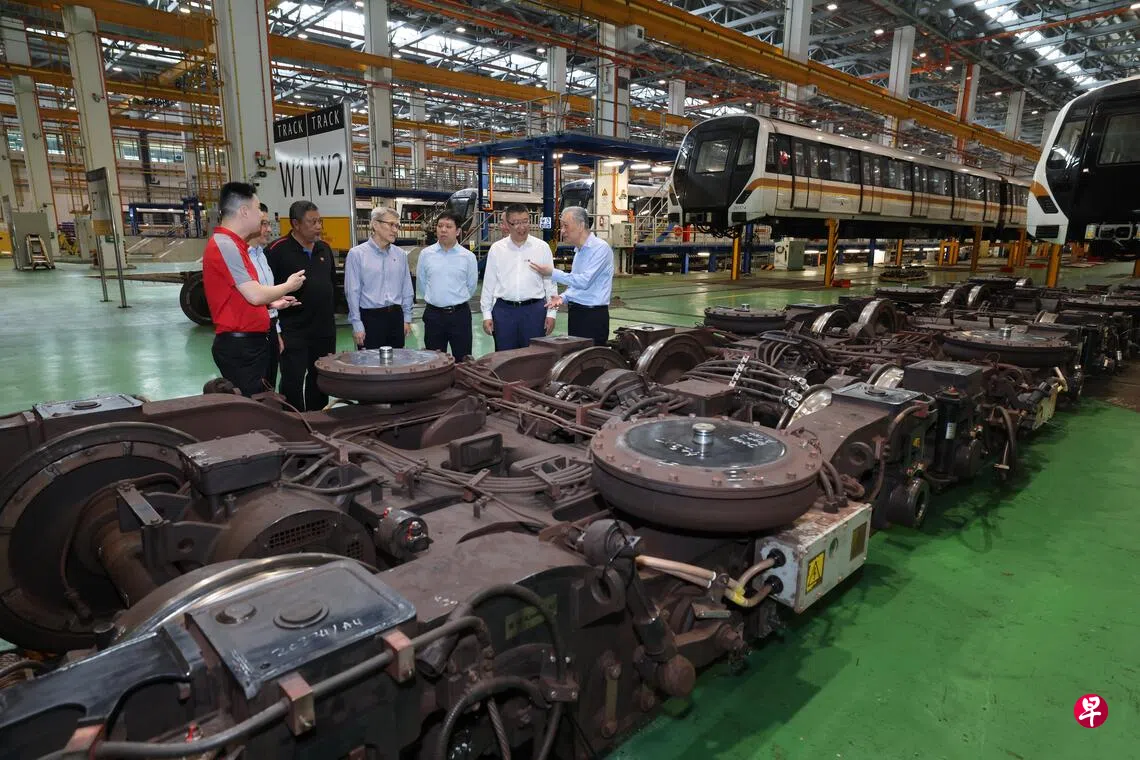
Upgrading works at the Mandai Depot workshop have officially begun. The revamp will not only double the efficiency of time- and labour-intensive train overhaul works, but also allow for better manpower deployment and enhance workplace safety.
The upgrading works were launched on Friday (6 November). Mandai will be the second MRT depot after Bishan to be upgraded to “Depot 4.0”.
SMRT Corporation Chairman Seah Moon Ming said in his speech: “This will help trains spend less time in the workshop and more time available for service. More consistent maintenance and better records will support more reliable journeys.”
Seah stressed that the upgrade would not simply replicate the improvements at Bishan depot. Instead, a new set of equipment and work processes would be tailored to Mandai depot’s needs.
Citing major train overhauls as an example, Yap Yi Shen, manager at STRIDES Technologies, who oversees the Mandai depot upgrade, said two new technologies would be introduced to automate train wheelset replacement and the transport of components within the depot.
Currently, each major overhaul, conducted every three to four years, requires more than 30 employees to inspect and replace components such as the train’s air-conditioning, braking and propulsion systems. The process takes about 24 days in total.
Yap said inspecting and servicing train bogies is the most time-consuming and labour-intensive part. Once a two-tonne bogie is detached from a train, two to four workers have to bend over and push it about 100 metres to a designated area, where it is dismantled further into components such as wheelsets and frames.
Workers then use a crane to lift the 1,400kg wheelset onto a machine to replace the wheels. During this process, some workers ensure that no one enters the work area, while others pull ropes taut to stabilise the suspended load.
Once the depot is upgraded to Depot 4.0, just one employee will be needed to remotely operate a new tug that pulls detached bogies to the dismantling area. Automated machinery will also replace the crane used in the wheel replacement process, improving safety and efficiency.
Overall, the time needed for a major overhaul is expected to fall to 12 days, while manpower requirements are projected to drop by 25%.
The shorter maintenance time will not compromise quality. Yap said the upgrade would also use technology to collect data and complete maintenance records automatically. For example, measurements of component lengths or proportions, previously taken manually by workers, will be automated, improving data precision and accuracy.
Freed-up staff can take on higher-level work
Seah stressed that automating operations did not mean the company would lay off staff. Instead, heavy lifting, repetitive work and dangerous tasks would be handed over to machines. “Our technicians and engineers can then focus on diagnosis or making decisions, and overseeing the work. We will support them with better data and continued training.”
Yap said the company led a delegation of at least eight employees to visit manufacturers in China this August to observe various advanced technologies. After gathering and reviewing feedback from the staff, the company selected new equipment suited to local depot requirements for to be introduced at Mandai.
Upgrade scheduled for completion by the middle of next year
Yap said the upgrade, costing about S$5.5 million, is expected to be completed in June next year. Work will be carried out in phases, without affecting the depot’s daily operations or maintenance work. This is Mandai depot’s first upgrade since it began operations in 2019.
The upgrade is a collaboration between SMRT, STRIDES Technologies and CRRC Qingdao Sifang. It is partly funded under the National Trades Union Congress’s (NTUC) Company Training Committee scheme.
In 2023, SMRT announced that it would spend S$7 million on the first comprehensive upgrade of Bishan MRT depot, which had been in service for nearly 40 years. Automated equipment and a digital scheduling system were introduced to reduce the manpower needed for major train overhauls by about 30%, as well as halve the time required from 14 days to seven.
Yap said that after the upgraded Bishan depot opened in November last year, further improvements in operational efficiency had cut overhaul time to five days.
Mandai depot primarily serves the Thomson-East Coast Line’s 91 trains, fewer than the approximately 200 served by Bishan depot.
Minister for Transport and Second Minister for Finance Jeffrey Siow announced on Wednesday (4 November) that Bedok South station on Stage 5 of the Thomson-East Coast Line, Xilin station on the Downtown Line, and Sungei Bedok interchange station, which connects the two, would open on 26 December.
