

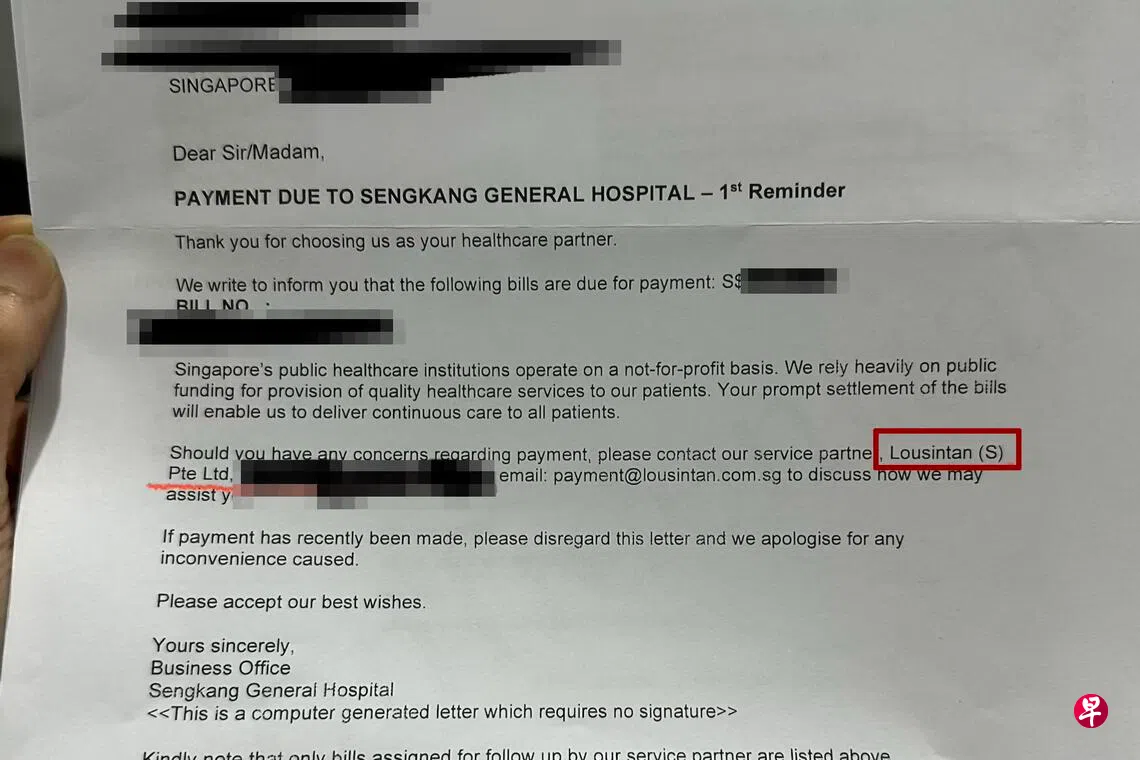
To ensure public resources are used responsibly and safeguard the healthcare system’s long-term sustainability, the Ministry of Health has engaged several licensed third-party debt collection companies to recover long-overdue payments from patients of public healthcare institutions (PHIs).
Lianhe Zaobao understands that these ministry-authorised debt collectors first send formal collection letters to patients with outstanding bills. If these go unanswered, they follow up with phone calls to remind patients and seek payment.
Debt collection halted and support offered to patients facing financial difficulties
In response to queries from Lianhe Zaobao, the Ministry of Health confirmed that all the third-party debt collection companies it appoints hold valid operating licences. It stressed that cases are referred to these companies only after hospitals have made repeated, unsuccessful attempts to recover payments themselves. If patients inform the hospital that they face financial difficulties after being contacted by a debt collector, they will be referred to appropriate support channels and further collection efforts by the company will be halted.
According to figures provided by the ministry, the net amount of new unpaid bills incurred each year by local residents seeking treatment at public healthcare institutions is about 2.5% of the total medical bills issued that year. This includes all outstanding bills at various stages of recovery. Nearly 98% of medical bills are settled within the stipulated period, indicating that the vast majority of patients pay on time.
A spokesperson said: “As the public healthcare system relies on significant public funding, there is a need to follow through to collect outstanding bills, as a matter of public accountability and sound stewardship. It is necessary to ensure the long-term sustainability of our public healthcare system to continue providing accessible, affordable care to all Singaporeans.”
While individual unpaid medical bills may be small, they add up to a substantial sum. Following up on these outstanding payments also ensures that Singaporeans continue to take personal responsibility and share in the cost of healthcare.
A reader told Lianhe Zaobao that a debt collection company had contacted him over unpaid medical bills. He said an elderly family member who was ill had made several hospital visits. However, when he tried to pay, he encountered either faulty self-service payment machines or long queues at the counter, so he decided to take the patient home first and pay later. With so many follow-up visits, he eventually lost track of which bills remained unpaid.
The reader added that, after receiving a letter and collection calls from the company, he had asked for an itemised list of the outstanding bills so he could check them. But the company said it was not authorised to provide the information and that he would have to check with the hospital himself.
Responding to this, the ministry spokesperson said public healthcare institutions have a standard process for reminders and follow-up. Within a few days of a patient’s discharge or consultation, the institution issues a medical bill and sends an SMS asking the patient to log in to HealthHub to view it. Family members caring for patients can also view and manage bills on their behalf, and pay through various channels, including PayNow, self-service kiosks and online payment.
If payment is overdue, the hospital sends the first SMS reminder within two weeks of issuing the bill. A second SMS follows if the bill remains unpaid after a month. If payment is still not received, a formal reminder letter is sent.
The spokesperson stressed that hospitals consider referring unpaid bills to third-party debt collectors only after these routine recovery procedures have been attempted and it has been confirmed that there are no queries over the bills. This is usually at least one and a half months after a bill is issued.
Outreach and reminder processes reviewed to ensure appropriate, respectful communication
Addressing concerns that third-party collectors might use heavy-handed methods, the ministry stressed that the companies it engages must strictly comply with contractual terms and professional codes of conduct when contacting patients.
The spokesperson said: “The Ministry of Health recognises that receiving multiple reminders on outstanding bills can feel burdensome, and PHIs continually review their outreach processes to ensure communications are proportionate and respectful.”
The ministry reiterated that no one in Singapore would be denied medical care because they could not afford it. Patients facing financial difficulties who cannot pay their bills will be referred to medical social workers for assessment for financial assistance. Their outstanding bills will not be referred to third-party debt collectors.
